AI Training for Employees: What Actually Works in 2026

By
Jan Meinecke
・
・
7
Min
Read
AI Training for Employees: What Actually Works in 2026
By
jan Meinecke
7
Min
Read
Your company has AI tools. Probably several of them. ChatGPT licences, a Copilot subscription, maybe Make or Airtable in the ops stack. Your team has heard the pitch. Some of them have even played around with it.
But when you look at how the work actually gets done? It's the same as it was two years ago.
This isn't unusual. According to McKinsey's 2025 State of AI report, 88% of organisations are using AI in at least one business function; but only around one third have moved beyond the experimenting or piloting stage into genuine, scaled adoption. The gap between buying AI and using AI is the defining business problem of 2026. And AI training for employees is the only thing that closes it.
The catch is that most AI training doesn't work. Not because the content is bad, but because it's built for the wrong outcome. This guide is about what good looks like: how to choose a programme, what to expect from it, and how to know whether it's actually changing anything.
What Is AI Training for Employees?
AI training for employees is any structured programme designed to help business teams build the skills to use AI tools effectively in their day-to-day work. This goes beyond awareness or theory. Good AI training is hands-on, tool-specific, and tied to real workflows rather than hypothetical use cases.
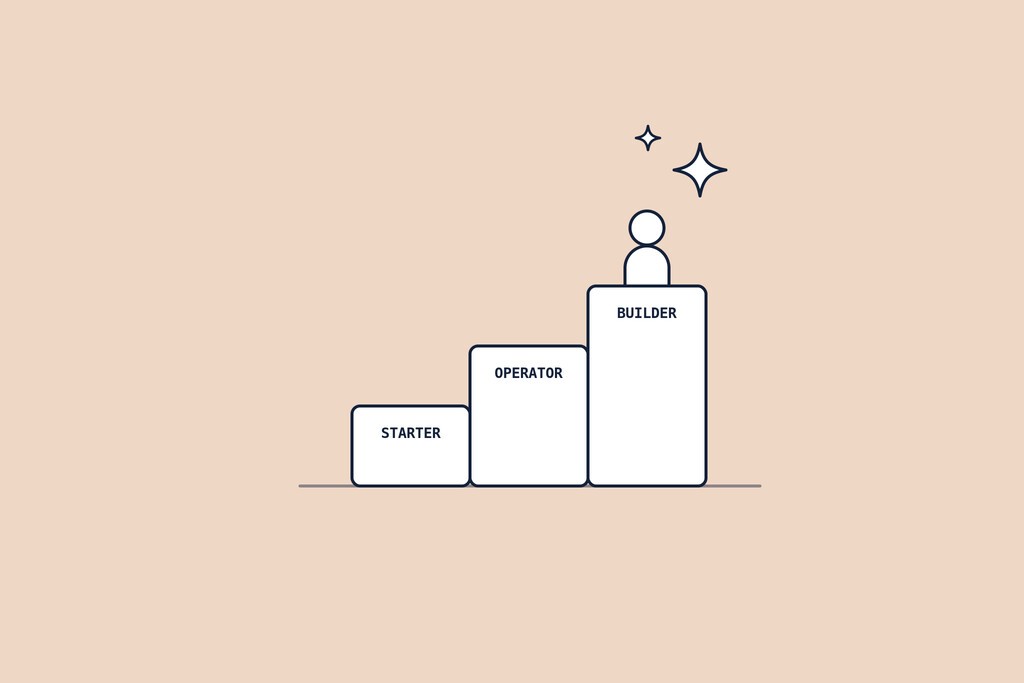
The best programmes move people along a spectrum: from basic AI literacy (understanding what these tools can and can't do) through to practical automation skills (building workflows, agents, and integrations without needing an engineering background). The goal isn't certification. It's changed behaviour on a Tuesday morning.
As 9x's own framework for AI transformation makes clear, most companies are stuck in the awareness phase: leadership is curious, a few individuals are experimenting, but the organisation as a whole hasn't yet committed to the structured capability-building that gets teams to the adoption and transformation phases. That progression doesn't happen on its own.
Why Most AI Training Programmes Fail
If you've ever sent your team through an online AI course and noticed no meaningful change in how they work, you're not alone, and you're not wrong. Most AI training misses for predictable reasons.
Generic content doesn't transfer. Knowing that "AI can help with content creation" does not tell a marketing ops manager how to build an automated brief generator in Make that pulls from their Airtable CMS. The gap between conceptual knowledge and practical application is enormous, and most course platforms don't bridge it. They teach what AI is. They don't teach how to use it on the specific tools your team actually has open at 9am.
Completion isn't the same as capability. BCG's AI at Work research consistently finds that access to tools and training is necessary but not sufficient for actual adoption. Plenty of organisations have high course completion rates and unchanged workflows. The metric that matters isn't whether someone finished a module: it's whether they automated something last week that they were doing manually the week before.
Ad hoc learning creates power users, not team transformation. The "leave it to the enthusiasts" approach — a few individuals explore tools on their own while the rest of the team watches — produces exactly that: a small cluster of power users surrounded by colleagues who are no more capable than they were. It's unscalable, unmeasurable, and unfair. Real AI adoption happens at the team level, not the individual level. This is a point 9x explores directly in AI Is The New Excel: just as spreadsheet skills became a universal business expectation, AI proficiency needs to reach every role, not just the technically confident ones.
The pace of change outstrips static content. A course that was comprehensive when it launched in early 2024 may not even mention tools that are now central to how business teams work. AI moves fast. Training that doesn't move with it goes stale within months. This is one of the structural reasons 9x builds weekly live sessions into its programmes alongside async course content.
The Real Cost of Not Training Your Team
The adoption gap isn't just a missed opportunity. It's a widening competitive disadvantage.
McKinsey's analysis of AI high performers—organisations where AI contributes more than 5% of EBIT—identifies a clear pattern. These companies are 3.6 times more likely to aim for transformational, enterprise-level change rather than incremental pilots. Critically, 55% of them fundamentally redesign workflows when deploying AI, compared to fewer than 20% of the laggard group. The companies still stuck in experimentation mode are falling further behind each quarter.
The numbers at the individual level are equally concrete. Participants in structured AI training programmes consistently report automating two to three manual processes that were previously completed multiple times per week: tasks that were costing real hours, real focus, and real money. Teams that reach this point don't just save time. They start to operate at a different speed.
The organisations that invest in structured AI training now will compound that advantage year on year. Those that don't will spend the next three years watching leaner competitors move faster with the same headcount.
What Good AI Training for Employees Actually Looks Like
Not all programmes are built the same. The best AI training for employees has a few characteristics that separate it from the rest.
It's built around the tools your team already uses
The biggest mistake in AI training is teaching people how AI works in the abstract rather than how to use it with the platforms already open on their desktop. Good training names tools: Make, Airtable, Relevance AI, n8n, Claude, ChatGPT. It shows learners how to build real workflows with them. A generic course platform can tell you what automation is. The programmes worth investing in show you how to build the specific automation your ops team needs before Wednesday. The 9x use cases library gives a sense of the specificity that matters: real automations, mapped to real business functions, built by people without technical backgrounds.
It covers the full spectrum from literacy to builder
Your team is not one thing. You have people who have never seriously used AI and people who are already building complex workflows. A good programme serves both, and everyone in between. The structure should move people from foundational AI literacy through practical tool use and into building automation workflows and AI agents. 9x's learning tracks reflect this directly: the AI Literacy Track covers the foundations; The AI Cowork Track moves into practical automation; and the AI Automation Track takes teams through to building agents and complex workflows. Crucially, this structure serves non-technical employees just as well as technical ones. The most valuable AI skills in a business context are the ones that ops, marketing, finance, and HR teams can apply — not just engineers.
It stays current
AI tools change fast enough that any fixed curriculum starts going out of date the moment it's published. The best programmes build live, regularly updated content into their structure: weekly sessions covering new tools and use cases as they emerge, not just a library of modules that were accurate six months ago. The BCG AI at Work 2025 report notes that only 13% of employees see AI agents deeply integrated into their daily workflows. The tools facilitating that integration are changing every few months. Training that doesn't keep pace leaves teams behind.
It delivers outcomes, not completions
The right question after an AI training programme is not "what was the completion rate?" It's "what did people build?" and "what are they doing differently?" Look for programmes that frame their value in terms of automations shipped, hours saved, and processes changed, not certifications issued. 9x's case studies are built around exactly these metrics: specific outcomes, by team, by function.
5 Signs Your Current AI Training Isn't Working
If you're evaluating whether an existing programme is delivering, here's what to look for.
Course completion goes up, but the work doesn't change. People are finishing modules and then returning to the same processes they were using before. Knowledge without application isn't transformation.
Only a small group of people are actually using AI. If your AI capability is concentrated in two or three enthusiastic individuals while the rest of the team has stayed static, you have power users, not adoption.
Training isn't connected to your actual tools and workflows. If the examples and exercises in the programme don't reflect how your team actually works, the learning won't transfer. Generic case studies don't produce specific outcomes.
The content is already out of date. If the programme hasn't been updated to include tools and use cases from the last six months, it's already behind where the market is.
You can't point to anything concrete that changed. The most honest test: can anyone on your team name a process they automated as a direct result of training? If not, something in the programme's design isn't connecting theory to practice. The 9x guide on how to find automation opportunities is a useful starting point for identifying what those processes might be in your team.
How to Choose the Right AI Training Programme for Your Team
There's no shortage of options: Udemy Business, Coursera, internal build projects, one-off workshops, specialist training partners. Choosing between them comes down to what kind of outcome you actually need.
If you want broad awareness across a large workforce and you're comfortable measuring success in completion rates, a large platform may serve you. The catalogue is extensive, the price per seat is low, and the logistics are manageable at scale. What you won't get is workflow-specific training, live expert support, or any guarantee that the content reflects how things actually work in 2026.
If you need your team to actually change how they work — to automate the Monday morning report, to build a lead qualification workflow in Relevance AI, to stop doing manually what they've been doing manually for two years — you need something closer to the work. That means expert-led training built around the tools your team uses, tied to specific business functions, and structured to move people from zero to shipping automations in weeks rather than months.
The questions worth asking any provider before you commit: What tools does the training actually cover? How do you measure outcomes, not just completions? How do you keep the content current? Can I speak to someone who built this, not a sales team?
For teams that want a faster path to getting started, custom workshops tailored to specific workflows and tools are the most direct entry point: one focused session can surface more automation opportunities than months of individual experimentation.
Approach | Best for | What you get | What you don't get |
Large platform (Udemy, Coursera) | Broad awareness at scale | Low cost, wide catalogue | Tool-specific depth, live support, current content |
Internal build | Custom fit | Full control | Time, maintenance, expertise to keep it current |
One-off workshops | Quick start, specific problems | Fast, focused, practical | Ongoing capability building |
Structured partner programme | Team-wide transformation | Tool-specific, outcome-measured, live and async | The speed of a one-day course |
What to Expect from a Structured AI Training Programme
A well-designed AI training programme for a business team of 20 to 100 people doesn't need to be a six-month project. The programmes that work tend to move fast and stay close to the real work.
In the early weeks, the focus is on foundation: making sure everyone on the team understands what these tools can and can't do, and establishing a shared language. This isn't about making everyone an expert. It's about lifting the floor so that no one is left behind when the team starts building.
From there, training shifts into the specific workflows and tools that matter for the team's function. Ops teams look different from marketing teams; marketing looks different from finance. Good AI training doesn't pretend otherwise. The 9x use cases library gives a concrete sense of this range: from automated LinkedIn outreach to employee onboarding automation to revenue reconciliation tools. The practical exercises in a good training programme should look like actual work, not abstract exercises.
Within a properly structured four to six week programme, participants routinely reach the point where they're shipping their first automations: real ones, in the tools they use every day, solving problems they've had for months or years. That moment, when someone automates a process they've been doing manually three times a week and never has to do it again, is when the investment in training becomes very easy to justify.
A Real Example: What Happens When It Works
When TravelPerk partnered with 9x to run a four-week AI and automation bootcamp followed by a hands-on hackathon week, the results were concrete and immediate. Participants across customer care, ops, and sales functions shipped automations handling over 1,000 weekly queries from customer service agents, built AI tools for internal knowledge management, and created automated reporting that had previously been assembled manually every week. The participants were not engineers. They were the kind of business operators who had always assumed automation was someone else's job.
One engineer who observed the hackathon described seeing colleagues with no technical background build solutions that would save their teams hours of manual work every week as "truly mind-blowing."
The Circula case study tells a similar story from a different angle. As Nikolai Skatchkov, CEO of Circula, put it: "9x is helping Circula operate on another level. Building scalable processes and staying lean is what we care about. By implementing solutions and training our different departments, 9x ensures this remains a reality."
That's the goal. Not certifications, not awareness, not a few power users. A team where everyone knows how to use AI to do their job differently. You can read what 9x learners have built across companies, functions, and skill levels on the Wall of Love.
Getting Started: Practical Next Steps for Your Team
If you're an ops or L&D leader trying to figure out where to begin, the practical starting point is an honest assessment of where your team actually is. The 9x post on how to find automation opportunities walks through a method for doing exactly this: identifying the processes in your team that are the most manual, the most repetitive, and the most clearly suited to automation.
These become your north star for training. They're the specific outcomes you're working toward, and good training should be able to point to them directly and show you how to get there.
Then ask yourself who needs to be involved. AI training works best as a team-wide initiative, not a solo project for the most enthusiastic person. The goal is to lift the whole floor, not just help the people who were already figuring it out on their own. The McKinsey State of AI research is unambiguous on this: the organisations achieving measurable EBIT impact from AI are the ones redesigning workflows at the team level, not running individual experiments at the margins.
Finally, choose a programme that can move fast. The window where your team is energised about AI and ready to change is not unlimited. The organisations that have moved from experimentation to transformation did so quickly: weeks, not months. The ones still in "exploring" mode two years later have largely stayed there.
If you want to see what the training looks like before you commit anything, 9x's free tutorials library is the fastest way to understand the approach: practical, tool-specific, and built for business operators rather than developers.
Frequently Asked Questions
How long does AI training for employees typically take?
It varies by programme and depth, but a well-structured team training engagement typically runs four to six weeks for the core programme, with ongoing access to live sessions and content updates. That's long enough to build genuine capability; short enough to fit into a normal working schedule without significant disruption. 9x's team training options include both sprint formats and longer subscription-based programmes depending on what the team needs.
Do employees need a technical background to benefit from AI training?
No, and this is one of the most important things to understand about modern AI training. The best programmes are specifically designed for non-technical business professionals: operations, marketing, finance, HR, and sales teams. The skills that matter most are not coding skills. They're process thinking, prompt craft, and knowing which tools to connect. Most of the most impactful automations built by 9x learners were created by people with no engineering background. BCG's AI at Work research confirms the pattern: when employees are well-informed and familiar with AI tools, apprehension turns into enthusiasm.
What's the difference between AI training and a generic online course?
A generic online course teaches you what AI is and what it can theoretically do. Structured AI training for business teams teaches you how to use specific tools: Make, Airtable, Claude, Relevance AI, n8n, and others to automate specific workflows in your specific function. The difference in outcome is significant: one produces understanding; the other produces automations.
How do you measure the ROI of AI training?
The most direct measures are: number of automations built and deployed within 90 days of training, hours saved per person per week on previously manual tasks, and reduction in process time for specific recurring workflows. These are more meaningful than completion rates or satisfaction scores, and any serious training provider should be able to talk about outcomes in these terms.
The Bottom Line
The companies getting genuine ROI from AI in 2026 are not the ones with the biggest tool budgets. They're the ones whose teams know how to use those tools to change how the work gets done. That's not a technology problem. It's a skills and behaviour problem: and the only thing that solves it is structured, expert-led training built around the tools and workflows your team actually uses.
Your team has the tools. The question is whether they have the skills to actually use them.
Ready to train your team? Talk to the 9x team about a programme built around your workflows, your tools, and your timeline — deployed in weeks, not months.
Or if you want to explore first: start with 9x's free tutorials.
Your company has AI tools. Probably several of them. ChatGPT licences, a Copilot subscription, maybe Make or Airtable in the ops stack. Your team has heard the pitch. Some of them have even played around with it.
But when you look at how the work actually gets done? It's the same as it was two years ago.
This isn't unusual. According to McKinsey's 2025 State of AI report, 88% of organisations are using AI in at least one business function; but only around one third have moved beyond the experimenting or piloting stage into genuine, scaled adoption. The gap between buying AI and using AI is the defining business problem of 2026. And AI training for employees is the only thing that closes it.
The catch is that most AI training doesn't work. Not because the content is bad, but because it's built for the wrong outcome. This guide is about what good looks like: how to choose a programme, what to expect from it, and how to know whether it's actually changing anything.
What Is AI Training for Employees?
AI training for employees is any structured programme designed to help business teams build the skills to use AI tools effectively in their day-to-day work. This goes beyond awareness or theory. Good AI training is hands-on, tool-specific, and tied to real workflows rather than hypothetical use cases.
The best programmes move people along a spectrum: from basic AI literacy (understanding what these tools can and can't do) through to practical automation skills (building workflows, agents, and integrations without needing an engineering background). The goal isn't certification. It's changed behaviour on a Tuesday morning.
As 9x's own framework for AI transformation makes clear, most companies are stuck in the awareness phase: leadership is curious, a few individuals are experimenting, but the organisation as a whole hasn't yet committed to the structured capability-building that gets teams to the adoption and transformation phases. That progression doesn't happen on its own.
Why Most AI Training Programmes Fail
If you've ever sent your team through an online AI course and noticed no meaningful change in how they work, you're not alone, and you're not wrong. Most AI training misses for predictable reasons.
Generic content doesn't transfer. Knowing that "AI can help with content creation" does not tell a marketing ops manager how to build an automated brief generator in Make that pulls from their Airtable CMS. The gap between conceptual knowledge and practical application is enormous, and most course platforms don't bridge it. They teach what AI is. They don't teach how to use it on the specific tools your team actually has open at 9am.
Completion isn't the same as capability. BCG's AI at Work research consistently finds that access to tools and training is necessary but not sufficient for actual adoption. Plenty of organisations have high course completion rates and unchanged workflows. The metric that matters isn't whether someone finished a module: it's whether they automated something last week that they were doing manually the week before.
Ad hoc learning creates power users, not team transformation. The "leave it to the enthusiasts" approach — a few individuals explore tools on their own while the rest of the team watches — produces exactly that: a small cluster of power users surrounded by colleagues who are no more capable than they were. It's unscalable, unmeasurable, and unfair. Real AI adoption happens at the team level, not the individual level. This is a point 9x explores directly in AI Is The New Excel: just as spreadsheet skills became a universal business expectation, AI proficiency needs to reach every role, not just the technically confident ones.
The pace of change outstrips static content. A course that was comprehensive when it launched in early 2024 may not even mention tools that are now central to how business teams work. AI moves fast. Training that doesn't move with it goes stale within months. This is one of the structural reasons 9x builds weekly live sessions into its programmes alongside async course content.
The Real Cost of Not Training Your Team
The adoption gap isn't just a missed opportunity. It's a widening competitive disadvantage.
McKinsey's analysis of AI high performers—organisations where AI contributes more than 5% of EBIT—identifies a clear pattern. These companies are 3.6 times more likely to aim for transformational, enterprise-level change rather than incremental pilots. Critically, 55% of them fundamentally redesign workflows when deploying AI, compared to fewer than 20% of the laggard group. The companies still stuck in experimentation mode are falling further behind each quarter.
The numbers at the individual level are equally concrete. Participants in structured AI training programmes consistently report automating two to three manual processes that were previously completed multiple times per week: tasks that were costing real hours, real focus, and real money. Teams that reach this point don't just save time. They start to operate at a different speed.
The organisations that invest in structured AI training now will compound that advantage year on year. Those that don't will spend the next three years watching leaner competitors move faster with the same headcount.
What Good AI Training for Employees Actually Looks Like
Not all programmes are built the same. The best AI training for employees has a few characteristics that separate it from the rest.
It's built around the tools your team already uses
The biggest mistake in AI training is teaching people how AI works in the abstract rather than how to use it with the platforms already open on their desktop. Good training names tools: Make, Airtable, Relevance AI, n8n, Claude, ChatGPT. It shows learners how to build real workflows with them. A generic course platform can tell you what automation is. The programmes worth investing in show you how to build the specific automation your ops team needs before Wednesday. The 9x use cases library gives a sense of the specificity that matters: real automations, mapped to real business functions, built by people without technical backgrounds.
It covers the full spectrum from literacy to builder
Your team is not one thing. You have people who have never seriously used AI and people who are already building complex workflows. A good programme serves both, and everyone in between. The structure should move people from foundational AI literacy through practical tool use and into building automation workflows and AI agents. 9x's learning tracks reflect this directly: the AI Literacy Track covers the foundations; The AI Cowork Track moves into practical automation; and the AI Automation Track takes teams through to building agents and complex workflows. Crucially, this structure serves non-technical employees just as well as technical ones. The most valuable AI skills in a business context are the ones that ops, marketing, finance, and HR teams can apply — not just engineers.
It stays current
AI tools change fast enough that any fixed curriculum starts going out of date the moment it's published. The best programmes build live, regularly updated content into their structure: weekly sessions covering new tools and use cases as they emerge, not just a library of modules that were accurate six months ago. The BCG AI at Work 2025 report notes that only 13% of employees see AI agents deeply integrated into their daily workflows. The tools facilitating that integration are changing every few months. Training that doesn't keep pace leaves teams behind.
It delivers outcomes, not completions
The right question after an AI training programme is not "what was the completion rate?" It's "what did people build?" and "what are they doing differently?" Look for programmes that frame their value in terms of automations shipped, hours saved, and processes changed, not certifications issued. 9x's case studies are built around exactly these metrics: specific outcomes, by team, by function.
5 Signs Your Current AI Training Isn't Working
If you're evaluating whether an existing programme is delivering, here's what to look for.
Course completion goes up, but the work doesn't change. People are finishing modules and then returning to the same processes they were using before. Knowledge without application isn't transformation.
Only a small group of people are actually using AI. If your AI capability is concentrated in two or three enthusiastic individuals while the rest of the team has stayed static, you have power users, not adoption.
Training isn't connected to your actual tools and workflows. If the examples and exercises in the programme don't reflect how your team actually works, the learning won't transfer. Generic case studies don't produce specific outcomes.
The content is already out of date. If the programme hasn't been updated to include tools and use cases from the last six months, it's already behind where the market is.
You can't point to anything concrete that changed. The most honest test: can anyone on your team name a process they automated as a direct result of training? If not, something in the programme's design isn't connecting theory to practice. The 9x guide on how to find automation opportunities is a useful starting point for identifying what those processes might be in your team.
How to Choose the Right AI Training Programme for Your Team
There's no shortage of options: Udemy Business, Coursera, internal build projects, one-off workshops, specialist training partners. Choosing between them comes down to what kind of outcome you actually need.
If you want broad awareness across a large workforce and you're comfortable measuring success in completion rates, a large platform may serve you. The catalogue is extensive, the price per seat is low, and the logistics are manageable at scale. What you won't get is workflow-specific training, live expert support, or any guarantee that the content reflects how things actually work in 2026.
If you need your team to actually change how they work — to automate the Monday morning report, to build a lead qualification workflow in Relevance AI, to stop doing manually what they've been doing manually for two years — you need something closer to the work. That means expert-led training built around the tools your team uses, tied to specific business functions, and structured to move people from zero to shipping automations in weeks rather than months.
The questions worth asking any provider before you commit: What tools does the training actually cover? How do you measure outcomes, not just completions? How do you keep the content current? Can I speak to someone who built this, not a sales team?
For teams that want a faster path to getting started, custom workshops tailored to specific workflows and tools are the most direct entry point: one focused session can surface more automation opportunities than months of individual experimentation.
Approach | Best for | What you get | What you don't get |
Large platform (Udemy, Coursera) | Broad awareness at scale | Low cost, wide catalogue | Tool-specific depth, live support, current content |
Internal build | Custom fit | Full control | Time, maintenance, expertise to keep it current |
One-off workshops | Quick start, specific problems | Fast, focused, practical | Ongoing capability building |
Structured partner programme | Team-wide transformation | Tool-specific, outcome-measured, live and async | The speed of a one-day course |
What to Expect from a Structured AI Training Programme
A well-designed AI training programme for a business team of 20 to 100 people doesn't need to be a six-month project. The programmes that work tend to move fast and stay close to the real work.
In the early weeks, the focus is on foundation: making sure everyone on the team understands what these tools can and can't do, and establishing a shared language. This isn't about making everyone an expert. It's about lifting the floor so that no one is left behind when the team starts building.
From there, training shifts into the specific workflows and tools that matter for the team's function. Ops teams look different from marketing teams; marketing looks different from finance. Good AI training doesn't pretend otherwise. The 9x use cases library gives a concrete sense of this range: from automated LinkedIn outreach to employee onboarding automation to revenue reconciliation tools. The practical exercises in a good training programme should look like actual work, not abstract exercises.
Within a properly structured four to six week programme, participants routinely reach the point where they're shipping their first automations: real ones, in the tools they use every day, solving problems they've had for months or years. That moment, when someone automates a process they've been doing manually three times a week and never has to do it again, is when the investment in training becomes very easy to justify.
A Real Example: What Happens When It Works
When TravelPerk partnered with 9x to run a four-week AI and automation bootcamp followed by a hands-on hackathon week, the results were concrete and immediate. Participants across customer care, ops, and sales functions shipped automations handling over 1,000 weekly queries from customer service agents, built AI tools for internal knowledge management, and created automated reporting that had previously been assembled manually every week. The participants were not engineers. They were the kind of business operators who had always assumed automation was someone else's job.
One engineer who observed the hackathon described seeing colleagues with no technical background build solutions that would save their teams hours of manual work every week as "truly mind-blowing."
The Circula case study tells a similar story from a different angle. As Nikolai Skatchkov, CEO of Circula, put it: "9x is helping Circula operate on another level. Building scalable processes and staying lean is what we care about. By implementing solutions and training our different departments, 9x ensures this remains a reality."
That's the goal. Not certifications, not awareness, not a few power users. A team where everyone knows how to use AI to do their job differently. You can read what 9x learners have built across companies, functions, and skill levels on the Wall of Love.
Getting Started: Practical Next Steps for Your Team
If you're an ops or L&D leader trying to figure out where to begin, the practical starting point is an honest assessment of where your team actually is. The 9x post on how to find automation opportunities walks through a method for doing exactly this: identifying the processes in your team that are the most manual, the most repetitive, and the most clearly suited to automation.
These become your north star for training. They're the specific outcomes you're working toward, and good training should be able to point to them directly and show you how to get there.
Then ask yourself who needs to be involved. AI training works best as a team-wide initiative, not a solo project for the most enthusiastic person. The goal is to lift the whole floor, not just help the people who were already figuring it out on their own. The McKinsey State of AI research is unambiguous on this: the organisations achieving measurable EBIT impact from AI are the ones redesigning workflows at the team level, not running individual experiments at the margins.
Finally, choose a programme that can move fast. The window where your team is energised about AI and ready to change is not unlimited. The organisations that have moved from experimentation to transformation did so quickly: weeks, not months. The ones still in "exploring" mode two years later have largely stayed there.
If you want to see what the training looks like before you commit anything, 9x's free tutorials library is the fastest way to understand the approach: practical, tool-specific, and built for business operators rather than developers.
Frequently Asked Questions
How long does AI training for employees typically take?
It varies by programme and depth, but a well-structured team training engagement typically runs four to six weeks for the core programme, with ongoing access to live sessions and content updates. That's long enough to build genuine capability; short enough to fit into a normal working schedule without significant disruption. 9x's team training options include both sprint formats and longer subscription-based programmes depending on what the team needs.
Do employees need a technical background to benefit from AI training?
No, and this is one of the most important things to understand about modern AI training. The best programmes are specifically designed for non-technical business professionals: operations, marketing, finance, HR, and sales teams. The skills that matter most are not coding skills. They're process thinking, prompt craft, and knowing which tools to connect. Most of the most impactful automations built by 9x learners were created by people with no engineering background. BCG's AI at Work research confirms the pattern: when employees are well-informed and familiar with AI tools, apprehension turns into enthusiasm.
What's the difference between AI training and a generic online course?
A generic online course teaches you what AI is and what it can theoretically do. Structured AI training for business teams teaches you how to use specific tools: Make, Airtable, Claude, Relevance AI, n8n, and others to automate specific workflows in your specific function. The difference in outcome is significant: one produces understanding; the other produces automations.
How do you measure the ROI of AI training?
The most direct measures are: number of automations built and deployed within 90 days of training, hours saved per person per week on previously manual tasks, and reduction in process time for specific recurring workflows. These are more meaningful than completion rates or satisfaction scores, and any serious training provider should be able to talk about outcomes in these terms.
The Bottom Line
The companies getting genuine ROI from AI in 2026 are not the ones with the biggest tool budgets. They're the ones whose teams know how to use those tools to change how the work gets done. That's not a technology problem. It's a skills and behaviour problem: and the only thing that solves it is structured, expert-led training built around the tools and workflows your team actually uses.
Your team has the tools. The question is whether they have the skills to actually use them.
Ready to train your team? Talk to the 9x team about a programme built around your workflows, your tools, and your timeline — deployed in weeks, not months.
Or if you want to explore first: start with 9x's free tutorials.
read next
Running AI Enablement Internally? Here are Three Things to Consider
AI enablement looks like a training project. It isn't. Skill levels, tools and functions all move at once. Here's what running it internally really takes.

What is Claude Slides, and How to Use Them (Guide for Beginners)
How to use Claude Slides to build an on-brand deck from a one-line brief, edit and export it, and where it beats PowerPoint and Google Slides, and where it doesn't.
read next
Running AI Enablement Internally? Here are Three Things to Consider
AI enablement looks like a training project. It isn't. Skill levels, tools and functions all move at once. Here's what running it internally really takes.
What is Claude Slides, and How to Use Them (Guide for Beginners)
How to use Claude Slides to build an on-brand deck from a one-line brief, edit and export it, and where it beats PowerPoint and Google Slides, and where it doesn't.