The Six Dimensions of AI Transformation

By
Alexandre Kantjas
・
・
7
Min
Read

The Six Dimensions of AI Transformation
By
Alexandre Kantjas
7
Min
Read
When companies share with us how they think about AI transformation, they're usually thinking about two or three dimensions. Some are more focused on tools ("Should we use ChatGPT Enterprise or build our own?"). Or they're stuck on strategy ("Where can AI create value?"). Others obsess over people ("How do we train our team to actually use this stuff?").
Most companies are far from true AI transformation because it requires not just one, but at least six interconnected dimensions to move together,
AI Transformation Requires Six Interconnected Dimensions
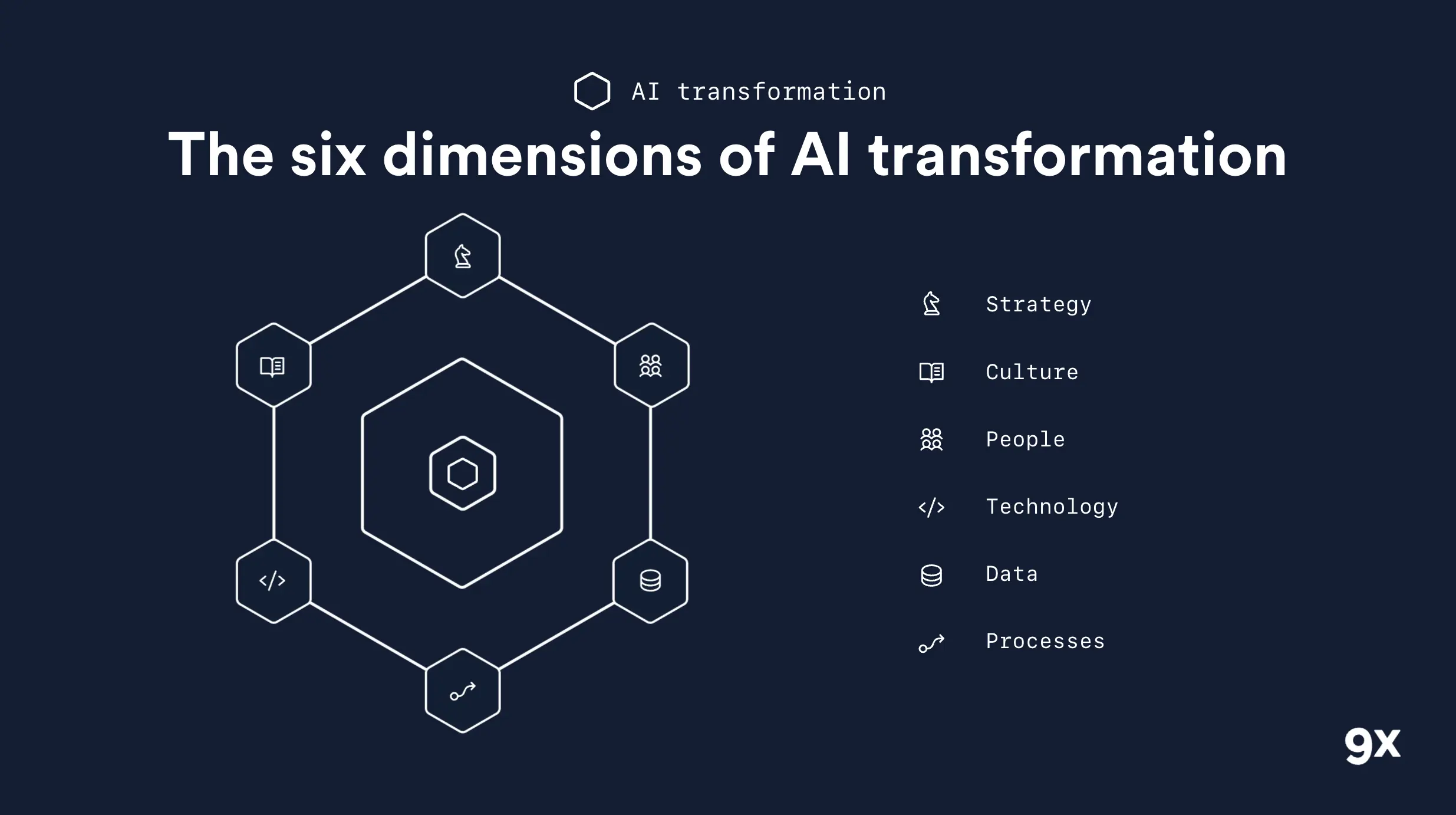
The six dimensions of AI transformation are:
Strategy
Culture
People
Technology
Data
Processes
Every dimension matters. In each, AI brings a set of new fundamental questions.
Dimension 1: Strategy & AI
Strategy is how your company responds to the business implications of AI. This is the first dimension because without clear strategic direction, everything else becomes random activity.
The kernel* of a strategy contains three elements:
Diagnosis: Surfaces the nature of the challenge and critical aspects
Guiding policy: Outlines the approach chosen to overcome the obstacles identified in the diagnosis
Coherent actions: Coordinated steps designed to carry out the guiding policy
This is nothing new: business strategy has been around for centuries.
What changes with AI?
What's fundamentally changed now is that with AI, every company faces the same challenges and opportunities. The top three strategic areas to consider:
Market: AI transforms their market, with rapidly shifting customers' expectations
Product: It opens up opportunities to redefine the products and services the company offers
Operations: The entire operating model can be redesigned with AI at the core.
And it is happening at a rapid pace that doesn't wait for the cautious or the uncertain. Your leadership team needs to build up a deep, comprehensive understanding of current AI capabilities, emerging technologies, and evolving market trends to correctly assess the company's strategic situation and land on the right diagnosis. Without this foundational understanding, the guiding policy and coherent actions that follow will inevitably miss critical opportunities, fail to capitalize on emerging advantages, and leave the company dangerously vulnerable to competitive disruption from more agile competitors who have properly understood the AI landscape.
*See Good Strategy Bad Strategy by Richard Rumelt
Dimension 2: Culture & AI
Second is Culture - the behaviors that define how your company operates:
Decisions: How your company makes decisions when you're not there
Actions: The actions you promote and tolerate.
"If you see something off-culture and ignore it, you've created a new culture."
Ben Horowitz
What changes with AI?
AI is about to bring the strongest test for your company culture because it doesn't bring incremental changes - it redefines how people work. Every day, teams face new decisions:
"Should we use AI for this task?"
"Do we need approval to try a new tool?"
"Can we share this AI-generated output with clients?"
"Is it safe to experiment and fail?"
AI will create opportunities and challenges, especially for people and organizations that prefer stability over adaptation. The old culture of "wait for permission" or "stick to what's proven" will kill AI adoption. Companies need to redefine their culture with AI at the core - and those that don't will face very challenging times ahead.
AI transformation requires a culture that promotes experimentation, tolerates productive failure, and rewards people who constantly look for better ways to work.
Dimension 3: People & AI
Next dimension are the organization's People.
People are about to undergo a radical transformation in their careers as AI becomes an integral part of every future job - requiring companies not only to build the right AI skills across teams, but also to rethink entirely the org chart.
Companies will need to:
Build AI skills: Give people the training they need for their role
Allow experimentation: Give teams time and safety to try AI and learn what works
Rethink roles: Understand that jobs will change as AI becomes part of daily work
What is different with AI?
AI differs from previous technology shifts in both scope and speed. While technologies like the Internet eventually touched everyone, that took decades. AI affects every person simultaneously and demands immediate action.
This creates unprecedented pressure: the change isn't optional, incremental, or limited to early adopters. Everyone needs different skill levels at once, while the technology itself evolves rapidly.
Everyone is affected: AI transformation impacts every person in the organization, not just technical teams or early adopters
Different roles need different skills: Some people need basic awareness, others need hands-on skills, and some need deep expertise
Learning never stops: Building AI capability is an ongoing effort, not a one-time training, because the technology keeps changing
These create immense pressure on People, L&D and AI enablement teams. This isn't a typical training rollout: it's a massive, ongoing initiative that requires sustained resources, coordination, and strategic oversight across the entire organization.
Dimension 4: Technology & AI
Technology is the infrastructure: the platforms, tools, and integrations that will enable AI to work across your organization.
Your core technology decisions will include:
Product: The technology - more specifically the AI capabilities - it makes sense to bring into your product
Internal tools: The AI platforms and tools your teams use for daily work
Your governance model: Whether technology is centralized, federated, or fragmented across teams, how easy it is to request new platforms, etc.
What changes with AI?
Speed: with AI, the tech landscape shifts faster than any previous business technology category.
This creates a fundamentally different requirement. Traditional approaches where you select a vendor, sign a three-year contract, standardize everything create dangerous rigidity. You need technology choices that maintain optionality. This requires, among other things, rethinking your procurement processes to support platform experimentation.
Dimension 5: Data & AI
Data is the raw material that powers AI. Data sets what AI can learn from, reason about, and act on. AI makes your data orders of magnitude more valuable, because it will allow you to immediately act on it, not only understand it.
Data is a broad topic, and one of the biggest challenges for companies going through their digital transformation. A lot has been written about it already that I won't repeat here.
What's different with AI?
When data is mentioned, structured data mostly comes to mind - tables, databases, CRM fields. With AI, the discussion will gradually shift towards unstructured data and tacit knowledge.
Unstructured data: Documents, emails, PDFs, images, videos - the vast majority of business information that doesn't fit neatly into database rows and columns.
Tacit knowledge: The knowledge that exists in people's heads: judgment calls, context about why decisions were made, tribal knowledge about how things actually work.
These - tacit knowledge in particular - pose a different challenge entirely. You can't just run a data quality script on someone's expertise. You need processes to capture, document, and make accessible the insights that currently live only in Slack threads, meeting notes, and experienced employees' memories. This tacit knowledge elicitation may prove more difficult than any data cleaning initiative. But also significantly more valuable.
Dimension 6: Processes & AI
Finally we have processes. Processes turn inputs into outputs that create value for the company. Just like the other dimensions, processes will be undergoing massive changes thanks to AI and automation capabilities.
What changes with AI?
The instinct when adopting AI is to automate existing processes - take what people do today and have AI do it faster.
This is almost always a suboptimal approach.
Consider customer support:
The traditional process: Customer writes in, ticket gets triaged, routed to the right team, someone researches the history, drafts a response, sends reply. With basic AI automation, you'd make each of these steps faster but keep the same structure.
Redesigning the process with AI at the core: you could have AI that instantly accesses full customer context, understands intent, generates personalized solutions based on similar cases, and responds directly - with human review only for edge cases. The entire 8-step, multi-day process can tomorrow become a single AI interaction with human oversight.
Only possible when you design with AI capabilities in mind.
AI transformation will require process redesign with AI at the core. And the best people to change these processes are the ones running them today.
Putting Things Together
These dimensions aren't sequential steps. You don't perfect Strategy, then Culture, then People. You can't build the right Technology without knowing your Strategy. You can't transform Processes without training your People. You can't shift Culture without some Technology wins to celebrate. Etc.
They're concurrent and interconnected.
To get started:
Assess where you stand in each dimension and identify your biggest gaps
Prioritize the dimensions creating the most friction
Take focused action on your biggest bottleneck first
Look at your organization through these six dimensions. Identify which one is holding you back most. Fix that constraint, then move to the next.
AI transformation won’t happen all at once but by removing bottlenecks systematically until momentum builds.
When companies share with us how they think about AI transformation, they're usually thinking about two or three dimensions. Some are more focused on tools ("Should we use ChatGPT Enterprise or build our own?"). Or they're stuck on strategy ("Where can AI create value?"). Others obsess over people ("How do we train our team to actually use this stuff?").
Most companies are far from true AI transformation because it requires not just one, but at least six interconnected dimensions to move together,
AI Transformation Requires Six Interconnected Dimensions
The six dimensions of AI transformation are:
Strategy
Culture
People
Technology
Data
Processes
Every dimension matters. In each, AI brings a set of new fundamental questions.
Dimension 1: Strategy & AI
Strategy is how your company responds to the business implications of AI. This is the first dimension because without clear strategic direction, everything else becomes random activity.
The kernel* of a strategy contains three elements:
Diagnosis: Surfaces the nature of the challenge and critical aspects
Guiding policy: Outlines the approach chosen to overcome the obstacles identified in the diagnosis
Coherent actions: Coordinated steps designed to carry out the guiding policy
This is nothing new: business strategy has been around for centuries.
What changes with AI?
What's fundamentally changed now is that with AI, every company faces the same challenges and opportunities. The top three strategic areas to consider:
Market: AI transforms their market, with rapidly shifting customers' expectations
Product: It opens up opportunities to redefine the products and services the company offers
Operations: The entire operating model can be redesigned with AI at the core.
And it is happening at a rapid pace that doesn't wait for the cautious or the uncertain. Your leadership team needs to build up a deep, comprehensive understanding of current AI capabilities, emerging technologies, and evolving market trends to correctly assess the company's strategic situation and land on the right diagnosis. Without this foundational understanding, the guiding policy and coherent actions that follow will inevitably miss critical opportunities, fail to capitalize on emerging advantages, and leave the company dangerously vulnerable to competitive disruption from more agile competitors who have properly understood the AI landscape.
*See Good Strategy Bad Strategy by Richard Rumelt
Dimension 2: Culture & AI
Second is Culture - the behaviors that define how your company operates:
Decisions: How your company makes decisions when you're not there
Actions: The actions you promote and tolerate.
"If you see something off-culture and ignore it, you've created a new culture."
Ben Horowitz
What changes with AI?
AI is about to bring the strongest test for your company culture because it doesn't bring incremental changes - it redefines how people work. Every day, teams face new decisions:
"Should we use AI for this task?"
"Do we need approval to try a new tool?"
"Can we share this AI-generated output with clients?"
"Is it safe to experiment and fail?"
AI will create opportunities and challenges, especially for people and organizations that prefer stability over adaptation. The old culture of "wait for permission" or "stick to what's proven" will kill AI adoption. Companies need to redefine their culture with AI at the core - and those that don't will face very challenging times ahead.
AI transformation requires a culture that promotes experimentation, tolerates productive failure, and rewards people who constantly look for better ways to work.
Dimension 3: People & AI
Next dimension are the organization's People.
People are about to undergo a radical transformation in their careers as AI becomes an integral part of every future job - requiring companies not only to build the right AI skills across teams, but also to rethink entirely the org chart.
Companies will need to:
Build AI skills: Give people the training they need for their role
Allow experimentation: Give teams time and safety to try AI and learn what works
Rethink roles: Understand that jobs will change as AI becomes part of daily work
What is different with AI?
AI differs from previous technology shifts in both scope and speed. While technologies like the Internet eventually touched everyone, that took decades. AI affects every person simultaneously and demands immediate action.
This creates unprecedented pressure: the change isn't optional, incremental, or limited to early adopters. Everyone needs different skill levels at once, while the technology itself evolves rapidly.
Everyone is affected: AI transformation impacts every person in the organization, not just technical teams or early adopters
Different roles need different skills: Some people need basic awareness, others need hands-on skills, and some need deep expertise
Learning never stops: Building AI capability is an ongoing effort, not a one-time training, because the technology keeps changing
These create immense pressure on People, L&D and AI enablement teams. This isn't a typical training rollout: it's a massive, ongoing initiative that requires sustained resources, coordination, and strategic oversight across the entire organization.
Dimension 4: Technology & AI
Technology is the infrastructure: the platforms, tools, and integrations that will enable AI to work across your organization.
Your core technology decisions will include:
Product: The technology - more specifically the AI capabilities - it makes sense to bring into your product
Internal tools: The AI platforms and tools your teams use for daily work
Your governance model: Whether technology is centralized, federated, or fragmented across teams, how easy it is to request new platforms, etc.
What changes with AI?
Speed: with AI, the tech landscape shifts faster than any previous business technology category.
This creates a fundamentally different requirement. Traditional approaches where you select a vendor, sign a three-year contract, standardize everything create dangerous rigidity. You need technology choices that maintain optionality. This requires, among other things, rethinking your procurement processes to support platform experimentation.
Dimension 5: Data & AI
Data is the raw material that powers AI. Data sets what AI can learn from, reason about, and act on. AI makes your data orders of magnitude more valuable, because it will allow you to immediately act on it, not only understand it.
Data is a broad topic, and one of the biggest challenges for companies going through their digital transformation. A lot has been written about it already that I won't repeat here.
What's different with AI?
When data is mentioned, structured data mostly comes to mind - tables, databases, CRM fields. With AI, the discussion will gradually shift towards unstructured data and tacit knowledge.
Unstructured data: Documents, emails, PDFs, images, videos - the vast majority of business information that doesn't fit neatly into database rows and columns.
Tacit knowledge: The knowledge that exists in people's heads: judgment calls, context about why decisions were made, tribal knowledge about how things actually work.
These - tacit knowledge in particular - pose a different challenge entirely. You can't just run a data quality script on someone's expertise. You need processes to capture, document, and make accessible the insights that currently live only in Slack threads, meeting notes, and experienced employees' memories. This tacit knowledge elicitation may prove more difficult than any data cleaning initiative. But also significantly more valuable.
Dimension 6: Processes & AI
Finally we have processes. Processes turn inputs into outputs that create value for the company. Just like the other dimensions, processes will be undergoing massive changes thanks to AI and automation capabilities.
What changes with AI?
The instinct when adopting AI is to automate existing processes - take what people do today and have AI do it faster.
This is almost always a suboptimal approach.
Consider customer support:
The traditional process: Customer writes in, ticket gets triaged, routed to the right team, someone researches the history, drafts a response, sends reply. With basic AI automation, you'd make each of these steps faster but keep the same structure.
Redesigning the process with AI at the core: you could have AI that instantly accesses full customer context, understands intent, generates personalized solutions based on similar cases, and responds directly - with human review only for edge cases. The entire 8-step, multi-day process can tomorrow become a single AI interaction with human oversight.
Only possible when you design with AI capabilities in mind.
AI transformation will require process redesign with AI at the core. And the best people to change these processes are the ones running them today.
Putting Things Together
These dimensions aren't sequential steps. You don't perfect Strategy, then Culture, then People. You can't build the right Technology without knowing your Strategy. You can't transform Processes without training your People. You can't shift Culture without some Technology wins to celebrate. Etc.
They're concurrent and interconnected.
To get started:
Assess where you stand in each dimension and identify your biggest gaps
Prioritize the dimensions creating the most friction
Take focused action on your biggest bottleneck first
Look at your organization through these six dimensions. Identify which one is holding you back most. Fix that constraint, then move to the next.
AI transformation won’t happen all at once but by removing bottlenecks systematically until momentum builds.
read next
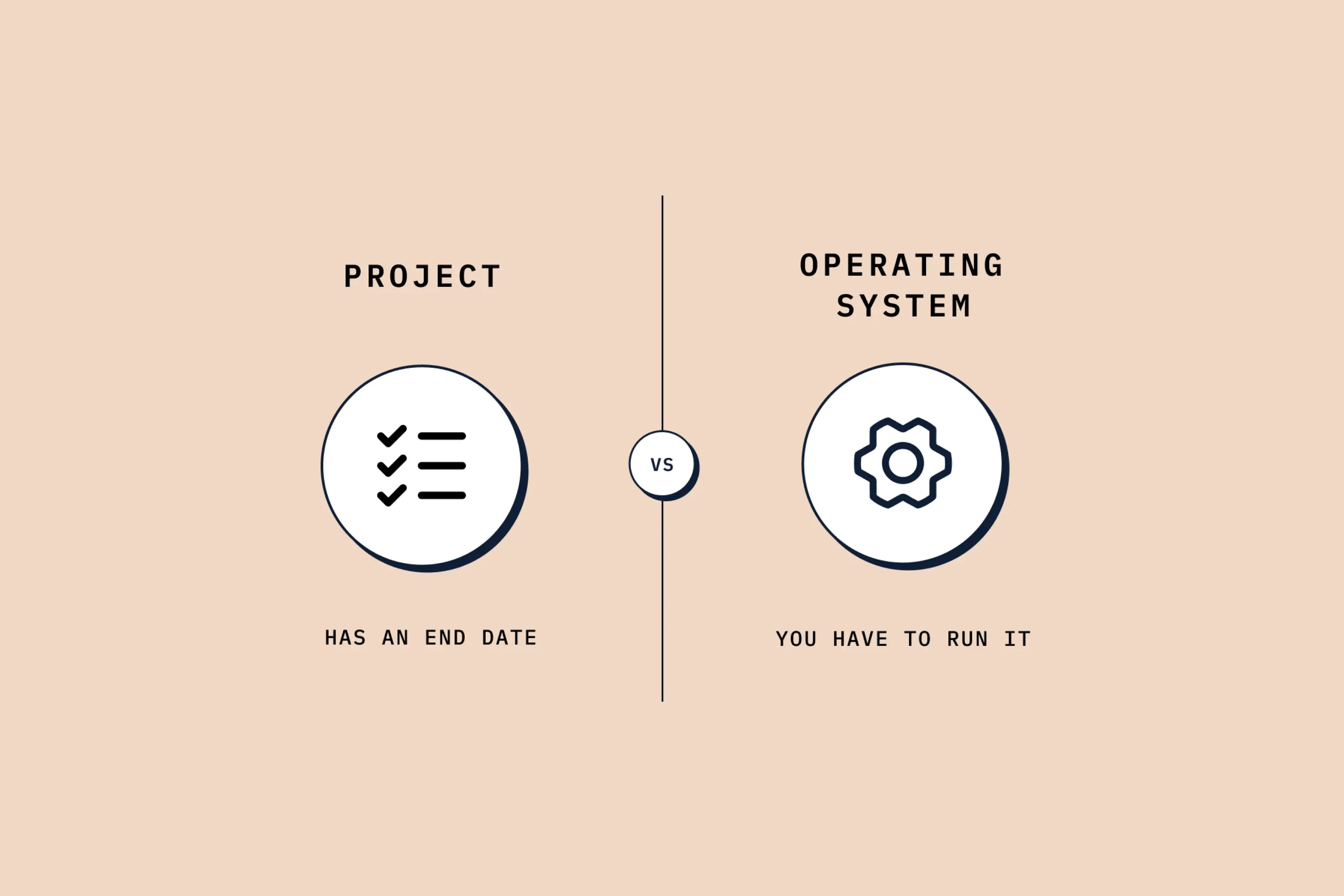
Running AI Enablement Internally? Here are Three Things to Consider
AI enablement looks like a training project. It isn't. Skill levels, tools and functions all move at once. Here's what running it internally really takes.

What is Claude Slides, and How to Use Them (Guide for Beginners)
How to use Claude Slides to build an on-brand deck from a one-line brief, edit and export it, and where it beats PowerPoint and Google Slides, and where it doesn't.
read next
Running AI Enablement Internally? Here are Three Things to Consider
AI enablement looks like a training project. It isn't. Skill levels, tools and functions all move at once. Here's what running it internally really takes.
What is Claude Slides, and How to Use Them (Guide for Beginners)
How to use Claude Slides to build an on-brand deck from a one-line brief, edit and export it, and where it beats PowerPoint and Google Slides, and where it doesn't.