The Path to AI-First Runs Through Your Team

By
Alexandre Kantjas
・
・
6
Min
Read
The Path to AI-First Runs Through Your Team
By
Alexandre Kantjas
6
Min
Read
Ask any leadership team what they want from AI and the answers converge fast: agents running the operations. Emails triaged before anyone opens the inbox. Invoices processed without a human touching them. Reports generated overnight. The logistics, the tool-hopping, the output production — all of that, delegated to agents.
We want that company too. It's the right ambition.
But there's a prerequisite hiding underneath it that most autopilot plans skip: agents can only run your operations if the skills they execute work reliably.
Skills are packaged instructions AI can execute: they contain the steps, the rules, the edge cases, the definition of done for one specific task. Skills are the unit of work agents run on. Unreliable skills mean unreliable agents — and unreliable agents don't get trusted with operations.
So the question becomes: how can your business build reliable skills?
Our answer: by having the people who run the processes today build them. Which means the path to a company on autopilot runs straight through the upskilling of your team.
From Manual Work to Autopilot: Three Phases
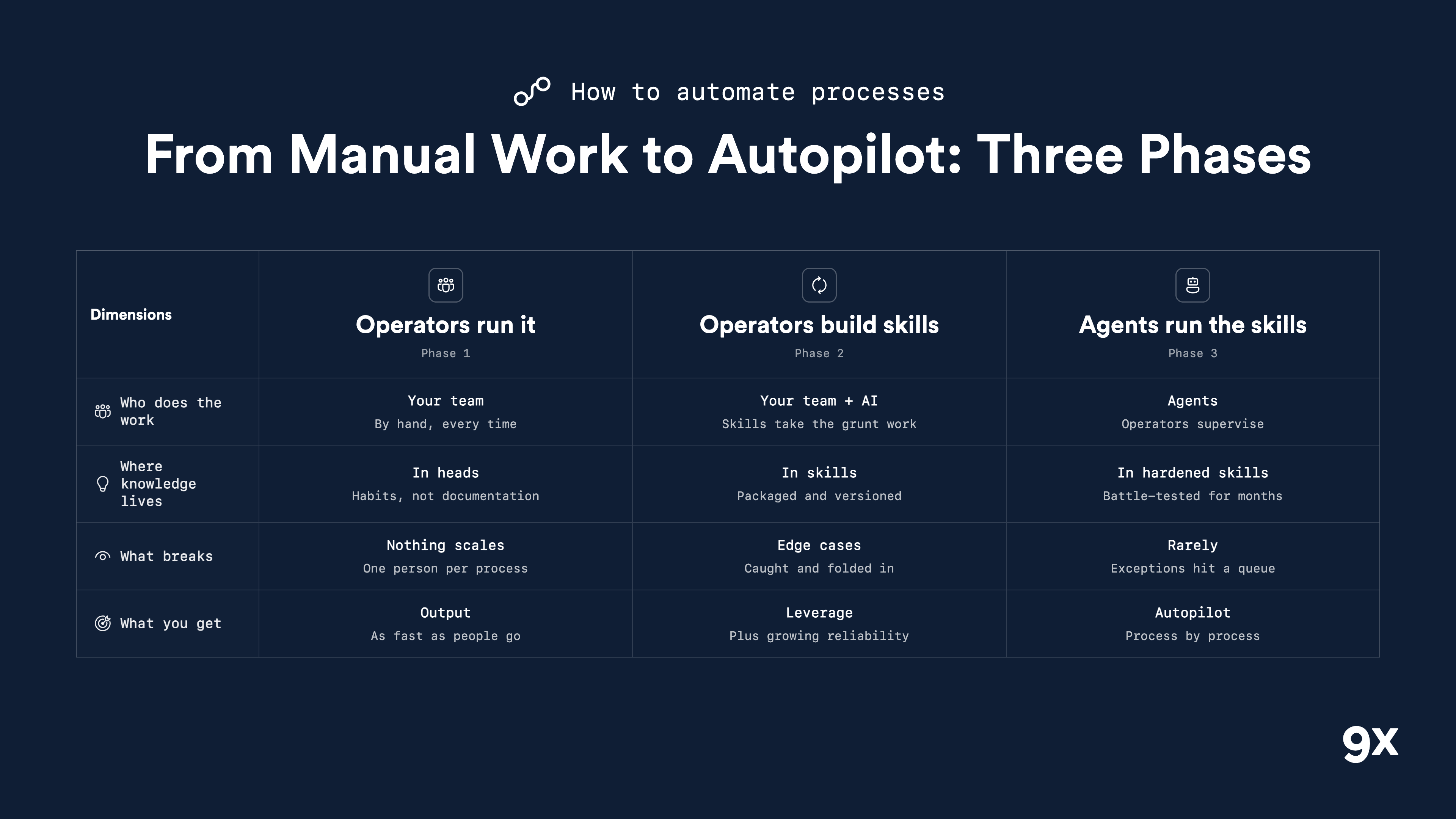
For a process to end up running on autopilot, it must move through three phases:
Phase 1: Operators run the process. The knowledge exists, but only in people's heads
Phase 2: Operators build the skills. Process knowledge is packaged into tested, reliable skills, run by humans
Phase 3: Agents run the skills. Hardened skills are handed over to agents. They run without a human on the happy path. Humans are involved for gate steps and edge cases.
The order is everything. We see companies trying to jump from Phase 1 straight to Phase 3. Invariably, this approach fails.
Let’s explore these phases.
Phase 1: Operators run the process
This is where every process untouched by AI stands today.
The process itself is usually documented — there's an SOP, a checklist, a wiki page. But the execution is entirely manual: a human reads the incoming email, opens the tool, moves the data, checks the numbers, chases the exception. Operators are managing activities end to end, sequencing the steps, deciding what's urgent, catching what looks off. The documentation describes the work. A person operates it.
And underneath the documented process sits a layer of knowledge no SOP captures. The operator running your invoicing knows which supplier always sends malformed PDFs. The person doing weekly reporting knows which numbers the CFO actually reads. The coordinator handling logistics knows the "exception" that happens every single week. That layer lives in people's heads and habits.
The classic mistake in this phase is trying to automate from the outside. We see it constantly: a company buys an automation platform, parks it with IT or an innovation team, and has someone who never ran the process map the happy path. The automation ships, then breaks on the first real-world exception - because the person who knew about that exception was never in the loop. It gets quietly abandoned, and the operator goes back to doing the work by hand.
The knowledge needed for reliable automation is already in your company. It's just not in a form an agent can execute yet.
You are in this phase when:
SOPs describe the work, but a person still executes every step
The same person handles the same exceptions every week, from memory
Automation attempts come from outside the team that runs the process
AI tools are available but used mostly for drafting and summarizing
When someone goes on holiday, their processes stall
"How does this actually work?" has exactly one person as the answer
Phase 2: Operators build the skills
This is the most important phase: it decides whether autopilot ever happens. And yet, this is the phase most organizations are not willing to go through!
The phase has two moments.
First, your operators learn the new way of working. They onboard onto agentic workflow platforms (like Claude Cowork or ChatGPT Work) and figure out how to work with them: how to delegate a task to AI, how to give it the right context, when to trust the output and when to check it. This moment is about fluency, and it can't be skipped — nobody can codify a way of working they haven't practiced.
Once that's through, the second moment starts: operators codify their knowledge. In 2026, that mostly means building skills that automate repeatable workflows and process steps. The SOP that used to describe the work becomes a skill that does the work: the invoicing operator packages the supplier quirks into it, the reporting owner encodes which numbers actually matter, the logistics coordinator writes the weekly exception straight into the rules.
Crucially, humans still run these skills. The operator triggers the skill, watches it work, and checks the output — AI executes the steps, but a person stays on every run. That's what makes this phase safe to move fast in.
And because they run their own skills, they run a loop:
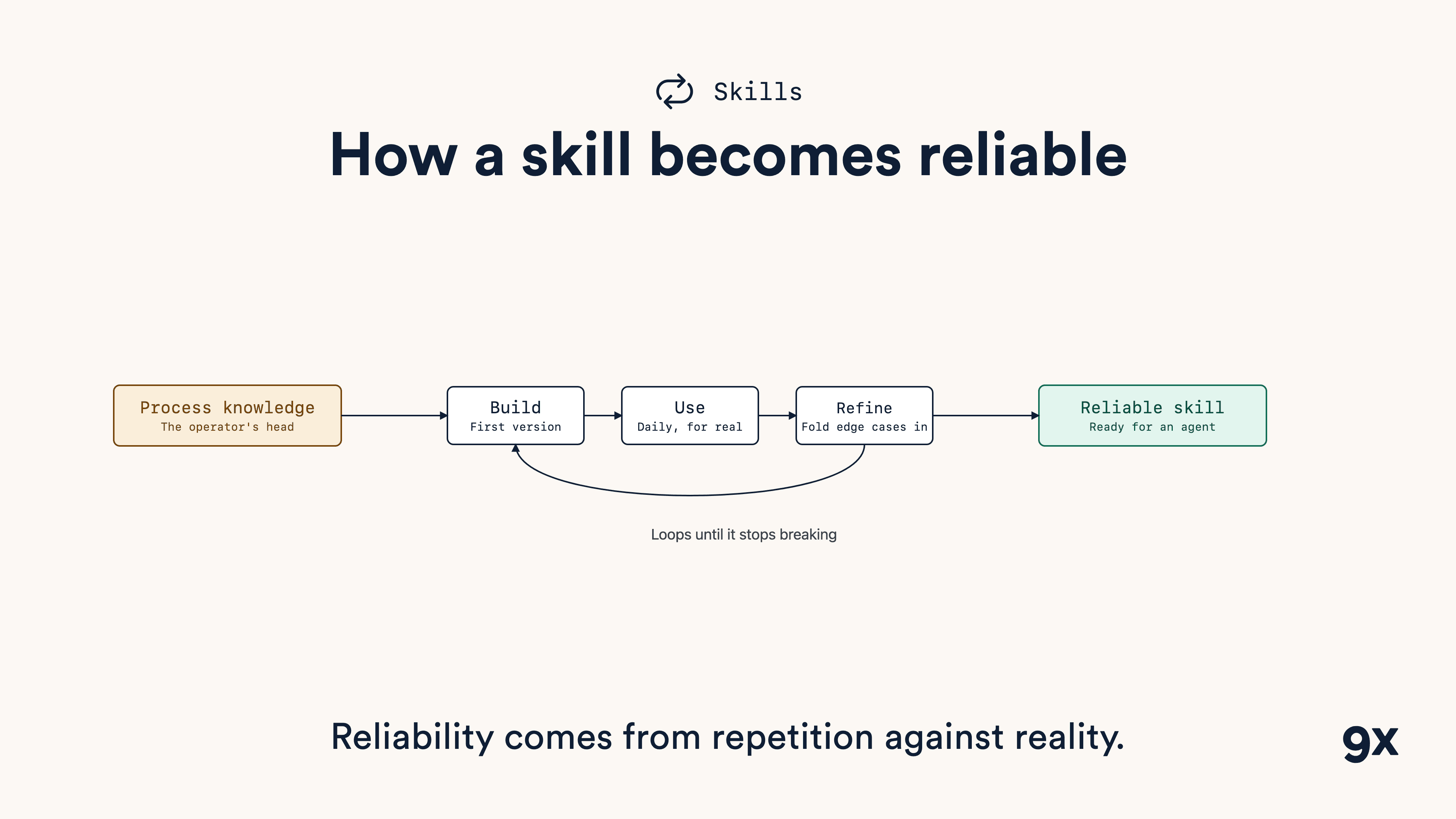
Build the first version, because they know what the process actually is
Use it daily, because it serves their own work
Refine it when it breaks, because reality routes every weird input through them
Harden it until the exceptions are handled and the output is trustworthy
This loop cannot be outsourced. Reliability comes from repetition against reality, and only the operator faces that reality every day. A consultant sees your process for two weeks. Your operator has lived it for years and will still be there next quarter when the edge case shows up. It's the same pattern we see across the companies we work with: the teams that reach reliable skills are the ones whose operators build and refine daily — not the ones that ran a workshop once and stopped.
There's a second payoff hiding in this phase: your team gets the leverage immediately. Every hardened skill takes grunt work off someone's plate long before any agent runs solo. Skill-building pays for itself while it builds the foundation for autopilot.
You are in this phase when:
Operators build and edit their own skills, instead of only consuming tools
Skills get refined after failures instead of abandoned
Edge cases get folded into the skill the same week they appear
Teams share working skills with each other
Process documentation improves as a side effect of skill-building
Skills are judged by reliability ("hasn't broken in a month")
AI enablement budget goes to the people running processes
Phase 3: Agents run the skills
In this last phase comes the reward: handing over skills to agents.
Once a skill runs reliably with a human in the loop, handing it to an agent is a much smaller step.
In 2026, that step rarely means building your own agents. AI agents are now a product feature that business users can operate directly. The transition typically runs through one of two routes:
Managed agents inside the AI platforms: Claude managed agents, Claude Tag, ChatGPT workspace agents are recommended destinations. The operator attaches the hardened skill, sets a trigger or a schedule, and defines which steps need a human sign-off. No code, no infrastructure.
Automation platforms like n8n or Make where the skill runs as a step inside a larger workflow, kicked off by an event: an invoice landing in the inbox, a form submission, a nightly schedule.
In both routes, business teams don't build or maintain agent infrastructure. They still own the part that matters — the skill — and delegate the running of it to these platforms. That's also why Phase 2 is the real investment: the skill is the asset that transfers; the agent is increasingly a commodity around it.
The agent executes the same hardened skill your team built. And the handover isn't all-or-nothing: the happy path runs without a human touching it, while gate steps — approvals, payments, anything outward-facing — stay with a human, and edge cases land in an exception queue for the operator to resolve.
What changes drastically is the operator's job.
They move from doing the work to supervising it: reviewing the exception queue, improving the skill when something new shows up, deciding which gate steps can eventually open, and choosing which process to hand over next.
This is where trust actually comes from. You trust the agent because you trust the skill — and you trust the skill because your own team built it, used it, and battle-tested it against months of real inputs. Autopilot arrives process by process, not as a big-bang replacement project.
And the role of your team changes for good. Operators stop being the people who do the work and become the people who own the systems that do the work.
That's a more valuable job — I’d argue, that’s the job of the future — and it's only available to teams that accepted to go through the meticulous work in Phase 2.
You are in this phase when:
Individual processes run end-to-end without a human touching the happy path
Operators review exception queues instead of doing the work itself
New processes get designed skill-first, with agent handover in mind
Reliability is measured per skill, and regressions get fixed fast
Conversations shift from "who does this work" to "who owns this system"
Where Is Your Team Today?
The companies that reach autopilot won't be the ones that waited for agents to get good enough. They'll be the ones whose teams spent that time turning process knowledge into hardened, reliable skills. Upskilling your team is the mechanism that makes automation trustworthy.
Take one process your team runs every week and ask: Which phase is it in? Who knows its edge cases? Could that person build the skill this quarter?
If you'd like help turning your operators into builders and your processes into reliable skills, book a call with us. We'll map where your team stands today and which process to hand to agents first.
FREE LIVE SESSIONS
What’s the best way to learn AI?
With 9x Live! Join a free session and learn the skills that’ll get you ahead of the 99%.
What to do next
1
Start learning free
Take our AI starter course and apply the latest technologies to your first use case. Completely free. Get started today.
2
Learn it live
Join a free weekly 9x Live session, watch work get automated in real time, and get your questions answered by leading educators. Sign up for the next session.
3
Watch our videos on YouTube
With one of the fastest growing channels in the industry, hundreds of thousands of people watch our tutorials every week. Subscribe here so you never miss a video.

AI
Ask any leadership team what they want from AI and the answers converge fast: agents running the operations. Emails triaged before anyone opens the inbox. Invoices processed without a human touching them. Reports generated overnight. The logistics, the tool-hopping, the output production — all of that, delegated to agents.
We want that company too. It's the right ambition.
But there's a prerequisite hiding underneath it that most autopilot plans skip: agents can only run your operations if the skills they execute work reliably.
Skills are packaged instructions AI can execute: they contain the steps, the rules, the edge cases, the definition of done for one specific task. Skills are the unit of work agents run on. Unreliable skills mean unreliable agents — and unreliable agents don't get trusted with operations.
So the question becomes: how can your business build reliable skills?
Our answer: by having the people who run the processes today build them. Which means the path to a company on autopilot runs straight through the upskilling of your team.
From Manual Work to Autopilot: Three Phases
For a process to end up running on autopilot, it must move through three phases:
Phase 1: Operators run the process. The knowledge exists, but only in people's heads
Phase 2: Operators build the skills. Process knowledge is packaged into tested, reliable skills, run by humans
Phase 3: Agents run the skills. Hardened skills are handed over to agents. They run without a human on the happy path. Humans are involved for gate steps and edge cases.
The order is everything. We see companies trying to jump from Phase 1 straight to Phase 3. Invariably, this approach fails.
Let’s explore these phases.
Phase 1: Operators run the process
This is where every process untouched by AI stands today.
The process itself is usually documented — there's an SOP, a checklist, a wiki page. But the execution is entirely manual: a human reads the incoming email, opens the tool, moves the data, checks the numbers, chases the exception. Operators are managing activities end to end, sequencing the steps, deciding what's urgent, catching what looks off. The documentation describes the work. A person operates it.
And underneath the documented process sits a layer of knowledge no SOP captures. The operator running your invoicing knows which supplier always sends malformed PDFs. The person doing weekly reporting knows which numbers the CFO actually reads. The coordinator handling logistics knows the "exception" that happens every single week. That layer lives in people's heads and habits.
The classic mistake in this phase is trying to automate from the outside. We see it constantly: a company buys an automation platform, parks it with IT or an innovation team, and has someone who never ran the process map the happy path. The automation ships, then breaks on the first real-world exception - because the person who knew about that exception was never in the loop. It gets quietly abandoned, and the operator goes back to doing the work by hand.
The knowledge needed for reliable automation is already in your company. It's just not in a form an agent can execute yet.
You are in this phase when:
SOPs describe the work, but a person still executes every step
The same person handles the same exceptions every week, from memory
Automation attempts come from outside the team that runs the process
AI tools are available but used mostly for drafting and summarizing
When someone goes on holiday, their processes stall
"How does this actually work?" has exactly one person as the answer
Phase 2: Operators build the skills
This is the most important phase: it decides whether autopilot ever happens. And yet, this is the phase most organizations are not willing to go through!
The phase has two moments.
First, your operators learn the new way of working. They onboard onto agentic workflow platforms (like Claude Cowork or ChatGPT Work) and figure out how to work with them: how to delegate a task to AI, how to give it the right context, when to trust the output and when to check it. This moment is about fluency, and it can't be skipped — nobody can codify a way of working they haven't practiced.
Once that's through, the second moment starts: operators codify their knowledge. In 2026, that mostly means building skills that automate repeatable workflows and process steps. The SOP that used to describe the work becomes a skill that does the work: the invoicing operator packages the supplier quirks into it, the reporting owner encodes which numbers actually matter, the logistics coordinator writes the weekly exception straight into the rules.
Crucially, humans still run these skills. The operator triggers the skill, watches it work, and checks the output — AI executes the steps, but a person stays on every run. That's what makes this phase safe to move fast in.
And because they run their own skills, they run a loop:
Build the first version, because they know what the process actually is
Use it daily, because it serves their own work
Refine it when it breaks, because reality routes every weird input through them
Harden it until the exceptions are handled and the output is trustworthy
This loop cannot be outsourced. Reliability comes from repetition against reality, and only the operator faces that reality every day. A consultant sees your process for two weeks. Your operator has lived it for years and will still be there next quarter when the edge case shows up. It's the same pattern we see across the companies we work with: the teams that reach reliable skills are the ones whose operators build and refine daily — not the ones that ran a workshop once and stopped.
There's a second payoff hiding in this phase: your team gets the leverage immediately. Every hardened skill takes grunt work off someone's plate long before any agent runs solo. Skill-building pays for itself while it builds the foundation for autopilot.
You are in this phase when:
Operators build and edit their own skills, instead of only consuming tools
Skills get refined after failures instead of abandoned
Edge cases get folded into the skill the same week they appear
Teams share working skills with each other
Process documentation improves as a side effect of skill-building
Skills are judged by reliability ("hasn't broken in a month")
AI enablement budget goes to the people running processes
Phase 3: Agents run the skills
In this last phase comes the reward: handing over skills to agents.
Once a skill runs reliably with a human in the loop, handing it to an agent is a much smaller step.
In 2026, that step rarely means building your own agents. AI agents are now a product feature that business users can operate directly. The transition typically runs through one of two routes:
Managed agents inside the AI platforms: Claude managed agents, Claude Tag, ChatGPT workspace agents are recommended destinations. The operator attaches the hardened skill, sets a trigger or a schedule, and defines which steps need a human sign-off. No code, no infrastructure.
Automation platforms like n8n or Make where the skill runs as a step inside a larger workflow, kicked off by an event: an invoice landing in the inbox, a form submission, a nightly schedule.
In both routes, business teams don't build or maintain agent infrastructure. They still own the part that matters — the skill — and delegate the running of it to these platforms. That's also why Phase 2 is the real investment: the skill is the asset that transfers; the agent is increasingly a commodity around it.
The agent executes the same hardened skill your team built. And the handover isn't all-or-nothing: the happy path runs without a human touching it, while gate steps — approvals, payments, anything outward-facing — stay with a human, and edge cases land in an exception queue for the operator to resolve.
What changes drastically is the operator's job.
They move from doing the work to supervising it: reviewing the exception queue, improving the skill when something new shows up, deciding which gate steps can eventually open, and choosing which process to hand over next.
This is where trust actually comes from. You trust the agent because you trust the skill — and you trust the skill because your own team built it, used it, and battle-tested it against months of real inputs. Autopilot arrives process by process, not as a big-bang replacement project.
And the role of your team changes for good. Operators stop being the people who do the work and become the people who own the systems that do the work.
That's a more valuable job — I’d argue, that’s the job of the future — and it's only available to teams that accepted to go through the meticulous work in Phase 2.
You are in this phase when:
Individual processes run end-to-end without a human touching the happy path
Operators review exception queues instead of doing the work itself
New processes get designed skill-first, with agent handover in mind
Reliability is measured per skill, and regressions get fixed fast
Conversations shift from "who does this work" to "who owns this system"
Where Is Your Team Today?
The companies that reach autopilot won't be the ones that waited for agents to get good enough. They'll be the ones whose teams spent that time turning process knowledge into hardened, reliable skills. Upskilling your team is the mechanism that makes automation trustworthy.
Take one process your team runs every week and ask: Which phase is it in? Who knows its edge cases? Could that person build the skill this quarter?
If you'd like help turning your operators into builders and your processes into reliable skills, book a call with us. We'll map where your team stands today and which process to hand to agents first.
FREE LIVE SESSIONS
What’s the best way to learn AI?
With 9x Live! Join a free session and learn the skills that’ll get you ahead of the 99%.
What to do next
1
Start learning free
Take our AI starter course and apply the latest technologies to your first use case. Completely free. Get started today.
2
Learn it live
Join a free weekly 9x Live session, watch work get automated in real time, and get your questions answered by leading educators. Sign up for the next session.
3
Watch our videos on YouTube
With one of the fastest growing channels in the industry, hundreds of thousands of people watch our tutorials every week. Subscribe here so you never miss a video.
AI
read next
Running AI Enablement Internally? Here are Three Things to Consider
AI enablement looks like a training project. It isn't. Skill levels, tools and functions all move at once. Here's what running it internally really takes.

What is Claude Slides, and How to Use Them (Guide for Beginners)
How to use Claude Slides to build an on-brand deck from a one-line brief, edit and export it, and where it beats PowerPoint and Google Slides, and where it doesn't.
read next
Running AI Enablement Internally? Here are Three Things to Consider
AI enablement looks like a training project. It isn't. Skill levels, tools and functions all move at once. Here's what running it internally really takes.
What is Claude Slides, and How to Use Them (Guide for Beginners)
How to use Claude Slides to build an on-brand deck from a one-line brief, edit and export it, and where it beats PowerPoint and Google Slides, and where it doesn't.
Your new home for learning AI.
Weekly live workshops, on-demand courses, and plug-and-play downloadables. Get started for free today.
Your new home for learning AI.
Weekly live workshops, on-demand courses, and plug-and-play downloadables. Get started for free today.
Your new home for learning AI.
Weekly live workshops, on-demand courses, and plug-and-play downloadables. Get started for free today.