Claude Skills vs Agents: What's the Difference?

By
Jan Meinecke
・
・
7
Min
Claude Skills vs Agents: What's the Difference?
By
jan Meinecke
7
Min
The short answer: a Claude skill is a set of instructions for doing one specific task, and an agent is the thing that actually plans and takes action to reach a goal. A skill is what an agent reads; the agent is what runs. They aren't competing ideas, they work together. This guide explains the difference between Claude skills and agents in plain English, and why it matters for getting good results.
The terms get muddled because both turn up in the same sentence constantly. Pulling them apart makes Claude a lot easier to reason about.
Watch: for the agent side in depth, see our Claude Managed Agents review.
What is a Claude skill?
A skill is a reusable set of instructions that teaches Claude exactly how to perform a specific task your way: your template, your tone, your steps. Think of it as a saved standard operating procedure, with its own structure of instructions and resources. On its own, a skill doesn't do anything; it's knowledge waiting to be used. Something has to pick it up and follow it.
What is an agent?
An agent is a system that takes a goal, decides its own steps, uses tools, and keeps going until the job is done, correcting itself along the way. Where a chatbot answers and stops, an agent acts. Claude Cowork and Claude Code are both agents: you describe an outcome, and they plan and execute it.
The key trait of an agent is the loop. It makes a plan, takes an action, checks its own work, and decides what to do next, repeating until it's finished. That self-direction is what makes it an agent rather than a script.
The difference in one line
A skill is how to do a task. An agent is what does it.
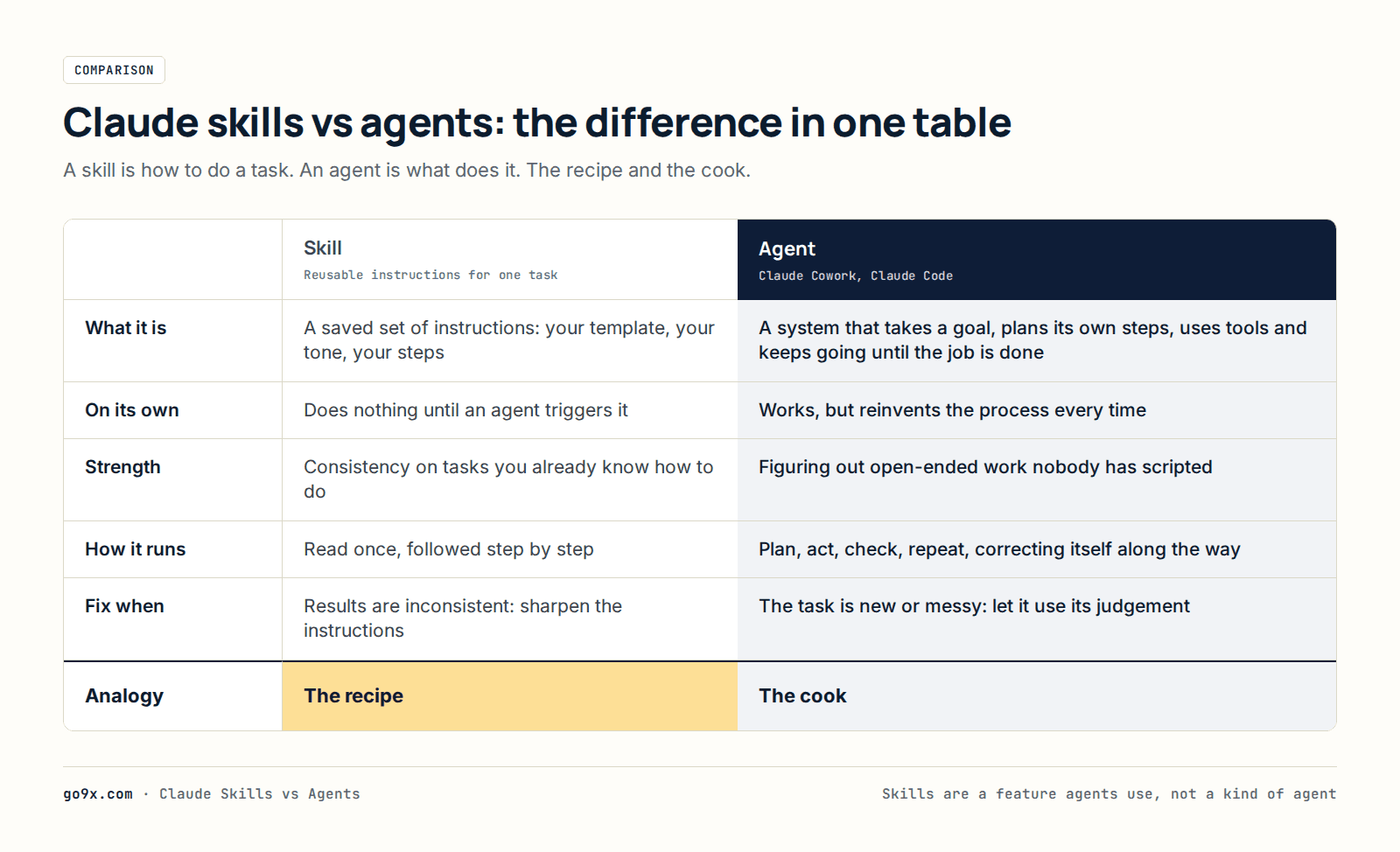
Put the two together and it clicks: the agent is the worker; the skill is the instruction sheet it pulls off the shelf when a job matches. You can have an agent with no skills (it figures everything out from scratch each time) or a pile of skills with an agent to run them (the powerful combination). A skill makes an agent faster and more consistent at a specific job; the agent makes the skill actually happen.
Claude skill | Agent | |
|---|---|---|
What it is | Reusable instructions for one task | A system that plans and acts toward a goal |
On its own | Does nothing until triggered | Works, but reinvents each process |
Best at | Consistency on a known task | Figuring out and completing open-ended work |
Analogy | The recipe | The cook |
Where sub-agents fit in
There's a third term that adds to the confusion: sub-agents. These are extra copies of the main agent that it spins up to work on parts of a big task in parallel, one researching each competitor, say, then reporting back. Sub-agents are still agents; they just work under a lead agent. And skills can use them: a skill can call a sub-agent for a step that benefits from focused, parallel attention, like analysing video footage frame by frame. So the hierarchy is simple: an agent runs, it can spin up sub-agents to help, and any of them can follow a skill.
A real example: skill and agent together
Our video-highlights workflow shows the two working as a pair. The agent is Claude Cowork: you ask it to turn this week's workshop into clips, and it plans the job, reads the files, and produces the result. The skill is the instruction sheet it follows, the exact steps and assets that make the clips look like ours. And inside that skill, the agent spins up a sub-agent, a dedicated visual analyser that looks at the footage frame by frame so the clips cut between screen and speaker at the right moments.
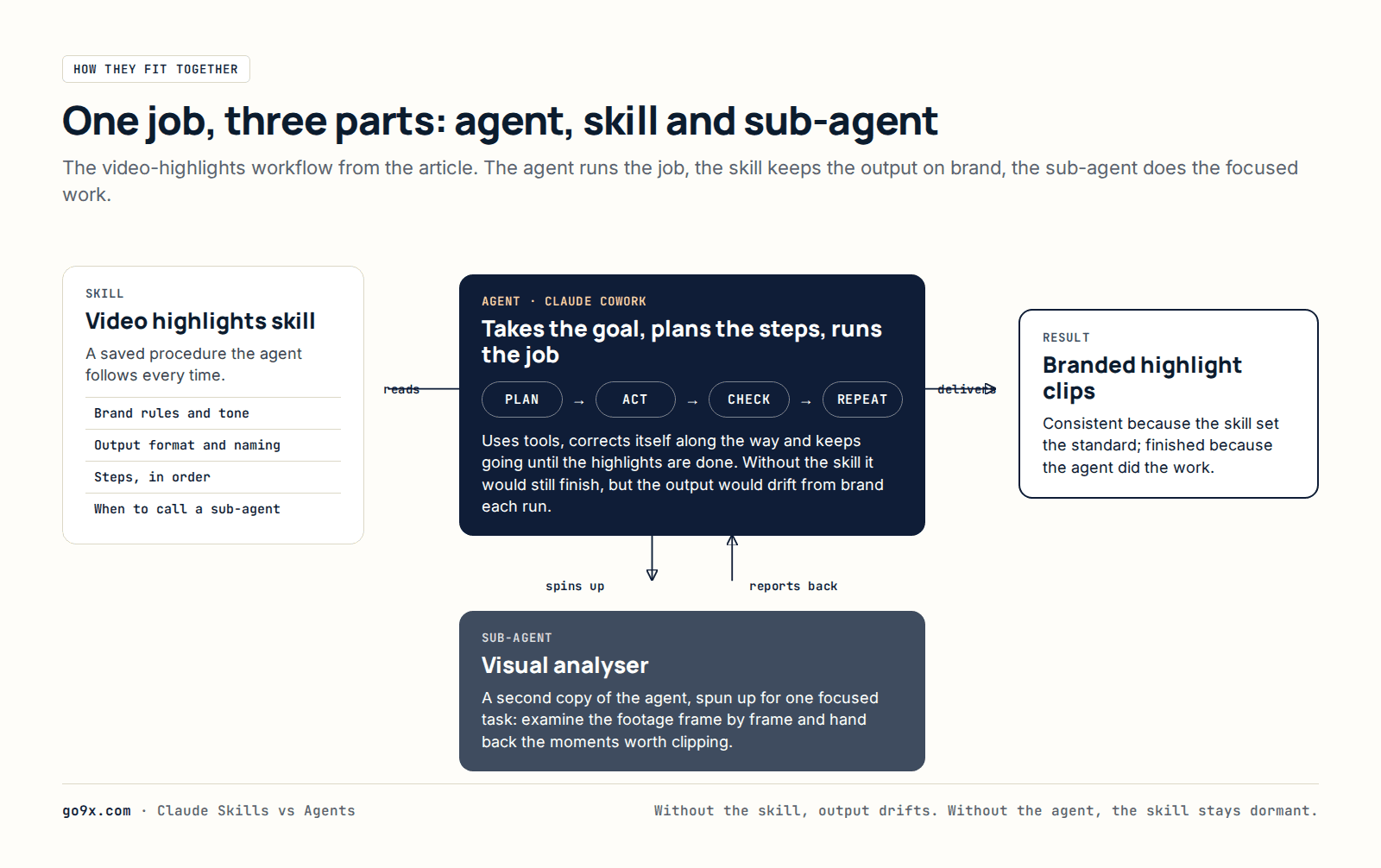
Take the skill away and the agent still works, but it reinvents the process each time and the output drifts. Take the agent away and the skill just sits there, a recipe with no cook. Together they give you the same result, to the same standard, on demand.
Where Claude Chat fits in
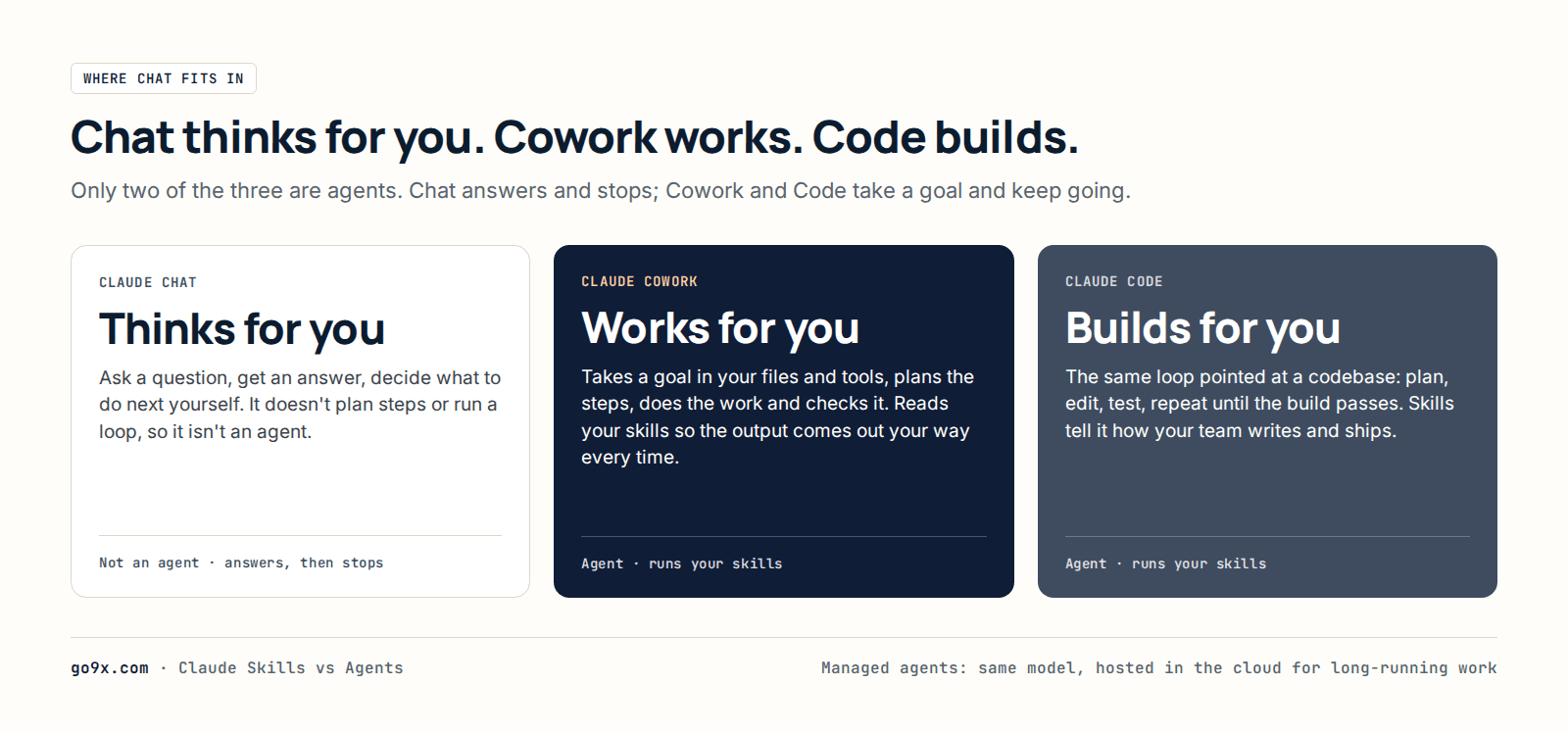
There's one more piece worth placing. Claude Chat isn't an agent at all; it answers and stops. Our co-founder Alex sums up the trio neatly: "Claude Chat thinks for you, Cowork works for you, Claude Code builds for you." Chat is the thinking partner, the agents (Cowork and Code) are the doers, and skills are what make those doers consistent at the jobs you repeat.
What about managed agents?
You may also hear "managed agents," which adds to the confusion. That's a separate, developer-facing product for running agents on long-running work in the cloud, rather than a different concept. It's still an agent, following skills, possibly spinning up sub-agents, just hosted elsewhere. The mental model doesn't change: agents act, skills instruct, sub-agents help.
Why the distinction matters
Knowing which is which changes how you build. When a result is inconsistent, the fix is usually a better skill, a clearer instruction sheet, not a different agent. When a task is new or open-ended, you want the agent's judgement, not a rigid skill. And when you want a process to run the same way every time, you capture it as a skill so the agent stops improvising. Understanding where you sit on the AI skills ladder helps you know which lever to reach for.
When to build a skill, and when to trust the agent
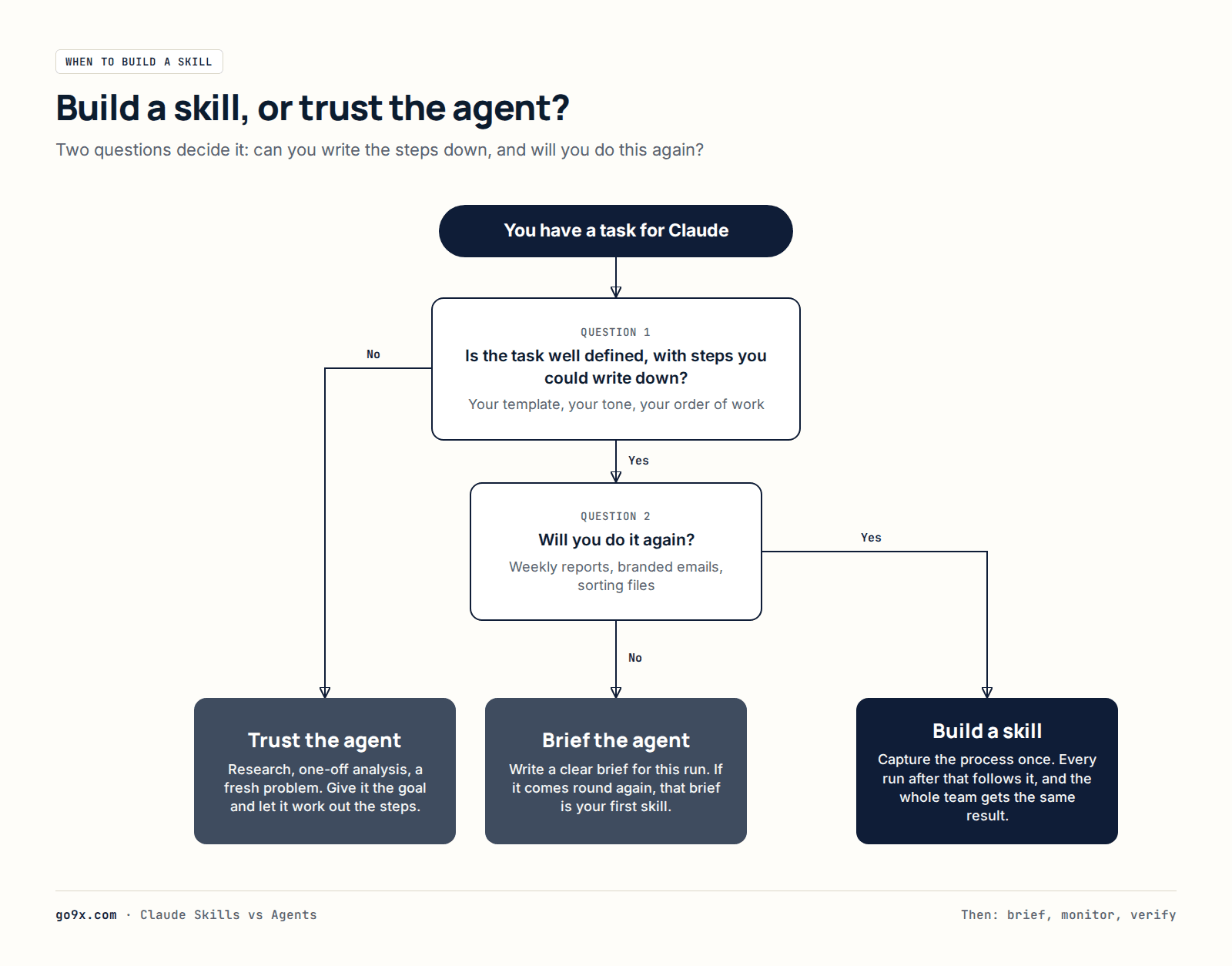
The practical value of the distinction is knowing which to reach for on a given job. Build a skill when a task is well-defined and you do it more than once: the weekly report, the branded email, the file sorting. You want it to run the same way every time, so you capture the steps and stop the agent improvising. Trust the agent's own judgement when a task is new, messy, or open-ended, where you can't write the steps in advance because you don't yet know them. Research, one-off analysis, and figuring out a fresh problem are agent work, not skill work.
There's a 9x habit that ties the two together: brief, monitor, verify. You brief the agent clearly (and, for repeat jobs, that brief becomes a skill), you keep half an eye on it as it works, and you check the result before you rely on it. Skills make the briefing reusable; the agent does the work; you stay in the loop. Get that rhythm and the skills-versus-agents question stops being abstract and becomes a simple daily call.
Common questions about skills and agents
Is a skill an agent? No. A skill is instructions; an agent is the thing that reads them and acts. A skill does nothing until an agent runs it.
Can an agent work without skills? Yes, it just figures out each process from scratch, which is fine for one-offs but inconsistent for repeated work.
Are Cowork and Code agents or skills? Both are agents. Skills are a feature they use.
Build skills as you go
A simple working habit keeps the two in balance: build skills as you go. Whenever your agent works something out that you'll want again, save it as a skill on the spot, so the agent never has to rediscover it. Over a few weeks this quietly compounds, the open-ended jobs stay the agent's to figure out, while the repeatable ones turn into a growing library of skills the whole team can run. You end up with the best of both: an agent for judgement, and skills for everything you've already proven works.
The takeaway
Claude skills and agents aren't rivals: the agent is the thing that plans and acts, and a skill is the reusable instruction set it follows for a specific job. Use agents for judgement and open-ended work, build skills to lock in the tasks you repeat, and combine them to get speed and consistency at once.
If you want your team building both, real skills around your processes, run by agents that act, our hands-on Claude Cowork training takes people from their first task to a working library of skills and automations.
FREE LIVE SESSIONS
What’s the best way to learn AI?
With 9x Live! Join a free session and learn the skills that’ll get you ahead of the 99%.
What to do next
1
Start learning free
Take our AI starter course and apply the latest technologies to your first use case. Completely free. Get started today.
2
Learn it live
Join a free weekly 9x Live session, watch work get automated in real time, and get your questions answered by leading educators. Sign up for the next session.
3
Watch our videos on YouTube
With one of the fastest growing channels in the industry, hundreds of thousands of people watch our tutorials every week. Subscribe here so you never miss a video.

Claude
The short answer: a Claude skill is a set of instructions for doing one specific task, and an agent is the thing that actually plans and takes action to reach a goal. A skill is what an agent reads; the agent is what runs. They aren't competing ideas, they work together. This guide explains the difference between Claude skills and agents in plain English, and why it matters for getting good results.
The terms get muddled because both turn up in the same sentence constantly. Pulling them apart makes Claude a lot easier to reason about.
Watch: for the agent side in depth, see our Claude Managed Agents review.
What is a Claude skill?
A skill is a reusable set of instructions that teaches Claude exactly how to perform a specific task your way: your template, your tone, your steps. Think of it as a saved standard operating procedure, with its own structure of instructions and resources. On its own, a skill doesn't do anything; it's knowledge waiting to be used. Something has to pick it up and follow it.
What is an agent?
An agent is a system that takes a goal, decides its own steps, uses tools, and keeps going until the job is done, correcting itself along the way. Where a chatbot answers and stops, an agent acts. Claude Cowork and Claude Code are both agents: you describe an outcome, and they plan and execute it.
The key trait of an agent is the loop. It makes a plan, takes an action, checks its own work, and decides what to do next, repeating until it's finished. That self-direction is what makes it an agent rather than a script.
The difference in one line
A skill is how to do a task. An agent is what does it.
Put the two together and it clicks: the agent is the worker; the skill is the instruction sheet it pulls off the shelf when a job matches. You can have an agent with no skills (it figures everything out from scratch each time) or a pile of skills with an agent to run them (the powerful combination). A skill makes an agent faster and more consistent at a specific job; the agent makes the skill actually happen.
Claude skill | Agent | |
|---|---|---|
What it is | Reusable instructions for one task | A system that plans and acts toward a goal |
On its own | Does nothing until triggered | Works, but reinvents each process |
Best at | Consistency on a known task | Figuring out and completing open-ended work |
Analogy | The recipe | The cook |
Where sub-agents fit in
There's a third term that adds to the confusion: sub-agents. These are extra copies of the main agent that it spins up to work on parts of a big task in parallel, one researching each competitor, say, then reporting back. Sub-agents are still agents; they just work under a lead agent. And skills can use them: a skill can call a sub-agent for a step that benefits from focused, parallel attention, like analysing video footage frame by frame. So the hierarchy is simple: an agent runs, it can spin up sub-agents to help, and any of them can follow a skill.
A real example: skill and agent together
Our video-highlights workflow shows the two working as a pair. The agent is Claude Cowork: you ask it to turn this week's workshop into clips, and it plans the job, reads the files, and produces the result. The skill is the instruction sheet it follows, the exact steps and assets that make the clips look like ours. And inside that skill, the agent spins up a sub-agent, a dedicated visual analyser that looks at the footage frame by frame so the clips cut between screen and speaker at the right moments.
Take the skill away and the agent still works, but it reinvents the process each time and the output drifts. Take the agent away and the skill just sits there, a recipe with no cook. Together they give you the same result, to the same standard, on demand.
Where Claude Chat fits in
There's one more piece worth placing. Claude Chat isn't an agent at all; it answers and stops. Our co-founder Alex sums up the trio neatly: "Claude Chat thinks for you, Cowork works for you, Claude Code builds for you." Chat is the thinking partner, the agents (Cowork and Code) are the doers, and skills are what make those doers consistent at the jobs you repeat.
What about managed agents?
You may also hear "managed agents," which adds to the confusion. That's a separate, developer-facing product for running agents on long-running work in the cloud, rather than a different concept. It's still an agent, following skills, possibly spinning up sub-agents, just hosted elsewhere. The mental model doesn't change: agents act, skills instruct, sub-agents help.
Why the distinction matters
Knowing which is which changes how you build. When a result is inconsistent, the fix is usually a better skill, a clearer instruction sheet, not a different agent. When a task is new or open-ended, you want the agent's judgement, not a rigid skill. And when you want a process to run the same way every time, you capture it as a skill so the agent stops improvising. Understanding where you sit on the AI skills ladder helps you know which lever to reach for.
When to build a skill, and when to trust the agent
The practical value of the distinction is knowing which to reach for on a given job. Build a skill when a task is well-defined and you do it more than once: the weekly report, the branded email, the file sorting. You want it to run the same way every time, so you capture the steps and stop the agent improvising. Trust the agent's own judgement when a task is new, messy, or open-ended, where you can't write the steps in advance because you don't yet know them. Research, one-off analysis, and figuring out a fresh problem are agent work, not skill work.
There's a 9x habit that ties the two together: brief, monitor, verify. You brief the agent clearly (and, for repeat jobs, that brief becomes a skill), you keep half an eye on it as it works, and you check the result before you rely on it. Skills make the briefing reusable; the agent does the work; you stay in the loop. Get that rhythm and the skills-versus-agents question stops being abstract and becomes a simple daily call.
Common questions about skills and agents
Is a skill an agent? No. A skill is instructions; an agent is the thing that reads them and acts. A skill does nothing until an agent runs it.
Can an agent work without skills? Yes, it just figures out each process from scratch, which is fine for one-offs but inconsistent for repeated work.
Are Cowork and Code agents or skills? Both are agents. Skills are a feature they use.
Build skills as you go
A simple working habit keeps the two in balance: build skills as you go. Whenever your agent works something out that you'll want again, save it as a skill on the spot, so the agent never has to rediscover it. Over a few weeks this quietly compounds, the open-ended jobs stay the agent's to figure out, while the repeatable ones turn into a growing library of skills the whole team can run. You end up with the best of both: an agent for judgement, and skills for everything you've already proven works.
The takeaway
Claude skills and agents aren't rivals: the agent is the thing that plans and acts, and a skill is the reusable instruction set it follows for a specific job. Use agents for judgement and open-ended work, build skills to lock in the tasks you repeat, and combine them to get speed and consistency at once.
If you want your team building both, real skills around your processes, run by agents that act, our hands-on Claude Cowork training takes people from their first task to a working library of skills and automations.
FREE LIVE SESSIONS
What’s the best way to learn AI?
With 9x Live! Join a free session and learn the skills that’ll get you ahead of the 99%.
What to do next
1
Start learning free
Take our AI starter course and apply the latest technologies to your first use case. Completely free. Get started today.
2
Learn it live
Join a free weekly 9x Live session, watch work get automated in real time, and get your questions answered by leading educators. Sign up for the next session.
3
Watch our videos on YouTube
With one of the fastest growing channels in the industry, hundreds of thousands of people watch our tutorials every week. Subscribe here so you never miss a video.
Claude
read next

8 ChatGPT Browser Use Cases That Save Me Hours Every Week
8 ChatGPT browser use cases I run every week, from turning a website into a spreadsheet to auditing a competitor's funnel, with the setup and prompts for each.

The 8 AI Skills That Will Separate Winners From Losers in 2027
The AI skills to learn in 2027 if you work for a company: five for delegating work to an agent, three for building AI for your team, and the tools for each.
read next
8 ChatGPT Browser Use Cases That Save Me Hours Every Week
8 ChatGPT browser use cases I run every week, from turning a website into a spreadsheet to auditing a competitor's funnel, with the setup and prompts for each.
The 8 AI Skills That Will Separate Winners From Losers in 2027
The AI skills to learn in 2027 if you work for a company: five for delegating work to an agent, three for building AI for your team, and the tools for each.
Your new home for learning AI.
Weekly live workshops, on-demand courses, and plug-and-play downloadables. Get started for free today.
Your new home for learning AI.
Weekly live workshops, on-demand courses, and plug-and-play downloadables. Get started for free today.
Your new home for learning AI.
Weekly live workshops, on-demand courses, and plug-and-play downloadables. Get started for free today.