The Best Claude Model for Every Job (2026)

By
Jan Meinecke
・
・
12
Min
The Best Claude Model for Every Job (2026)
By
jan Meinecke
12
Min
The best Claude model isn't the smartest one you can reach, it's the one that fits the job in front of you. Anthropic's line-up now runs from Haiku 4.5 up through Sonnet 5, the Opus 5.5 flagship, and the Fable 5.1 and Mythos 5.1 frontier, and in 2026 that's a toolkit, not a ladder to climb. Point the frontier at a quick summary and you've overpaid many times over; point a cheap model at a days-long build and it falls apart. This guide explains which Claude model to use for what, how they compare, and the one rule that saves the most money.
The old strategy of picking the flagship and routing everything through it is finished. The models are now priced and tuned for a world of agents doing multi-step work, where the smart move is matching the model to the difficulty of the task, not reaching for maximum horsepower every time. Get that right and you can cut your costs by more than half with no real drop in quality.
Watch: our walkthrough of eight jobs where the most powerful model actually earns its cost.
The 2026 Claude line-up at a glance
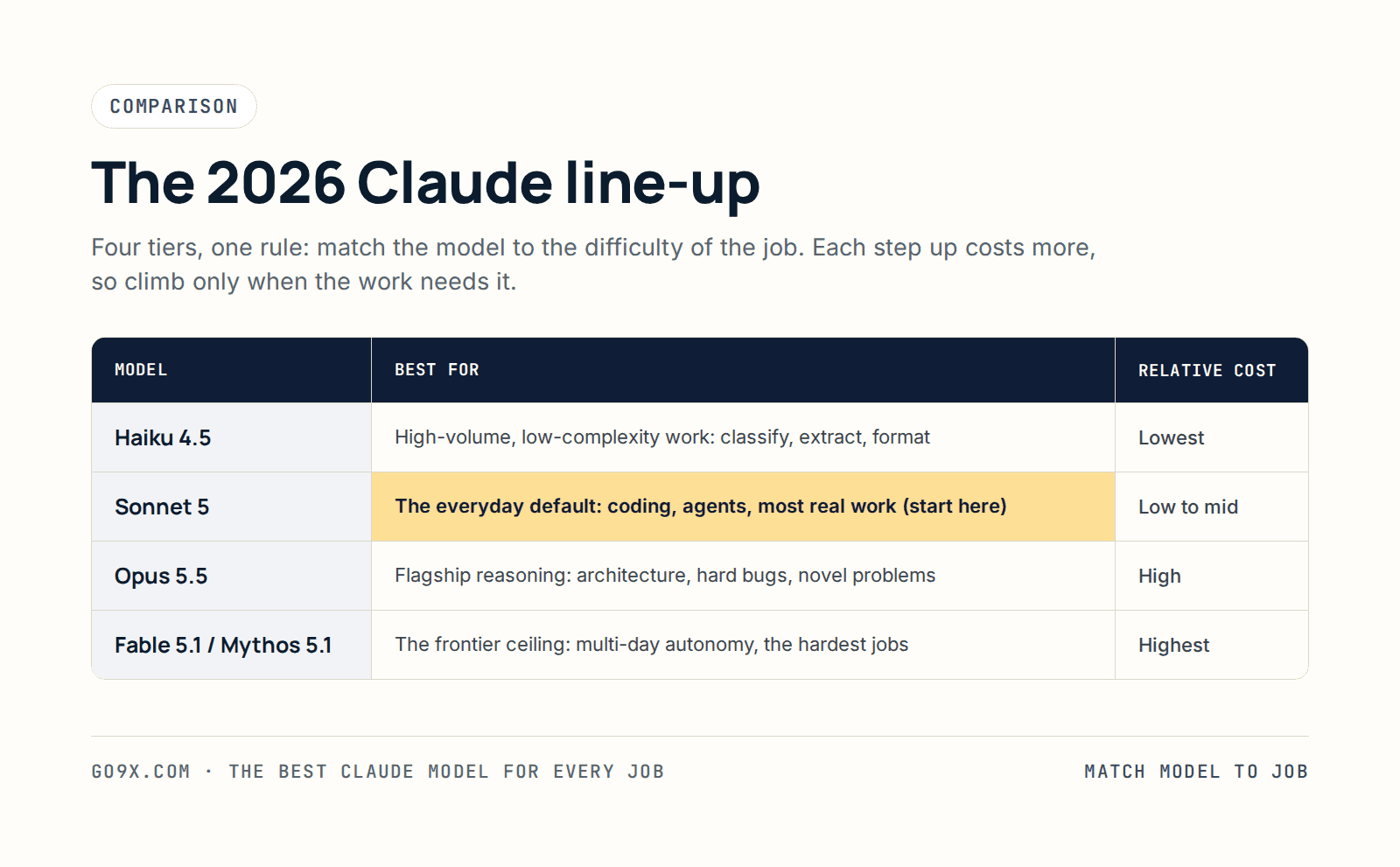
The pattern hasn't changed even as the names have: each step up costs more, so you only climb when the job truly needs it. What did change in late 2026 is where the value now sits. Opus 5.5 arrived performing at the level of the Fable 5.1 frontier for a good deal less, which pulled most "hard problem" work down a rung.
Plan with the strong model, execute with the cheap one
If you take one thing from this, take this. The expensive models are for the hard thinking: planning a project, breaking it into steps, checking the work, untangling something ambiguous. The cheaper models do the high-volume execution once the thinking is done. Using a frontier model to write a summary or format a document isn't just wasteful, it's a design mistake. You have to be deliberate about what earns that spend.
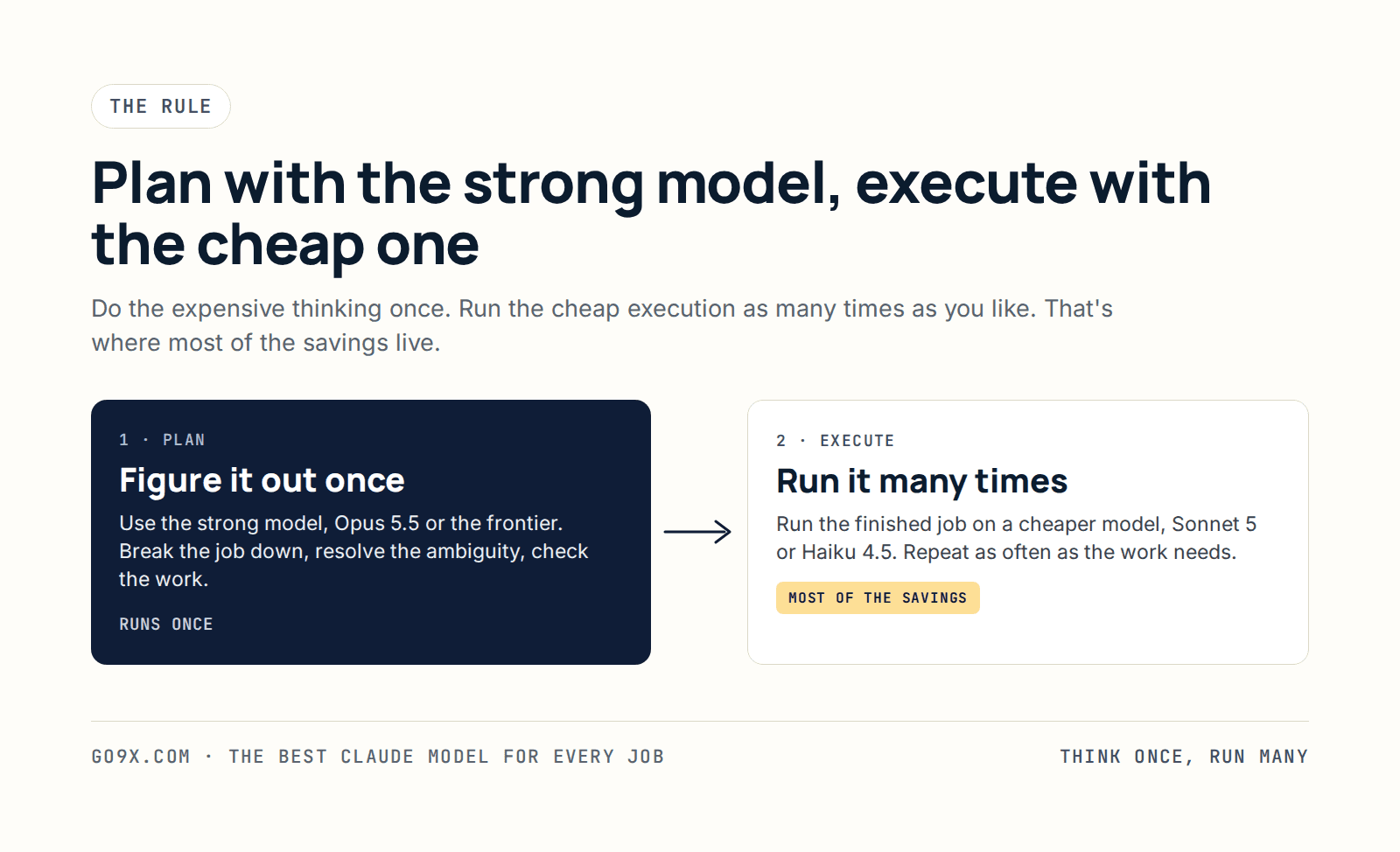
The sharpest version of this is a workflow you can copy. Use the top model to figure the hard thing out once, then run the finished thing on a cheaper model. The frontier tier is what you want when there's a lot to figure out over a long-running task. Once it's built, everything is figured out, so you can run the finished job on any model in your subscription. I'd start with Opus 5.5, and I'd test whether Sonnet 5 can handle it too.
That single habit, do the expensive thinking once and run the cheap execution many times, is where most of the savings live.
Model by model: Which Claude to reach for
Haiku 4.5, the fast, cheap workhorse
Haiku 4.5 is the cheapest model in the line-up and built for scale and speed. It handles a large context and is the right choice for high-volume, low-complexity jobs: classifying support tickets, extracting fields from documents, tidying formatting, running simple checks. It isn't for deep reasoning or production-grade code, and it lacks the reasoning controls the bigger models have. But when you're doing the same small job thousands of times and speed and cost matter more than nuance, nothing else comes close.
Sonnet 5, the default for real work
Sonnet 5 is the workhorse, and for most people, most of the time, it's the right answer. It's the default for Free and Pro users and comes close to flagship performance at a fraction of the cost, with a large context window. It's the model doing the bulk of everyday coding, drafting, and agentic work in Claude Cowork and Claude Code. It's meaningfully cheaper than the flagship per token, which makes it the natural engine for anything that involves generating a lot of text or code.
One thing to watch, covered in full further down: Sonnet 5 thinks harder than older models by default, and pushing that effort to the maximum can quietly make it cost more than Opus.
Opus 5.5, the flagship
Opus 5.5, launched on 22 September as the first model in the Claude 5.5 family, is the most consequential release of the year for how you should choose. It performs at the level of the Fable 5.1 frontier at around 40% lower cost, so the top of the model picker got both smarter and cheaper at once. The practical effect is huge: Opus 5.5 absorbed most of the jobs that used to need a frontier model, at a fraction of the frontier's cost. For "maximum horsepower" on a hard problem, Opus 5.5 is now what you reach for, and only on the very hardest, longest work does the frontier still earn its premium.
Fable 5.1 and Mythos 5.1, the ceiling
On 1 September Anthropic launched Claude Fable 5.1 and a new Claude Mythos 5.1, its most advanced models yet for coding and knowledge work. They sit at the top of the range and cost the most to run. They're built for days-long, highly autonomous jobs where errors compound across long chains, the kind of work where the cost of the API call is trivial next to the cost of the human labour it replaces: a huge legacy code migration, deep multi-source analysis, a system built end to end from one brief. We walk through eight jobs where the top of the range earns that cost in Claude Fable 5 use cases. The frontier holds state across enormous context, plans across stages, checks its own intermediate work, and can orchestrate other models. But most people won't reach for it day to day now that Opus 5.5 delivers frontier-level capability for far less.
If you are going to use the frontier tier, run it inside an agent, not a chat window. Do it in Claude Cowork or Claude Code, not the regular Claude chat, because in a chat you burn a lot of usage for what you get back.
Subscription vs pay-per-use
How you pay changes the calculation entirely.
On a subscription (Pro, Max, Team), you're spending against weekly limits, not per token. Reach for the best model your plan gives you: on Max that's Opus 5.5 as your default, and there's no reason to ration it in favour of Sonnet for hard work. The frontier tier is the exception. Fable 5.1 and Mythos 5.1 draw far more heavily against your limits, so they tend to be capped on the plans that include them and funded with pay-as-you-go credits on the ones that don't. Check what your plan actually covers before you build a workflow around them.
On the API (pay-per-token), the ranking above is the whole story: Haiku for volume, Sonnet for execution, Opus 5.5 for the hard reasoning, and the frontier only when a job is too big and too ambiguous for anything else.
Why maximum effort can cost more than the flagship
Here's the counterintuitive one that catches teams out. Sonnet 5 reasons before it answers by default, and you can dial that effort up. Crank it to the maximum to try to squeeze flagship-level intelligence out of the cheaper model, and it writes long, verbose internal reasoning for even simple prompts, and the output cost balloons. In testing, Sonnet 5 at maximum effort has come out more expensive per task than Opus 5.5, which reaches the right answer efficiently because its baseline intelligence is higher.
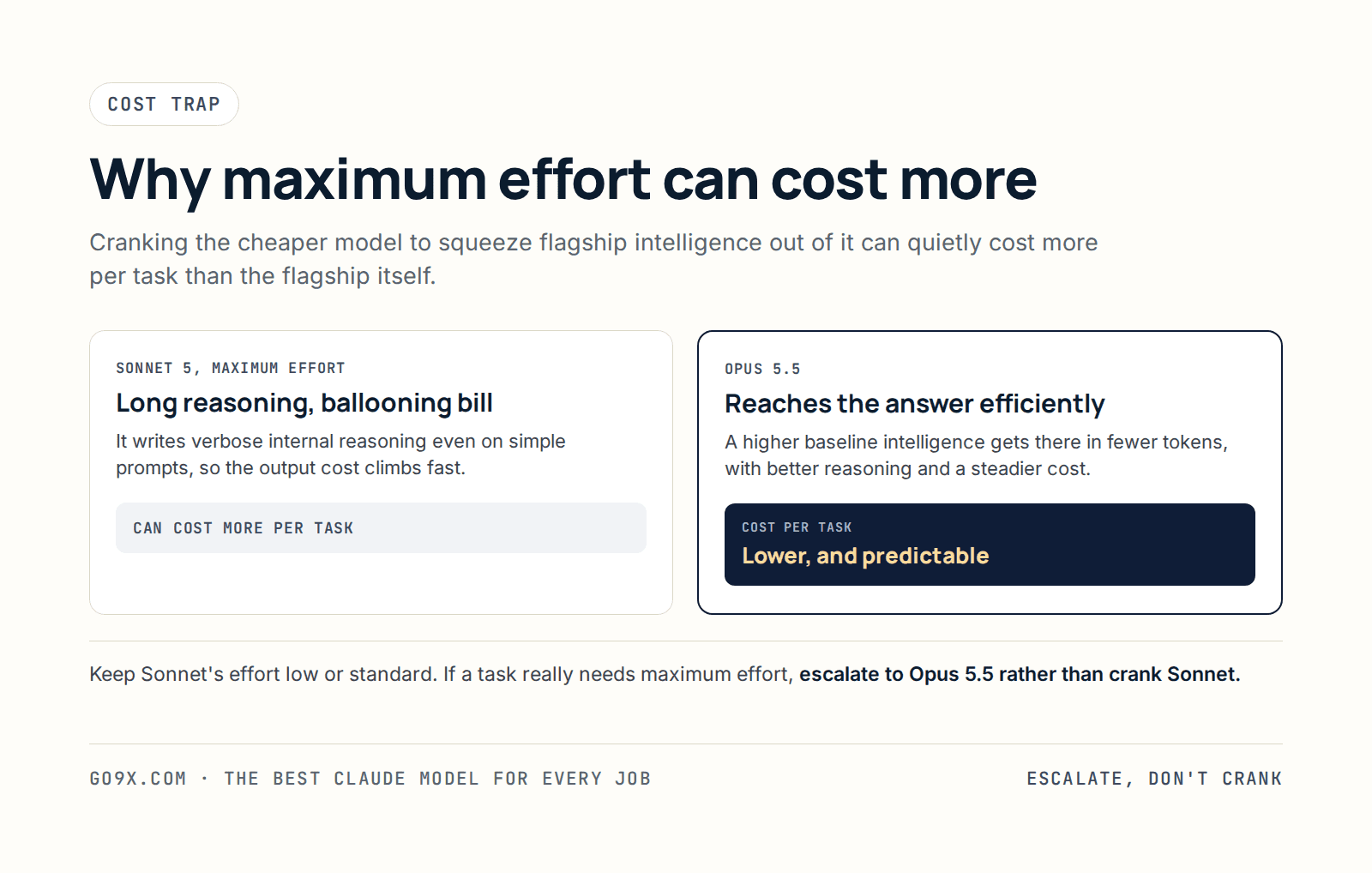
The rule: keep Sonnet's effort low or standard for most work, and if a task really needs maximum effort, don't crank Sonnet, escalate to Opus 5.5. You get better reasoning at a more predictable cost.
For developers: Two routing patterns that cut the bill
If you're building agentic pipelines, two patterns get most of the frontier's quality for a fraction of the spend.
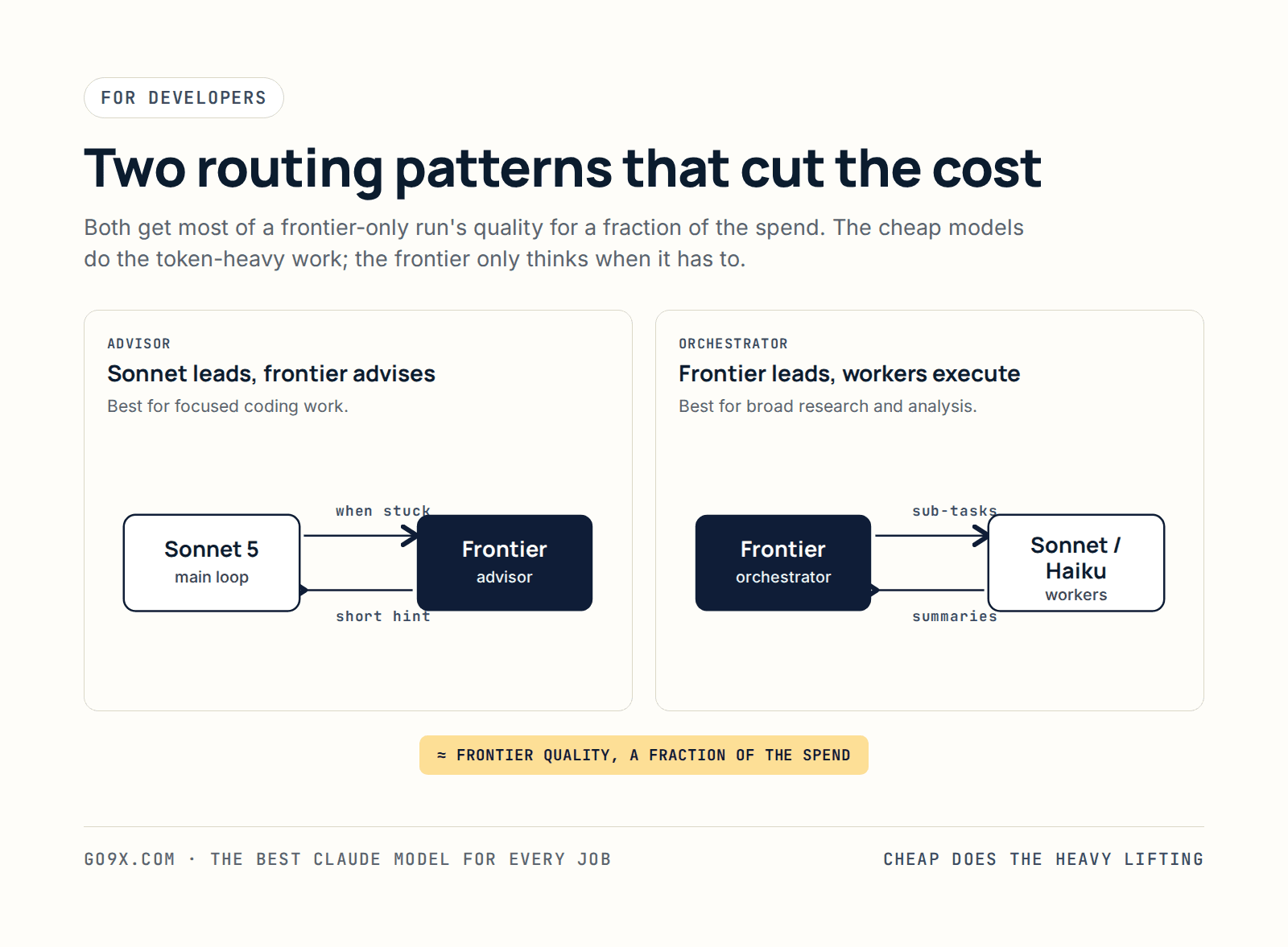
The advisor pattern suits focused coding work. Sonnet 5 runs the main loop, reading files, writing patches, running commands, and only calls a frontier model as an advisor when it hits something ambiguous it can't resolve. The frontier returns a short strategic instruction, not reams of code, so the expensive model barely generates any tokens. You get most of a frontier-only run's quality for a large saving.
The orchestrator pattern suits broad research and analysis. A frontier model is the brain: it takes the big goal, breaks it into sub-tasks, and dispatches them to a swarm of Sonnet or Haiku workers that do the token-heavy reading and return compressed summaries. Again, close to frontier-only quality at a fraction of the cost.
The other big lever is prompt caching, which can cut input costs by up to 90% on repeated context. Put your stable content, tool definitions, system instructions, knowledge, at the very start of the prompt so the cache holds, and keep variable user input after it.
How to choose, quickly
A quick, high-volume, repetitive job (classify, extract, format) → Haiku 4.5
Most real work (coding, agents, drafting, execution) → Sonnet 5
Hard reasoning (architecture, tricky multi-file bugs, novel problems) → Opus 5.5
A huge, multi-day, high-stakes autonomous build → the Fable 5.1 frontier, and even then, plan with it and execute on something cheaper
A living guide
The models change every few months, so treat the version numbers as a snapshot, not scripture. Opus 5.5 took the top slot from Opus 5 in September, performing at frontier level for less; Sonnet is the default; the frontier keeps moving. We track the specifics in our running guide to what's changed in Claude. The durable skill isn't memorising today's line-up, it's the principle: match the model to the job, plan with the strong one, execute with the cheap one. That's the same instinct behind knowing where you sit on the AI skills ladder.
In summary
There is no single best Claude model, there's a best model for each job. Haiku 4.5 is cheapest and fastest for high-volume work; Sonnet 5 is the everyday default and the best value for real execution; Opus 5.5 is the flagship for hard reasoning and now handles most of what used to need the frontier; Fable 5.1 and Mythos 5.1 are the ceiling, worth their premium only on the biggest, longest, most autonomous jobs. Match the model to the difficulty, use the strong ones to plan and the cheap ones to execute, and you get frontier results without frontier bills.
If you want your team fluent in this, choosing the right model, running the big ones inside Cowork and Code, and building the workflows that do the work, our hands-on Claude training for teams takes people from their first task to a working system.
Common questions
What is the best Claude model? It depends on the job. Opus 5.5 is the best all-round flagship for hard reasoning, Sonnet 5 is the best default for everyday work and value, Haiku 4.5 is cheapest for high-volume tasks, and the Fable 5.1 frontier is the ceiling for multi-day autonomous jobs. Matching the model to the task beats always reaching for the smartest.
Is the Claude frontier tier worth it? For most people, rarely. Opus 5.5 delivers frontier-level intelligence for a good deal less and has absorbed most of the jobs the frontier used to be needed for. Fable 5.1 and Mythos 5.1 earn their cost only on the biggest, multi-day, high-stakes autonomous work, and even then you plan with them and execute on a cheaper model.
Fable 5.1 vs Opus 5.5: which should I use? Opus 5.5 for almost everything hard, it's frontier-level for less. Reach for the Fable 5.1 frontier only when a single job is too large and too ambiguous for Opus to hold, such as a multi-day migration or an end-to-end build from one brief.
Which Claude model is cheapest? Haiku 4.5, roughly a fraction of the flagship's cost. For everyday work that still needs to be good, Sonnet 5 is the best value.
Which Claude model should I use for coding? Sonnet 5 for day-to-day coding and feature work, it's fast and cost-efficient. Escalate to Opus 5.5 for complex, multi-file architectural changes and hard bugs.
FREE LIVE SESSIONS
What’s the best way to learn AI?
With 9x Live! Join a free session and learn the skills that’ll get you ahead of the 99%.
What to do next
1
Start learning free
Take our AI starter course and apply the latest technologies to your first use case. Completely free. Get started today.
2
Learn it live
Join a free weekly 9x Live session, watch work get automated in real time, and get your questions answered by leading educators. Sign up for the next session.
3
Watch our videos on YouTube
With one of the fastest growing channels in the industry, hundreds of thousands of people watch our tutorials every week. Subscribe here so you never miss a video.

Claude
The best Claude model isn't the smartest one you can reach, it's the one that fits the job in front of you. Anthropic's line-up now runs from Haiku 4.5 up through Sonnet 5, the Opus 5.5 flagship, and the Fable 5.1 and Mythos 5.1 frontier, and in 2026 that's a toolkit, not a ladder to climb. Point the frontier at a quick summary and you've overpaid many times over; point a cheap model at a days-long build and it falls apart. This guide explains which Claude model to use for what, how they compare, and the one rule that saves the most money.
The old strategy of picking the flagship and routing everything through it is finished. The models are now priced and tuned for a world of agents doing multi-step work, where the smart move is matching the model to the difficulty of the task, not reaching for maximum horsepower every time. Get that right and you can cut your costs by more than half with no real drop in quality.
Watch: our walkthrough of eight jobs where the most powerful model actually earns its cost.
The 2026 Claude line-up at a glance
The pattern hasn't changed even as the names have: each step up costs more, so you only climb when the job truly needs it. What did change in late 2026 is where the value now sits. Opus 5.5 arrived performing at the level of the Fable 5.1 frontier for a good deal less, which pulled most "hard problem" work down a rung.
Plan with the strong model, execute with the cheap one
If you take one thing from this, take this. The expensive models are for the hard thinking: planning a project, breaking it into steps, checking the work, untangling something ambiguous. The cheaper models do the high-volume execution once the thinking is done. Using a frontier model to write a summary or format a document isn't just wasteful, it's a design mistake. You have to be deliberate about what earns that spend.
The sharpest version of this is a workflow you can copy. Use the top model to figure the hard thing out once, then run the finished thing on a cheaper model. The frontier tier is what you want when there's a lot to figure out over a long-running task. Once it's built, everything is figured out, so you can run the finished job on any model in your subscription. I'd start with Opus 5.5, and I'd test whether Sonnet 5 can handle it too.
That single habit, do the expensive thinking once and run the cheap execution many times, is where most of the savings live.
Model by model: Which Claude to reach for
Haiku 4.5, the fast, cheap workhorse
Haiku 4.5 is the cheapest model in the line-up and built for scale and speed. It handles a large context and is the right choice for high-volume, low-complexity jobs: classifying support tickets, extracting fields from documents, tidying formatting, running simple checks. It isn't for deep reasoning or production-grade code, and it lacks the reasoning controls the bigger models have. But when you're doing the same small job thousands of times and speed and cost matter more than nuance, nothing else comes close.
Sonnet 5, the default for real work
Sonnet 5 is the workhorse, and for most people, most of the time, it's the right answer. It's the default for Free and Pro users and comes close to flagship performance at a fraction of the cost, with a large context window. It's the model doing the bulk of everyday coding, drafting, and agentic work in Claude Cowork and Claude Code. It's meaningfully cheaper than the flagship per token, which makes it the natural engine for anything that involves generating a lot of text or code.
One thing to watch, covered in full further down: Sonnet 5 thinks harder than older models by default, and pushing that effort to the maximum can quietly make it cost more than Opus.
Opus 5.5, the flagship
Opus 5.5, launched on 22 September as the first model in the Claude 5.5 family, is the most consequential release of the year for how you should choose. It performs at the level of the Fable 5.1 frontier at around 40% lower cost, so the top of the model picker got both smarter and cheaper at once. The practical effect is huge: Opus 5.5 absorbed most of the jobs that used to need a frontier model, at a fraction of the frontier's cost. For "maximum horsepower" on a hard problem, Opus 5.5 is now what you reach for, and only on the very hardest, longest work does the frontier still earn its premium.
Fable 5.1 and Mythos 5.1, the ceiling
On 1 September Anthropic launched Claude Fable 5.1 and a new Claude Mythos 5.1, its most advanced models yet for coding and knowledge work. They sit at the top of the range and cost the most to run. They're built for days-long, highly autonomous jobs where errors compound across long chains, the kind of work where the cost of the API call is trivial next to the cost of the human labour it replaces: a huge legacy code migration, deep multi-source analysis, a system built end to end from one brief. We walk through eight jobs where the top of the range earns that cost in Claude Fable 5 use cases. The frontier holds state across enormous context, plans across stages, checks its own intermediate work, and can orchestrate other models. But most people won't reach for it day to day now that Opus 5.5 delivers frontier-level capability for far less.
If you are going to use the frontier tier, run it inside an agent, not a chat window. Do it in Claude Cowork or Claude Code, not the regular Claude chat, because in a chat you burn a lot of usage for what you get back.
Subscription vs pay-per-use
How you pay changes the calculation entirely.
On a subscription (Pro, Max, Team), you're spending against weekly limits, not per token. Reach for the best model your plan gives you: on Max that's Opus 5.5 as your default, and there's no reason to ration it in favour of Sonnet for hard work. The frontier tier is the exception. Fable 5.1 and Mythos 5.1 draw far more heavily against your limits, so they tend to be capped on the plans that include them and funded with pay-as-you-go credits on the ones that don't. Check what your plan actually covers before you build a workflow around them.
On the API (pay-per-token), the ranking above is the whole story: Haiku for volume, Sonnet for execution, Opus 5.5 for the hard reasoning, and the frontier only when a job is too big and too ambiguous for anything else.
Why maximum effort can cost more than the flagship
Here's the counterintuitive one that catches teams out. Sonnet 5 reasons before it answers by default, and you can dial that effort up. Crank it to the maximum to try to squeeze flagship-level intelligence out of the cheaper model, and it writes long, verbose internal reasoning for even simple prompts, and the output cost balloons. In testing, Sonnet 5 at maximum effort has come out more expensive per task than Opus 5.5, which reaches the right answer efficiently because its baseline intelligence is higher.
The rule: keep Sonnet's effort low or standard for most work, and if a task really needs maximum effort, don't crank Sonnet, escalate to Opus 5.5. You get better reasoning at a more predictable cost.
For developers: Two routing patterns that cut the bill
If you're building agentic pipelines, two patterns get most of the frontier's quality for a fraction of the spend.
The advisor pattern suits focused coding work. Sonnet 5 runs the main loop, reading files, writing patches, running commands, and only calls a frontier model as an advisor when it hits something ambiguous it can't resolve. The frontier returns a short strategic instruction, not reams of code, so the expensive model barely generates any tokens. You get most of a frontier-only run's quality for a large saving.
The orchestrator pattern suits broad research and analysis. A frontier model is the brain: it takes the big goal, breaks it into sub-tasks, and dispatches them to a swarm of Sonnet or Haiku workers that do the token-heavy reading and return compressed summaries. Again, close to frontier-only quality at a fraction of the cost.
The other big lever is prompt caching, which can cut input costs by up to 90% on repeated context. Put your stable content, tool definitions, system instructions, knowledge, at the very start of the prompt so the cache holds, and keep variable user input after it.
How to choose, quickly
A quick, high-volume, repetitive job (classify, extract, format) → Haiku 4.5
Most real work (coding, agents, drafting, execution) → Sonnet 5
Hard reasoning (architecture, tricky multi-file bugs, novel problems) → Opus 5.5
A huge, multi-day, high-stakes autonomous build → the Fable 5.1 frontier, and even then, plan with it and execute on something cheaper
A living guide
The models change every few months, so treat the version numbers as a snapshot, not scripture. Opus 5.5 took the top slot from Opus 5 in September, performing at frontier level for less; Sonnet is the default; the frontier keeps moving. We track the specifics in our running guide to what's changed in Claude. The durable skill isn't memorising today's line-up, it's the principle: match the model to the job, plan with the strong one, execute with the cheap one. That's the same instinct behind knowing where you sit on the AI skills ladder.
In summary
There is no single best Claude model, there's a best model for each job. Haiku 4.5 is cheapest and fastest for high-volume work; Sonnet 5 is the everyday default and the best value for real execution; Opus 5.5 is the flagship for hard reasoning and now handles most of what used to need the frontier; Fable 5.1 and Mythos 5.1 are the ceiling, worth their premium only on the biggest, longest, most autonomous jobs. Match the model to the difficulty, use the strong ones to plan and the cheap ones to execute, and you get frontier results without frontier bills.
If you want your team fluent in this, choosing the right model, running the big ones inside Cowork and Code, and building the workflows that do the work, our hands-on Claude training for teams takes people from their first task to a working system.
Common questions
What is the best Claude model? It depends on the job. Opus 5.5 is the best all-round flagship for hard reasoning, Sonnet 5 is the best default for everyday work and value, Haiku 4.5 is cheapest for high-volume tasks, and the Fable 5.1 frontier is the ceiling for multi-day autonomous jobs. Matching the model to the task beats always reaching for the smartest.
Is the Claude frontier tier worth it? For most people, rarely. Opus 5.5 delivers frontier-level intelligence for a good deal less and has absorbed most of the jobs the frontier used to be needed for. Fable 5.1 and Mythos 5.1 earn their cost only on the biggest, multi-day, high-stakes autonomous work, and even then you plan with them and execute on a cheaper model.
Fable 5.1 vs Opus 5.5: which should I use? Opus 5.5 for almost everything hard, it's frontier-level for less. Reach for the Fable 5.1 frontier only when a single job is too large and too ambiguous for Opus to hold, such as a multi-day migration or an end-to-end build from one brief.
Which Claude model is cheapest? Haiku 4.5, roughly a fraction of the flagship's cost. For everyday work that still needs to be good, Sonnet 5 is the best value.
Which Claude model should I use for coding? Sonnet 5 for day-to-day coding and feature work, it's fast and cost-efficient. Escalate to Opus 5.5 for complex, multi-file architectural changes and hard bugs.
FREE LIVE SESSIONS
What’s the best way to learn AI?
With 9x Live! Join a free session and learn the skills that’ll get you ahead of the 99%.
What to do next
1
Start learning free
Take our AI starter course and apply the latest technologies to your first use case. Completely free. Get started today.
2
Learn it live
Join a free weekly 9x Live session, watch work get automated in real time, and get your questions answered by leading educators. Sign up for the next session.
3
Watch our videos on YouTube
With one of the fastest growing channels in the industry, hundreds of thousands of people watch our tutorials every week. Subscribe here so you never miss a video.
Claude
read next
Running AI Enablement Internally? Here are Three Things to Consider
AI enablement looks like a training project. It isn't. Skill levels, tools and functions all move at once. Here's what running it internally really takes.

What is Claude Slides, and How to Use Them (Guide for Beginners)
How to use Claude Slides to build an on-brand deck from a one-line brief, edit and export it, and where it beats PowerPoint and Google Slides, and where it doesn't.
read next
Running AI Enablement Internally? Here are Three Things to Consider
AI enablement looks like a training project. It isn't. Skill levels, tools and functions all move at once. Here's what running it internally really takes.
What is Claude Slides, and How to Use Them (Guide for Beginners)
How to use Claude Slides to build an on-brand deck from a one-line brief, edit and export it, and where it beats PowerPoint and Google Slides, and where it doesn't.
Your new home for learning AI.
Weekly live workshops, on-demand courses, and plug-and-play downloadables. Get started for free today.
Your new home for learning AI.
Weekly live workshops, on-demand courses, and plug-and-play downloadables. Get started for free today.
Your new home for learning AI.
Weekly live workshops, on-demand courses, and plug-and-play downloadables. Get started for free today.