The Three Tiers of AI Skills

By
Alexandre Kantjas
・
・
5
Min
Read
The Three Tiers of AI Skills
By
Alexandre Kantjas
5
Min
Read
In January, AI skills roughly fell under two tiers. Now there are clearly three, with different mindsets, different leverage, and a different share of your workforce that should reach each one.
We see it every week in the conversations we have with operators: the gap between teams that have only deployed AI chat and teams that are now starting to build automations is widening fast. In between, a new tier has emerged that didn't really exist a year ago.
This is how we currently think about it.
Three Tiers, Three Mindsets
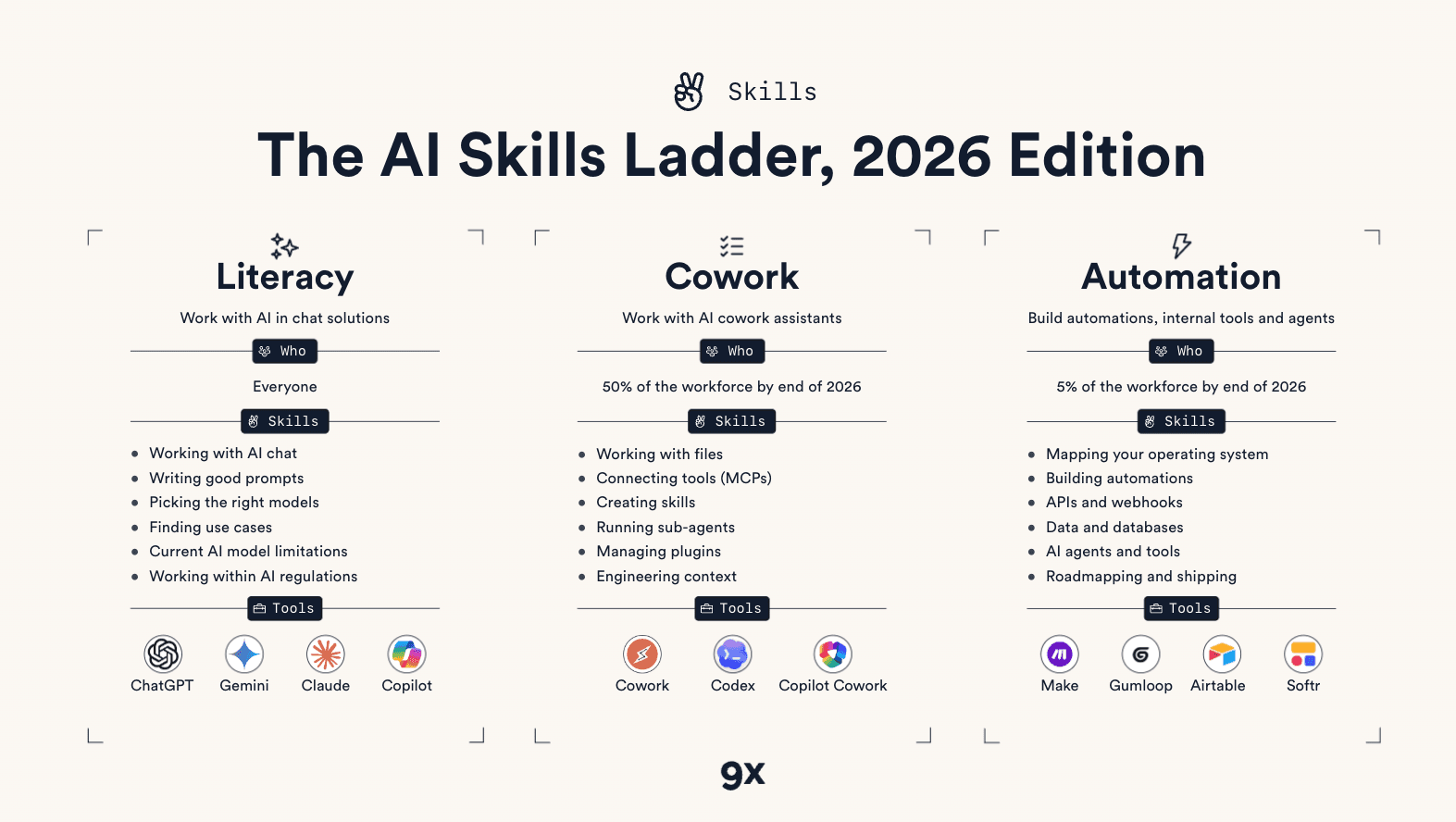
The three tiers of AI skills are:
Tier 1: AI Literacy — the baseline
Tier 2: AI Cowork — the 2026 unlock
Tier 3: AI Automation — the compounding tier
Each tier requires a different mindset, unlocks a different kind of leverage, and applies to a different share of your workforce. Skipping a tier doesn't work: you can't build agents if your team can't write a decent prompt, and you can't get value out of a work assistant if you've never used AI chat seriously.
Tier 1: AI Literacy
This is the baseline. Everyone in your organization should reach this tier.
AI literacy is about being fluent with AI chat - ChatGPT, Gemini, Claude, Copilot. Not as a novelty, but as part of how work gets done every day.
Skills:
Writing good prompts
Picking the right models
Finding use cases in your day-to-day
Understanding current AI model limitations
Working within AI regulations
The bar moved here in 2024. If your team isn't fluent yet, you're already behind. This is no longer the frontier — it's the floor.
Signs your team has reached this tier
Most employees have a paid AI chat account they actually use
People share prompts and use cases across teams
Teams know which model to pick for which task
Leadership has set clear guidelines on what data can go into which tools
New hires are onboarded with AI tooling from day one
Tier 2: AI Cowork
This is the big 2026 unlock — and the tier most companies are sleeping on.
AI Cowork refers to working with an AI assistant - Claude Cowork, Codex, Copilot Cowork - with access to your files, your tools, and a job to do. Instead of copying and pasting context into a chat, you bring the assistant into your environment and let it work alongside you.
This tier is slower to adopt because the mindset shift is real. Even people used to working with AI chat solutions need to learn to set up an environment, hand over context, check AI outputs and trust an assistant to operate inside their tools. It feels foreign at first, then it feels obvious.
Skills:
Working with files
Managing plugins and connectors
Engineering context
Working with and creating sub-agents
The leverage is too significant to leave to a small group. Aim for 50% of your workforce to reach this tier by the end of 2026.
Signs your team has reached this tier
People in non-technical roles run AI assistants connected to their files and tools
Teams build and share their own skills and workflows
MCPs and plugins are part of the regular tooling conversation
Sub-agents are used to handle parallel work, not just single prompts
Context engineering is a common topic, not a niche one
Work that used to take a full day is wrapped up in an hour
Tier 3: AI Automation
This is the compounding tier.
AI Automation is about building automations, internal tools, and agents — systems that run without anyone watching. APIs, webhooks, data pipelines, AI in the loop. The work isn't "use AI to do this task faster." It's "design a system where this task no longer needs a human in the loop."
Skills:
Mapping your operating system
Building automations
APIs and webhooks
Data and databases
AI agents and tools
Roadmapping and shipping
This tier produces compounding returns: every automation built keeps running, frees up capacity, and unlocks the next one. But it also requires a different kind of operator — one who can think in systems, not just tasks.
Aim for 5% of your workforce to reach this tier by the end of 2026. You don't need many of these people. You need the right ones, with real ownership and the mandate to ship.
Signs your team has reached this tier
A dedicated AI automation squad ships internal tools and agents
Operators map their own processes before automating them
APIs, webhooks, and databases are part of the operator's toolkit
Agents run in production with proper monitoring and guardrails
Automation backlog is managed like a product roadmap
Headcount needs are reassessed as automations come online
The Bridge Between Literacy and Automation
The most interesting trend we're seeing right now: AI Cowork is bridging the gap between literacy and automation.
Claude Cowork and Claude Code in particular have started a wave of people getting "Claude pilled" - operators who discovered Cowork, and are now graduating to building their own automations and internal tools. People who would never have called themselves "technical" two years ago are now shipping agents.
This matters strategically.
Tier 2 is not a simple productivity boost, it's the talent pipeline for Tier 3. Investing in AI Cowork adoption today is the surest way to build your AI Automation capacity tomorrow.
Where Is Your Team Today?
Take a moment to map your organization across the three tiers:
What share of your team is fluent at Tier 1? Is the floor really set?
How many people have actually moved into Tier 2? Or are they still copying and pasting into a chat?
Who are your Tier 3 operators? Do they exist yet, and do they have the mandate to ship?
If you'd like help mapping where your team stands today and building the path forward, book a call with us. We'll walk through it together.
FREE LIVE SESSIONS
What’s the best way to learn AI?
With 9x Live! Join a free session and learn the skills that’ll get you ahead of the 99%.
What to do next
1
Start learning free
Take our AI starter course and apply the latest technologies to your first use case. Completely free. Get started today.
2
Learn it live
Join a free weekly 9x Live session, watch work get automated in real time, and get your questions answered by leading educators. Sign up for the next session.
3
Watch our videos on YouTube
With one of the fastest growing channels in the industry, hundreds of thousands of people watch our tutorials every week. Subscribe here so you never miss a video.

Training
In January, AI skills roughly fell under two tiers. Now there are clearly three, with different mindsets, different leverage, and a different share of your workforce that should reach each one.
We see it every week in the conversations we have with operators: the gap between teams that have only deployed AI chat and teams that are now starting to build automations is widening fast. In between, a new tier has emerged that didn't really exist a year ago.
This is how we currently think about it.
Three Tiers, Three Mindsets
The three tiers of AI skills are:
Tier 1: AI Literacy — the baseline
Tier 2: AI Cowork — the 2026 unlock
Tier 3: AI Automation — the compounding tier
Each tier requires a different mindset, unlocks a different kind of leverage, and applies to a different share of your workforce. Skipping a tier doesn't work: you can't build agents if your team can't write a decent prompt, and you can't get value out of a work assistant if you've never used AI chat seriously.
Tier 1: AI Literacy
This is the baseline. Everyone in your organization should reach this tier.
AI literacy is about being fluent with AI chat - ChatGPT, Gemini, Claude, Copilot. Not as a novelty, but as part of how work gets done every day.
Skills:
Writing good prompts
Picking the right models
Finding use cases in your day-to-day
Understanding current AI model limitations
Working within AI regulations
The bar moved here in 2024. If your team isn't fluent yet, you're already behind. This is no longer the frontier — it's the floor.
Signs your team has reached this tier
Most employees have a paid AI chat account they actually use
People share prompts and use cases across teams
Teams know which model to pick for which task
Leadership has set clear guidelines on what data can go into which tools
New hires are onboarded with AI tooling from day one
Tier 2: AI Cowork
This is the big 2026 unlock — and the tier most companies are sleeping on.
AI Cowork refers to working with an AI assistant - Claude Cowork, Codex, Copilot Cowork - with access to your files, your tools, and a job to do. Instead of copying and pasting context into a chat, you bring the assistant into your environment and let it work alongside you.
This tier is slower to adopt because the mindset shift is real. Even people used to working with AI chat solutions need to learn to set up an environment, hand over context, check AI outputs and trust an assistant to operate inside their tools. It feels foreign at first, then it feels obvious.
Skills:
Working with files
Managing plugins and connectors
Engineering context
Working with and creating sub-agents
The leverage is too significant to leave to a small group. Aim for 50% of your workforce to reach this tier by the end of 2026.
Signs your team has reached this tier
People in non-technical roles run AI assistants connected to their files and tools
Teams build and share their own skills and workflows
MCPs and plugins are part of the regular tooling conversation
Sub-agents are used to handle parallel work, not just single prompts
Context engineering is a common topic, not a niche one
Work that used to take a full day is wrapped up in an hour
Tier 3: AI Automation
This is the compounding tier.
AI Automation is about building automations, internal tools, and agents — systems that run without anyone watching. APIs, webhooks, data pipelines, AI in the loop. The work isn't "use AI to do this task faster." It's "design a system where this task no longer needs a human in the loop."
Skills:
Mapping your operating system
Building automations
APIs and webhooks
Data and databases
AI agents and tools
Roadmapping and shipping
This tier produces compounding returns: every automation built keeps running, frees up capacity, and unlocks the next one. But it also requires a different kind of operator — one who can think in systems, not just tasks.
Aim for 5% of your workforce to reach this tier by the end of 2026. You don't need many of these people. You need the right ones, with real ownership and the mandate to ship.
Signs your team has reached this tier
A dedicated AI automation squad ships internal tools and agents
Operators map their own processes before automating them
APIs, webhooks, and databases are part of the operator's toolkit
Agents run in production with proper monitoring and guardrails
Automation backlog is managed like a product roadmap
Headcount needs are reassessed as automations come online
The Bridge Between Literacy and Automation
The most interesting trend we're seeing right now: AI Cowork is bridging the gap between literacy and automation.
Claude Cowork and Claude Code in particular have started a wave of people getting "Claude pilled" - operators who discovered Cowork, and are now graduating to building their own automations and internal tools. People who would never have called themselves "technical" two years ago are now shipping agents.
This matters strategically.
Tier 2 is not a simple productivity boost, it's the talent pipeline for Tier 3. Investing in AI Cowork adoption today is the surest way to build your AI Automation capacity tomorrow.
Where Is Your Team Today?
Take a moment to map your organization across the three tiers:
What share of your team is fluent at Tier 1? Is the floor really set?
How many people have actually moved into Tier 2? Or are they still copying and pasting into a chat?
Who are your Tier 3 operators? Do they exist yet, and do they have the mandate to ship?
If you'd like help mapping where your team stands today and building the path forward, book a call with us. We'll walk through it together.
FREE LIVE SESSIONS
What’s the best way to learn AI?
With 9x Live! Join a free session and learn the skills that’ll get you ahead of the 99%.
What to do next
1
Start learning free
Take our AI starter course and apply the latest technologies to your first use case. Completely free. Get started today.
2
Learn it live
Join a free weekly 9x Live session, watch work get automated in real time, and get your questions answered by leading educators. Sign up for the next session.
3
Watch our videos on YouTube
With one of the fastest growing channels in the industry, hundreds of thousands of people watch our tutorials every week. Subscribe here so you never miss a video.
Training
read next
Running AI Enablement Internally? Here are Three Things to Consider
AI enablement looks like a training project. It isn't. Skill levels, tools and functions all move at once. Here's what running it internally really takes.

What is Claude Slides, and How to Use Them (Guide for Beginners)
How to use Claude Slides to build an on-brand deck from a one-line brief, edit and export it, and where it beats PowerPoint and Google Slides, and where it doesn't.
read next
Running AI Enablement Internally? Here are Three Things to Consider
AI enablement looks like a training project. It isn't. Skill levels, tools and functions all move at once. Here's what running it internally really takes.
What is Claude Slides, and How to Use Them (Guide for Beginners)
How to use Claude Slides to build an on-brand deck from a one-line brief, edit and export it, and where it beats PowerPoint and Google Slides, and where it doesn't.
Your new home for learning AI.
Weekly live workshops, on-demand courses, and plug-and-play downloadables. Get started for free today.
Your new home for learning AI.
Weekly live workshops, on-demand courses, and plug-and-play downloadables. Get started for free today.
Your new home for learning AI.
Weekly live workshops, on-demand courses, and plug-and-play downloadables. Get started for free today.