How to Use Claude Projects: A Practical Guide

By
Jan Meinecke
・
・
8
Min
Read

How to Use Claude Projects: A Practical Guide
By
jan Meinecke
8
Min
Read
If you keep pasting the same background into Claude at the start of every chat, your brand guidelines, your product details, the way you want things written, a Project is the fix. A Claude Project is a workspace that holds all of that once, so every conversation inside it already has the context. You set it up in a few minutes, and from then on you brief Claude on the task, not the backstory.
This is the practical guide to how to use Claude Projects: What they are, how to create one, what to load into it, and how to write the instructions that make it genuinely useful. By the end you'll have a workspace you can hand real work to.
What a Claude Project is
A Project is a self-contained workspace inside Claude. Anthropic describes Projects as letting you "create self-contained workspaces with their own chat histories and knowledge bases." Two things live in each one: A knowledge base, where you put the documents and context Claude should always have, and a set of custom instructions that tell Claude how to behave in that workspace.
The value is standing context. A normal chat starts blank, so you supply the background every time. A Project carries the background for you, so every conversation in it already knows your material and your rules. It's the same instinct behind a CLAUDE.md file for developers, or Claude's memory across chats: Give Claude the context once, and stop re-explaining. A Project is that idea in a tidy, shareable box.
One thing to hold in mind from the start: Chats inside a Project don't automatically share their content with each other. As Anthropic puts it, "context is not shared across chats within a project unless the information is added into the project knowledge base." So the knowledge base, not one particular chat, is the shared brain of the Project.
How to create a Claude Project
Setting one up takes a couple of minutes. Go to claude.ai/projects, or hover over your account and click Projects, then choose New Project. Give it a name and a short description, so it's clear what the workspace is for. On Team and Enterprise plans you'll also pick whether it's private to you or visible to your organisation.
That's the whole setup. What turns an empty Project into a useful one is the next two steps: Loading its knowledge and writing its instructions. Both are worth doing properly, because they're what every chat in the Project inherits.
Adding project knowledge
The knowledge base is where you put the material Claude should always have to hand. Click the button to add to the project knowledge, on the right of the project page, and upload your documents, text or other files. From then on Claude uses that content as context across every chat in the Project, without you attaching anything again.
What goes in depends on the job. A content Project might hold your brand guidelines, tone-of-voice notes and a few strong past examples. A support Project might hold your product documentation and FAQ. A sales Project might hold your pitch, your pricing and your objection-handling notes. The test is simple: If it's context you'd otherwise paste in or re-explain, it belongs in the knowledge base.
There's a capacity point worth knowing on paid plans. When your project knowledge gets close to the context window limit, Claude automatically switches on RAG mode, which Anthropic says can "expand capacity by up to 10x while maintaining response quality." In plain terms, a paid Project can hold a lot of reference material and still stay sharp, because Claude pulls the relevant parts in as needed rather than carrying all of it at once. That just-in-time approach is a core idea in context engineering, and here you get it automatically.
Writing project instructions
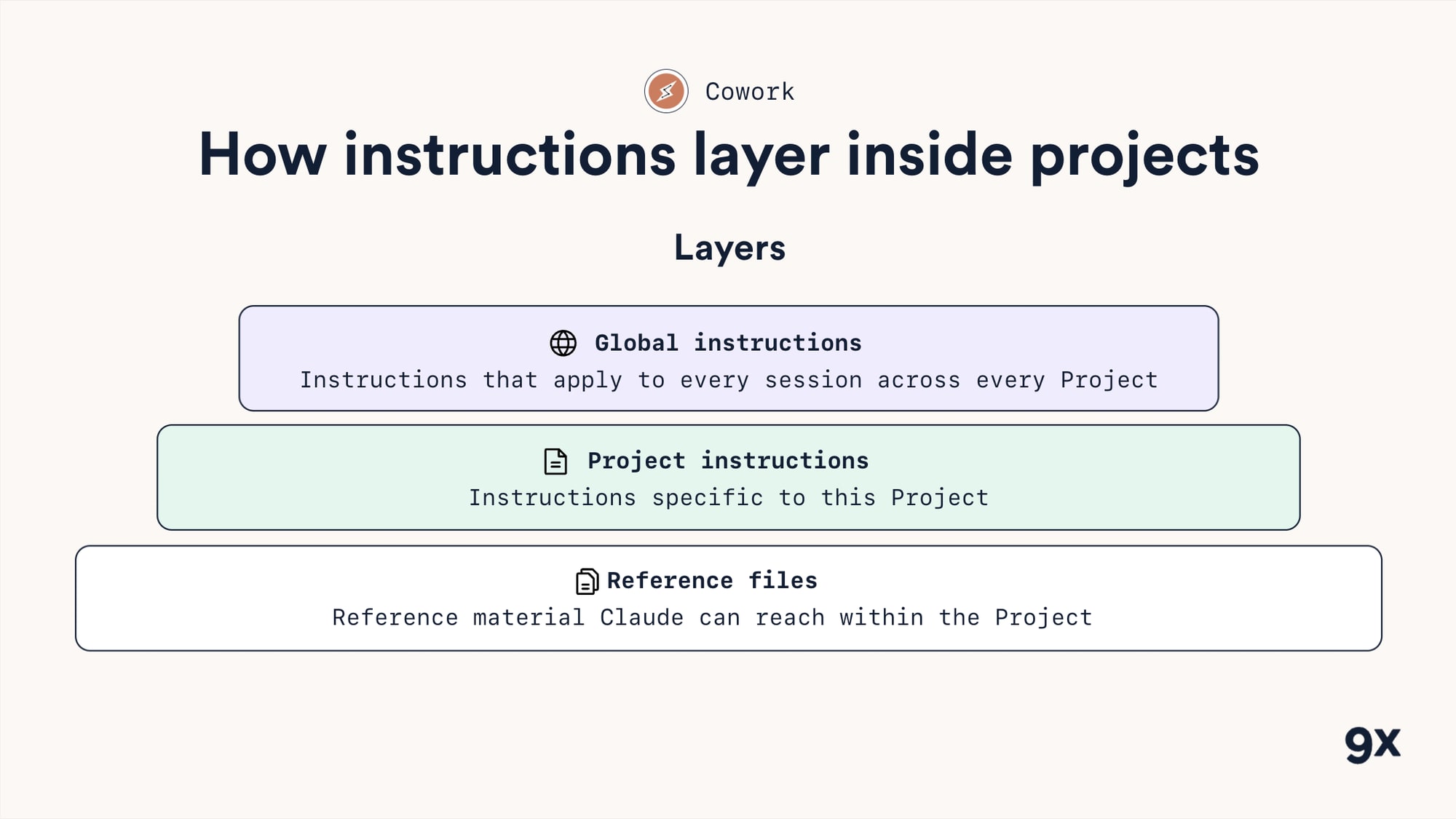
Knowledge is what Claude knows; instructions are how it behaves. Click Set project instructions, add your guidance, and save. These apply to every chat in the Project, so it's where you set the standing rules: The voice to write in, the format to return, the things to always do and always avoid.
Good instructions are specific. "Write in a warm, plain style, British spelling, no jargon, and always end with a clear next step" gives Claude something to act on. "Be professional" doesn't. Treat this like briefing a capable new hire: The clearer the standing brief, the less you correct later. If you find yourself giving the same steer in chat after chat, that steer belongs in the instructions.
Knowledge and instructions work as a pair. The knowledge base gives Claude your material; the instructions tell it what to do with it. Get both right and a chat in the Project needs only the task itself, everything else is already in place.
Who gets Projects, and sharing them
Projects are available across plans, with a couple of limits worth knowing. On the free plan you can create up to five Projects. On paid plans, Pro, Max, Team and Enterprise, you get the advanced knowledge handling (that RAG capacity above) and no five-Project cap.
Sharing is where teams get the most from them. On Team and Enterprise plans you can share a Project: Open it, choose Share project, and add people by name, email or a pasted list, setting each to either view-only or full edit access. That turns a Project into shared infrastructure, one workspace where everyone's Claude works from the same approved knowledge and the same instructions, rather than each person briefing their own from scratch. For pulling in live data alongside those static files, connectors let a Project reach your other tools.
How to actually use a Project well
The Projects that earn their keep are built around a recurring job, not a one-off. If you do the same kind of work often, drafting in a house style, answering questions from a fixed body of documentation, preparing the same kind of brief, that's a Project. A thing you'll do once isn't; a normal chat is fine for that.
Start small and let it grow. Create the Project, load the handful of documents that matter most, write a short set of instructions, and use it. When you notice Claude missing context, add the document that would have helped. When you catch yourself giving the same correction, move it into the instructions. A Project gets better the way a good CLAUDE.md does, by pruning and adding as you go, not by being perfect on day one.
And keep the knowledge base tidy. Out-of-date material in there quietly steers Claude wrong, so clear out the old version when you add the new one. A lean, current Project beats a bloated one every time, for the same reason a short instruction file beats a long one.
Projects are one piece of setting Claude up to do real work for you, alongside memory, connectors and the rest. Getting that whole setup right, so you delegate instead of re-brief, is exactly what we teach. Claude Cowork for Growth is our five-week live cohort for people in Growth, Marketing, Sales and RevOps who want to be the one on their team who actually makes AI work, not just talks about it. It's practical rather than theoretical: You leave with a real workflow you've built and configured properly, plus an Open Badge to show for it. If that's the year you're trying to have, reserve your seat.
Common questions
What is a Claude Project? It's a self-contained workspace in Claude with its own knowledge base and custom instructions. Every chat inside it shares that context, so Claude always has your documents and follows your rules without you re-supplying them each time.
How do I create a Claude Project? Go to claude.ai/projects or click Projects under your account, choose New Project, and give it a name and description. Then add your documents to the project knowledge and set the project instructions. Those two steps are what make the workspace useful.
What should I put in project knowledge? The reference material Claude should always have: Brand or style guides, product documentation, pricing, strong past examples, anything you'd otherwise paste in or re-explain. On paid plans a Project can hold a lot of it, because Claude pulls in the relevant parts as needed.
How many Claude Projects can I have? Free-plan users can create up to five Projects. Paid plans, Pro, Max, Team and Enterprise, remove that cap and add the advanced knowledge handling that expands how much reference material a Project can use.
Can I share a Claude Project with my team? Yes, on Team and Enterprise plans. Open the Project, choose Share project, and add people by name, email or a pasted list, giving each either view-only or edit access so the whole team works from the same knowledge and instructions.
FREE LIVE SESSIONS
What’s the best way to learn AI?
With 9x Live! Join a free session and learn the skills that’ll get you ahead of the 99%.
What to do next
1
Start learning free
Take our AI starter course and apply the latest technologies to your first use case. Completely free. Get started today.
2
Learn it live
Join a free weekly 9x Live session, watch work get automated in real time, and get your questions answered by leading educators. Sign up for the next session.
3
Watch our videos on YouTube
With one of the fastest growing channels in the industry, hundreds of thousands of people watch our tutorials every week. Subscribe here so you never miss a video.

Claude
If you keep pasting the same background into Claude at the start of every chat, your brand guidelines, your product details, the way you want things written, a Project is the fix. A Claude Project is a workspace that holds all of that once, so every conversation inside it already has the context. You set it up in a few minutes, and from then on you brief Claude on the task, not the backstory.
This is the practical guide to how to use Claude Projects: What they are, how to create one, what to load into it, and how to write the instructions that make it genuinely useful. By the end you'll have a workspace you can hand real work to.
What a Claude Project is
A Project is a self-contained workspace inside Claude. Anthropic describes Projects as letting you "create self-contained workspaces with their own chat histories and knowledge bases." Two things live in each one: A knowledge base, where you put the documents and context Claude should always have, and a set of custom instructions that tell Claude how to behave in that workspace.
The value is standing context. A normal chat starts blank, so you supply the background every time. A Project carries the background for you, so every conversation in it already knows your material and your rules. It's the same instinct behind a CLAUDE.md file for developers, or Claude's memory across chats: Give Claude the context once, and stop re-explaining. A Project is that idea in a tidy, shareable box.
One thing to hold in mind from the start: Chats inside a Project don't automatically share their content with each other. As Anthropic puts it, "context is not shared across chats within a project unless the information is added into the project knowledge base." So the knowledge base, not one particular chat, is the shared brain of the Project.
How to create a Claude Project
Setting one up takes a couple of minutes. Go to claude.ai/projects, or hover over your account and click Projects, then choose New Project. Give it a name and a short description, so it's clear what the workspace is for. On Team and Enterprise plans you'll also pick whether it's private to you or visible to your organisation.
That's the whole setup. What turns an empty Project into a useful one is the next two steps: Loading its knowledge and writing its instructions. Both are worth doing properly, because they're what every chat in the Project inherits.
Adding project knowledge
The knowledge base is where you put the material Claude should always have to hand. Click the button to add to the project knowledge, on the right of the project page, and upload your documents, text or other files. From then on Claude uses that content as context across every chat in the Project, without you attaching anything again.
What goes in depends on the job. A content Project might hold your brand guidelines, tone-of-voice notes and a few strong past examples. A support Project might hold your product documentation and FAQ. A sales Project might hold your pitch, your pricing and your objection-handling notes. The test is simple: If it's context you'd otherwise paste in or re-explain, it belongs in the knowledge base.
There's a capacity point worth knowing on paid plans. When your project knowledge gets close to the context window limit, Claude automatically switches on RAG mode, which Anthropic says can "expand capacity by up to 10x while maintaining response quality." In plain terms, a paid Project can hold a lot of reference material and still stay sharp, because Claude pulls the relevant parts in as needed rather than carrying all of it at once. That just-in-time approach is a core idea in context engineering, and here you get it automatically.
Writing project instructions
Knowledge is what Claude knows; instructions are how it behaves. Click Set project instructions, add your guidance, and save. These apply to every chat in the Project, so it's where you set the standing rules: The voice to write in, the format to return, the things to always do and always avoid.
Good instructions are specific. "Write in a warm, plain style, British spelling, no jargon, and always end with a clear next step" gives Claude something to act on. "Be professional" doesn't. Treat this like briefing a capable new hire: The clearer the standing brief, the less you correct later. If you find yourself giving the same steer in chat after chat, that steer belongs in the instructions.
Knowledge and instructions work as a pair. The knowledge base gives Claude your material; the instructions tell it what to do with it. Get both right and a chat in the Project needs only the task itself, everything else is already in place.
Who gets Projects, and sharing them
Projects are available across plans, with a couple of limits worth knowing. On the free plan you can create up to five Projects. On paid plans, Pro, Max, Team and Enterprise, you get the advanced knowledge handling (that RAG capacity above) and no five-Project cap.
Sharing is where teams get the most from them. On Team and Enterprise plans you can share a Project: Open it, choose Share project, and add people by name, email or a pasted list, setting each to either view-only or full edit access. That turns a Project into shared infrastructure, one workspace where everyone's Claude works from the same approved knowledge and the same instructions, rather than each person briefing their own from scratch. For pulling in live data alongside those static files, connectors let a Project reach your other tools.
How to actually use a Project well
The Projects that earn their keep are built around a recurring job, not a one-off. If you do the same kind of work often, drafting in a house style, answering questions from a fixed body of documentation, preparing the same kind of brief, that's a Project. A thing you'll do once isn't; a normal chat is fine for that.
Start small and let it grow. Create the Project, load the handful of documents that matter most, write a short set of instructions, and use it. When you notice Claude missing context, add the document that would have helped. When you catch yourself giving the same correction, move it into the instructions. A Project gets better the way a good CLAUDE.md does, by pruning and adding as you go, not by being perfect on day one.
And keep the knowledge base tidy. Out-of-date material in there quietly steers Claude wrong, so clear out the old version when you add the new one. A lean, current Project beats a bloated one every time, for the same reason a short instruction file beats a long one.
Projects are one piece of setting Claude up to do real work for you, alongside memory, connectors and the rest. Getting that whole setup right, so you delegate instead of re-brief, is exactly what we teach. Claude Cowork for Growth is our five-week live cohort for people in Growth, Marketing, Sales and RevOps who want to be the one on their team who actually makes AI work, not just talks about it. It's practical rather than theoretical: You leave with a real workflow you've built and configured properly, plus an Open Badge to show for it. If that's the year you're trying to have, reserve your seat.
Common questions
What is a Claude Project? It's a self-contained workspace in Claude with its own knowledge base and custom instructions. Every chat inside it shares that context, so Claude always has your documents and follows your rules without you re-supplying them each time.
How do I create a Claude Project? Go to claude.ai/projects or click Projects under your account, choose New Project, and give it a name and description. Then add your documents to the project knowledge and set the project instructions. Those two steps are what make the workspace useful.
What should I put in project knowledge? The reference material Claude should always have: Brand or style guides, product documentation, pricing, strong past examples, anything you'd otherwise paste in or re-explain. On paid plans a Project can hold a lot of it, because Claude pulls in the relevant parts as needed.
How many Claude Projects can I have? Free-plan users can create up to five Projects. Paid plans, Pro, Max, Team and Enterprise, remove that cap and add the advanced knowledge handling that expands how much reference material a Project can use.
Can I share a Claude Project with my team? Yes, on Team and Enterprise plans. Open the Project, choose Share project, and add people by name, email or a pasted list, giving each either view-only or edit access so the whole team works from the same knowledge and instructions.
FREE LIVE SESSIONS
What’s the best way to learn AI?
With 9x Live! Join a free session and learn the skills that’ll get you ahead of the 99%.
What to do next
1
Start learning free
Take our AI starter course and apply the latest technologies to your first use case. Completely free. Get started today.
2
Learn it live
Join a free weekly 9x Live session, watch work get automated in real time, and get your questions answered by leading educators. Sign up for the next session.
3
Watch our videos on YouTube
With one of the fastest growing channels in the industry, hundreds of thousands of people watch our tutorials every week. Subscribe here so you never miss a video.
Claude
read next

8 ChatGPT Browser Use Cases That Save Me Hours Every Week
8 ChatGPT browser use cases I run every week, from turning a website into a spreadsheet to auditing a competitor's funnel, with the setup and prompts for each.

The 8 AI Skills That Will Separate Winners From Losers in 2027
The AI skills to learn in 2027 if you work for a company: five for delegating work to an agent, three for building AI for your team, and the tools for each.
read next
8 ChatGPT Browser Use Cases That Save Me Hours Every Week
8 ChatGPT browser use cases I run every week, from turning a website into a spreadsheet to auditing a competitor's funnel, with the setup and prompts for each.
The 8 AI Skills That Will Separate Winners From Losers in 2027
The AI skills to learn in 2027 if you work for a company: five for delegating work to an agent, three for building AI for your team, and the tools for each.
Your new home for learning AI.
Weekly live workshops, on-demand courses, and plug-and-play downloadables. Get started for free today.
Your new home for learning AI.
Weekly live workshops, on-demand courses, and plug-and-play downloadables. Get started for free today.
Your new home for learning AI.
Weekly live workshops, on-demand courses, and plug-and-play downloadables. Get started for free today.