Context Engineering vs Prompt Engineering, Explained

By
Jan Meinecke
・
・
7
Min
Context Engineering vs Prompt Engineering, Explained
By
jan Meinecke
7
Min
There's a ceiling on how far better prompts will take you, and you hit it the moment you hand Claude real, multi-step work. Past that point, the wording of your opening message matters far less than something most people never think about: Everything else the model can see while it works.
That's what context engineering is, and the gap between it and prompt engineering is the gap between AI that looks impressive in a demo and AI you can actually trust with a job. Here's what each one is, why the second matters more than the first once you move past one-off questions, and what it looks like in practice.
What prompt engineering is
Prompt engineering is the craft you already know. Anthropic defines it as "methods for writing and organizing LLM instructions for optimal outcomes." It's about the message you send: How you phrase the request, how you structure it, what examples you include, what role you ask the model to play.
It's genuinely useful, and for a single turn it's most of the game. If you ask Claude to rewrite an email, the quality of your instruction is the main lever you have. Be specific, show an example of the tone you want, say what to avoid, and you get a better result. None of what follows means prompt engineering stops mattering. It means it stops being the whole story.
What context engineering is
Context engineering is the bigger idea. Anthropic describes it as "the set of strategies for curating and maintaining the optimal set of tokens (information) during LLM inference, including all the other information that may land there outside of the prompts."
Read that last part again, because it's the whole point. Your prompt is one input. But when Claude works on a real task, it's also seeing the files it has read, the outputs of tools it has run, the earlier turns of the conversation, the instructions in your project setup, and the results of every search it made along the way. Context engineering is the work of managing all of that, so the model has what it needs and not a heap of noise it doesn't.
The neat way to hold the distinction in your head: Prompt engineering is writing one good instruction. Context engineering is managing everything the model sees across a whole task, turn after turn, as the work unfolds.
Why it matters more than wording once the work gets real
Here's the part that changes how you work with AI. A model doesn't have unlimited attention. Anthropic calls this the "attention budget," and there's a well-documented effect they call "context rot": As the number of tokens in the window grows, the model's accuracy at recalling any particular one goes down. More context isn't better. Past a point, more context is actively worse.
That's why a long, messy session where Claude has read forty files and run a dozen commands can start producing weaker answers than a short, clean one, even though it "knows more." The useful information is buried. The guiding principle Anthropic gives is worth writing on a wall: "Find the smallest possible set of high-signal tokens that maximize the likelihood of some desired outcome."
So the skill isn't stuffing everything in. It's curation. Getting the right information in front of the model at the right moment, and keeping the rest out. That's the thing that separates AI that demos beautifully on a toy example from AI that stays reliable on the twentieth step of real work.
The same task, two ways
Take a real job: A first-draft outreach email to a prospect. Prompt engineering alone is you writing one careful instruction, "Write a warm, concise outreach email to a Head of Growth at a B2B SaaS company, three short paragraphs, no jargon, one clear ask." You'll get a competent, generic email, because a careful instruction is all you gave it.
Context engineering is that same instruction with the right material around it: The prospect's post from last week pulled in through the browser, your last two emails to similar buyers so the voice matches, and your one-line positioning from a project file so the ask lands the way you'd make it. Same model, same core prompt. The second email references something real, sounds like you, and needs a light edit rather than a rewrite. The wording barely changed. What changed is what the model could see, and that's the whole game once the work is real.
What context engineering looks like in practice
The good news is that most of this isn't abstract. If you use Claude for real work, the levers are concrete, and you're probably already pulling some of them without the label.
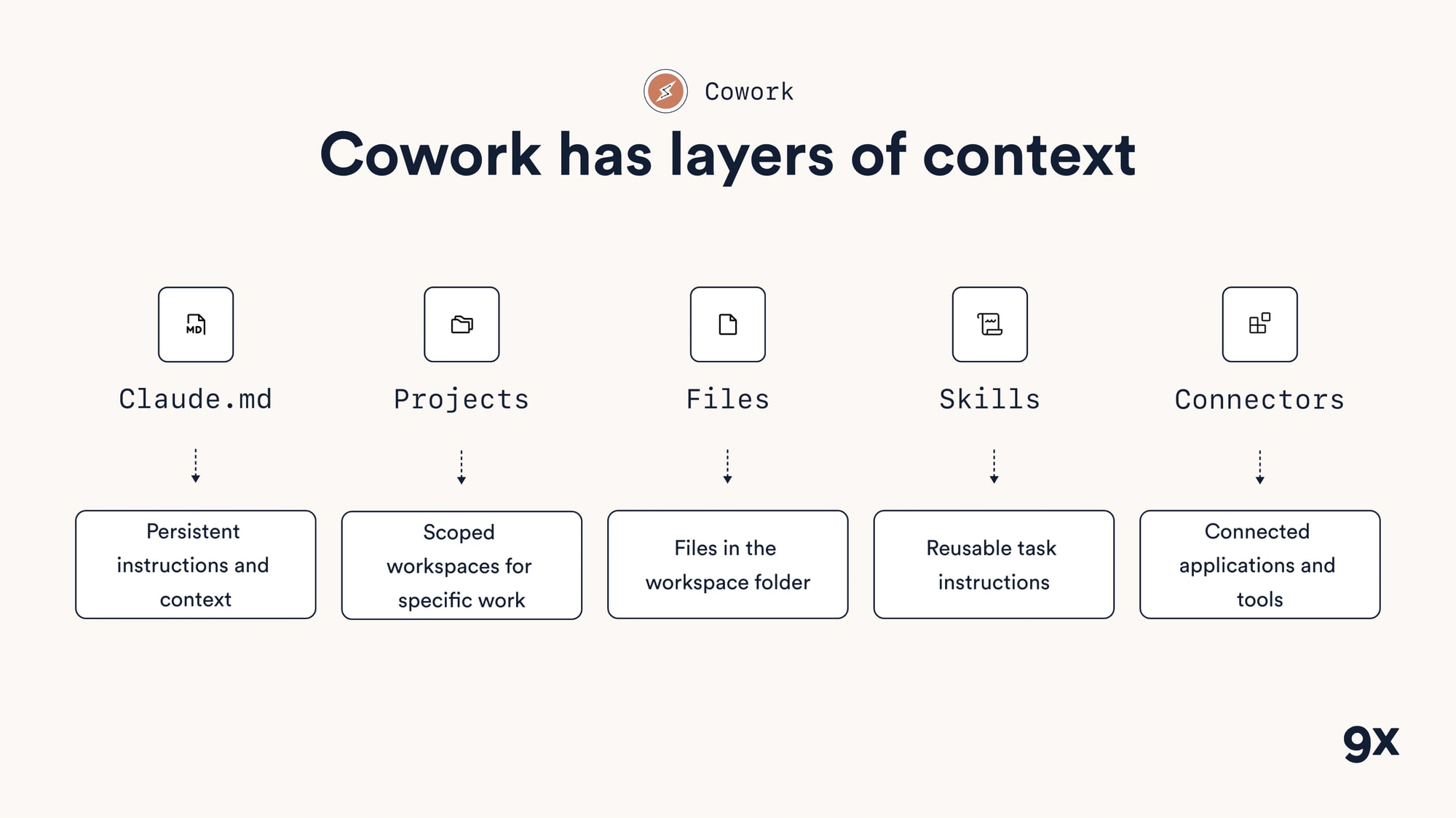
Writing a CLAUDE.md file is context engineering. You're deciding what standing context the model should have in every session, and, just as importantly, keeping it short so the important lines aren't lost in noise.
Connecting your tools is context engineering. When you set up connectors, you're letting Claude pull in exactly the information it needs from your CRM, your docs, your calendar, at the moment it needs it, rather than you pasting it all in up front. Anthropic calls this "just-in-time" retrieval, and it mirrors how people work: We don't memorise the whole filing cabinet, we open the drawer we need.
Using skills is context engineering. A skill loads specialised instructions only when they're relevant, so your everyday sessions aren't carrying knowledge they don't need.
Handing a research job to a sub-agent is context engineering. A sub-agent reads the fifty files in its own separate context and reports back a clean summary, so the messy exploration never clogs your main conversation.
And the plain habits count too. Starting a fresh session for a new task rather than piling it onto an old one. Letting the model summarise and compress a long conversation instead of dragging every word forward. These aren't productivity tips bolted on the side. They're the same principle, applied by hand: Protect the attention budget, keep the signal high.
How to tell your context needs managing
You'll feel this before you can name it. The tell-tale signs are consistent: Claude starts ignoring an instruction it followed happily earlier in the session, its answers drift off the actual question, it repeats work it already did, or the quality quietly drops the deeper into a long thread you go. All four are the same problem, the signal buried under noise. The fix is almost never a cleverer prompt. It's a cleaner context: Start a fresh session, hand it only the files this task needs, and let it summarise the long history rather than re-reading all of it.
The takeaway
Prompt engineering gets you a good answer to a question. Context engineering gets you an AI that can do a job. As the work you hand to AI grows from single questions into real, multi-step tasks, the wording of your opening message matters less and less, and how you manage everything around it matters more and more. That's the shift worth making, and once you see it you can't unsee it.
Learning to do this deliberately is exactly what we teach. Claude Cowork for Growth is our five-week live cohort for people in Growth, Marketing, Sales and RevOps who want to be the one on their team who actually makes AI work, not just talks about it. It's practical rather than theoretical: You leave with a real growth workflow you've set up and configured properly, context and all, plus an Open Badge to show for it. If that's the year you're trying to have, reserve your seat.
Common questions
What's the difference between context engineering and prompt engineering? Prompt engineering is writing one good instruction, the message you send the model. Context engineering is managing everything the model sees across a whole task, including the files it reads, tool outputs, earlier turns and standing instructions. Prompt engineering is most of the game for a single question; context engineering is what makes AI reliable on real, multi-step work.
Is prompt engineering still worth learning? Yes. A well-written instruction is still the main lever for any single request, and context engineering doesn't replace it. The point is that once you move past one-off questions into ongoing work, wording matters less than how you manage the model's context around it.
Why does adding more context sometimes make results worse? Because models have a finite "attention budget." As the amount of information in the window grows, the model's ability to recall any specific part of it drops, an effect known as context rot. Curating a small set of high-signal information beats dumping everything in.
How do I actually do context engineering? With concrete moves you're probably already making: A tight CLAUDE.md, connectors that pull in information just in time, skills that load only when relevant, sub-agents that keep research out of your main thread, and the plain habit of starting clean sessions rather than letting one balloon.
FREE LIVE SESSIONS
What’s the best way to learn AI?
With 9x Live! Join a free session and learn the skills that’ll get you ahead of the 99%.
What to do next
1
Start learning free
Take our AI starter course and apply the latest technologies to your first use case. Completely free. Get started today.
2
Learn it live
Join a free weekly 9x Live session, watch work get automated in real time, and get your questions answered by leading educators. Sign up for the next session.
3
Watch our videos on YouTube
With one of the fastest growing channels in the industry, hundreds of thousands of people watch our tutorials every week. Subscribe here so you never miss a video.

AI
There's a ceiling on how far better prompts will take you, and you hit it the moment you hand Claude real, multi-step work. Past that point, the wording of your opening message matters far less than something most people never think about: Everything else the model can see while it works.
That's what context engineering is, and the gap between it and prompt engineering is the gap between AI that looks impressive in a demo and AI you can actually trust with a job. Here's what each one is, why the second matters more than the first once you move past one-off questions, and what it looks like in practice.
What prompt engineering is
Prompt engineering is the craft you already know. Anthropic defines it as "methods for writing and organizing LLM instructions for optimal outcomes." It's about the message you send: How you phrase the request, how you structure it, what examples you include, what role you ask the model to play.
It's genuinely useful, and for a single turn it's most of the game. If you ask Claude to rewrite an email, the quality of your instruction is the main lever you have. Be specific, show an example of the tone you want, say what to avoid, and you get a better result. None of what follows means prompt engineering stops mattering. It means it stops being the whole story.
What context engineering is
Context engineering is the bigger idea. Anthropic describes it as "the set of strategies for curating and maintaining the optimal set of tokens (information) during LLM inference, including all the other information that may land there outside of the prompts."
Read that last part again, because it's the whole point. Your prompt is one input. But when Claude works on a real task, it's also seeing the files it has read, the outputs of tools it has run, the earlier turns of the conversation, the instructions in your project setup, and the results of every search it made along the way. Context engineering is the work of managing all of that, so the model has what it needs and not a heap of noise it doesn't.
The neat way to hold the distinction in your head: Prompt engineering is writing one good instruction. Context engineering is managing everything the model sees across a whole task, turn after turn, as the work unfolds.
Why it matters more than wording once the work gets real
Here's the part that changes how you work with AI. A model doesn't have unlimited attention. Anthropic calls this the "attention budget," and there's a well-documented effect they call "context rot": As the number of tokens in the window grows, the model's accuracy at recalling any particular one goes down. More context isn't better. Past a point, more context is actively worse.
That's why a long, messy session where Claude has read forty files and run a dozen commands can start producing weaker answers than a short, clean one, even though it "knows more." The useful information is buried. The guiding principle Anthropic gives is worth writing on a wall: "Find the smallest possible set of high-signal tokens that maximize the likelihood of some desired outcome."
So the skill isn't stuffing everything in. It's curation. Getting the right information in front of the model at the right moment, and keeping the rest out. That's the thing that separates AI that demos beautifully on a toy example from AI that stays reliable on the twentieth step of real work.
The same task, two ways
Take a real job: A first-draft outreach email to a prospect. Prompt engineering alone is you writing one careful instruction, "Write a warm, concise outreach email to a Head of Growth at a B2B SaaS company, three short paragraphs, no jargon, one clear ask." You'll get a competent, generic email, because a careful instruction is all you gave it.
Context engineering is that same instruction with the right material around it: The prospect's post from last week pulled in through the browser, your last two emails to similar buyers so the voice matches, and your one-line positioning from a project file so the ask lands the way you'd make it. Same model, same core prompt. The second email references something real, sounds like you, and needs a light edit rather than a rewrite. The wording barely changed. What changed is what the model could see, and that's the whole game once the work is real.
What context engineering looks like in practice
The good news is that most of this isn't abstract. If you use Claude for real work, the levers are concrete, and you're probably already pulling some of them without the label.
Writing a CLAUDE.md file is context engineering. You're deciding what standing context the model should have in every session, and, just as importantly, keeping it short so the important lines aren't lost in noise.
Connecting your tools is context engineering. When you set up connectors, you're letting Claude pull in exactly the information it needs from your CRM, your docs, your calendar, at the moment it needs it, rather than you pasting it all in up front. Anthropic calls this "just-in-time" retrieval, and it mirrors how people work: We don't memorise the whole filing cabinet, we open the drawer we need.
Using skills is context engineering. A skill loads specialised instructions only when they're relevant, so your everyday sessions aren't carrying knowledge they don't need.
Handing a research job to a sub-agent is context engineering. A sub-agent reads the fifty files in its own separate context and reports back a clean summary, so the messy exploration never clogs your main conversation.
And the plain habits count too. Starting a fresh session for a new task rather than piling it onto an old one. Letting the model summarise and compress a long conversation instead of dragging every word forward. These aren't productivity tips bolted on the side. They're the same principle, applied by hand: Protect the attention budget, keep the signal high.
How to tell your context needs managing
You'll feel this before you can name it. The tell-tale signs are consistent: Claude starts ignoring an instruction it followed happily earlier in the session, its answers drift off the actual question, it repeats work it already did, or the quality quietly drops the deeper into a long thread you go. All four are the same problem, the signal buried under noise. The fix is almost never a cleverer prompt. It's a cleaner context: Start a fresh session, hand it only the files this task needs, and let it summarise the long history rather than re-reading all of it.
The takeaway
Prompt engineering gets you a good answer to a question. Context engineering gets you an AI that can do a job. As the work you hand to AI grows from single questions into real, multi-step tasks, the wording of your opening message matters less and less, and how you manage everything around it matters more and more. That's the shift worth making, and once you see it you can't unsee it.
Learning to do this deliberately is exactly what we teach. Claude Cowork for Growth is our five-week live cohort for people in Growth, Marketing, Sales and RevOps who want to be the one on their team who actually makes AI work, not just talks about it. It's practical rather than theoretical: You leave with a real growth workflow you've set up and configured properly, context and all, plus an Open Badge to show for it. If that's the year you're trying to have, reserve your seat.
Common questions
What's the difference between context engineering and prompt engineering? Prompt engineering is writing one good instruction, the message you send the model. Context engineering is managing everything the model sees across a whole task, including the files it reads, tool outputs, earlier turns and standing instructions. Prompt engineering is most of the game for a single question; context engineering is what makes AI reliable on real, multi-step work.
Is prompt engineering still worth learning? Yes. A well-written instruction is still the main lever for any single request, and context engineering doesn't replace it. The point is that once you move past one-off questions into ongoing work, wording matters less than how you manage the model's context around it.
Why does adding more context sometimes make results worse? Because models have a finite "attention budget." As the amount of information in the window grows, the model's ability to recall any specific part of it drops, an effect known as context rot. Curating a small set of high-signal information beats dumping everything in.
How do I actually do context engineering? With concrete moves you're probably already making: A tight CLAUDE.md, connectors that pull in information just in time, skills that load only when relevant, sub-agents that keep research out of your main thread, and the plain habit of starting clean sessions rather than letting one balloon.
FREE LIVE SESSIONS
What’s the best way to learn AI?
With 9x Live! Join a free session and learn the skills that’ll get you ahead of the 99%.
What to do next
1
Start learning free
Take our AI starter course and apply the latest technologies to your first use case. Completely free. Get started today.
2
Learn it live
Join a free weekly 9x Live session, watch work get automated in real time, and get your questions answered by leading educators. Sign up for the next session.
3
Watch our videos on YouTube
With one of the fastest growing channels in the industry, hundreds of thousands of people watch our tutorials every week. Subscribe here so you never miss a video.
AI
read next

8 ChatGPT Browser Use Cases That Save Me Hours Every Week
8 ChatGPT browser use cases I run every week, from turning a website into a spreadsheet to auditing a competitor's funnel, with the setup and prompts for each.

The 8 AI Skills That Will Separate Winners From Losers in 2027
The AI skills to learn in 2027 if you work for a company: five for delegating work to an agent, three for building AI for your team, and the tools for each.
read next
8 ChatGPT Browser Use Cases That Save Me Hours Every Week
8 ChatGPT browser use cases I run every week, from turning a website into a spreadsheet to auditing a competitor's funnel, with the setup and prompts for each.
The 8 AI Skills That Will Separate Winners From Losers in 2027
The AI skills to learn in 2027 if you work for a company: five for delegating work to an agent, three for building AI for your team, and the tools for each.
Your new home for learning AI.
Weekly live workshops, on-demand courses, and plug-and-play downloadables. Get started for free today.
Your new home for learning AI.
Weekly live workshops, on-demand courses, and plug-and-play downloadables. Get started for free today.
Your new home for learning AI.
Weekly live workshops, on-demand courses, and plug-and-play downloadables. Get started for free today.