ChatGPT Work vs Chat: What's the Difference?

By
Jan Meinecke
・
・
12
Min
ChatGPT Work vs Chat: What's the Difference?
By
jan Meinecke
12
Min
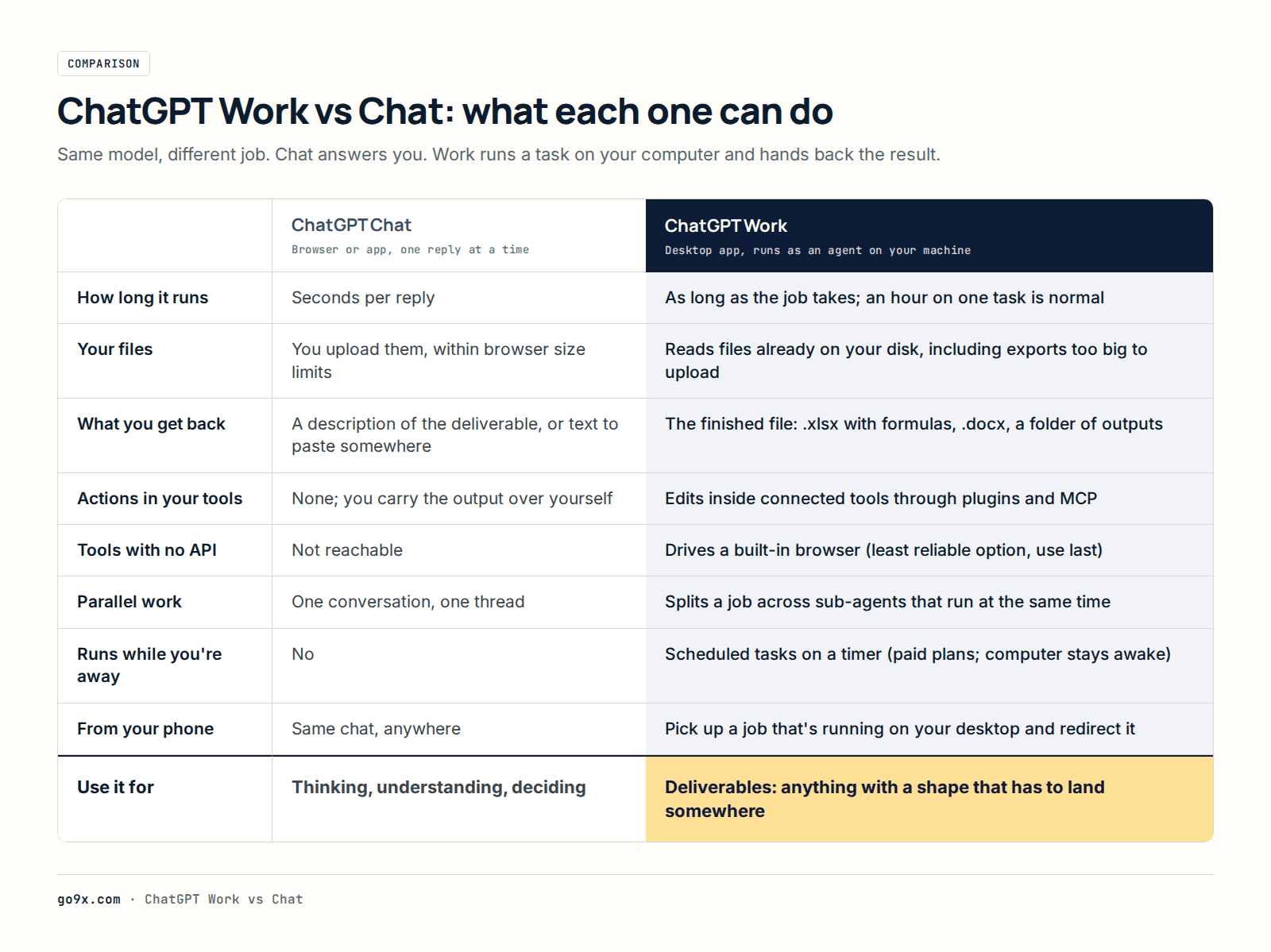
So what's the difference between ChatGPT Work and ChatGPT's standard chat?
This question usually gets answered with vague words like "it's more powerful" or "it's agentic". That's not useful. What you really want to know is what ChatGPT Work can do that the chat can't do. And that's exactly what we're going to cover in this article—by way of eight things ChatGPT Work does that the chat window cannot do at all, whatever prompt you write.
Every one has its origins in work I've actually run, with the timings and failures attached. If you want to see them in action rather than just read about them, check out the video above.
1. Read the files already on your computer
Chat can accept an upload. Work can read your disk.
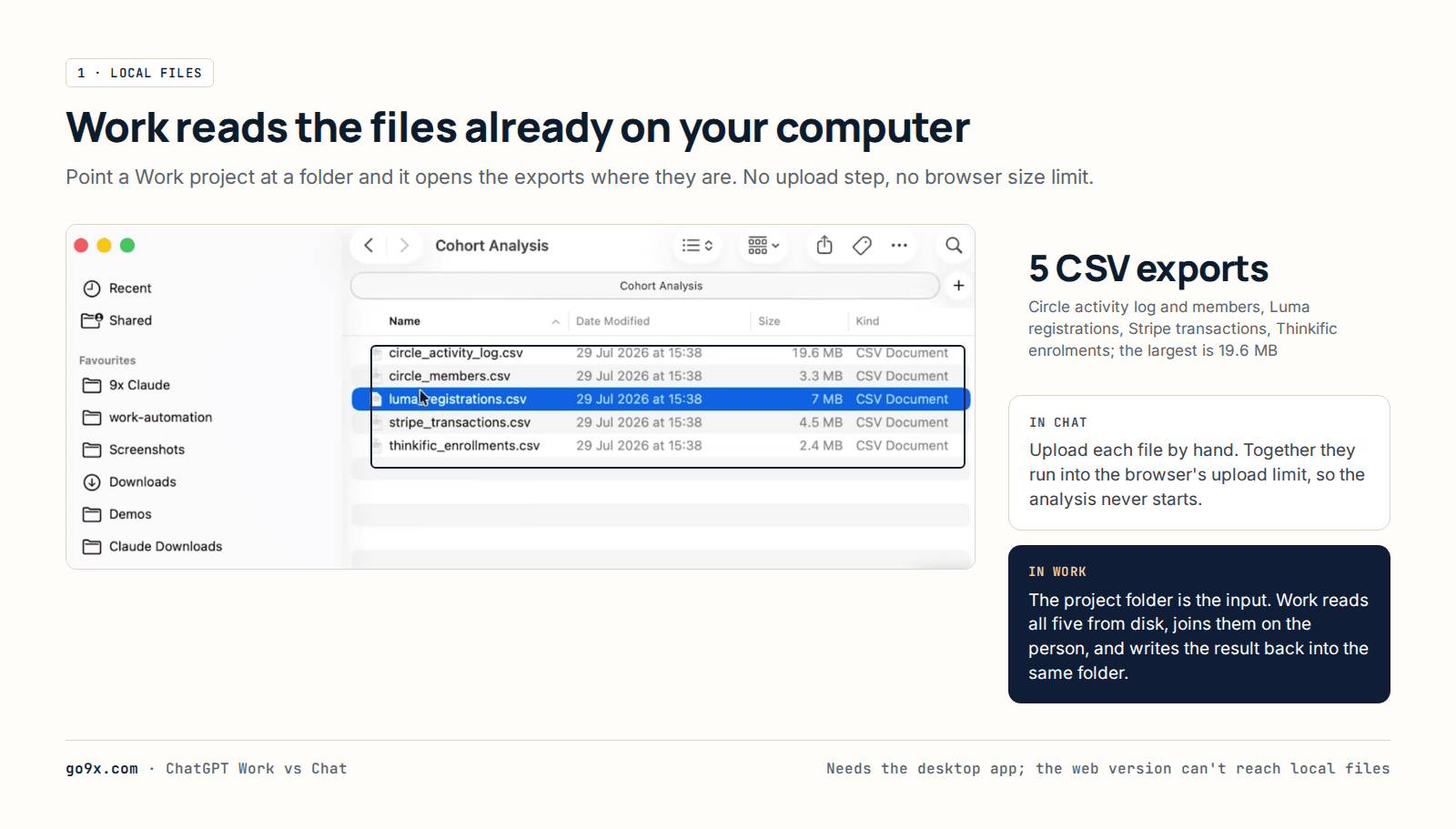
That sounds like a small difference until you hit the ceiling. I put five CSV exports from four systems, roughly 35MB and hundreds of thousands of rows, in front of both. The browser refuses the upload outright: too big, too many rows. The desktop app reads the same files straight off the disk, without uploading them anywhere.
The mechanism is a project. You create one, point it at source folders, and Work can read and write inside them. Claude reaches the same outcome through its own file creation environment, scoped to the folders you connect. A project can hold several folders but only one primary folder, which matters because that is where it looks for persistent instructions.
This is also the capability that decides local versus cloud mode. Anything touching your files has to run on your machine, which means the machine stays awake. Jobs that only use connected apps can run in the cloud on OpenAI's servers and keep going with the laptop shut.
2. Work for an hour on a single task
A chat answers in seconds because that is its job. An agent takes as long as the work takes.
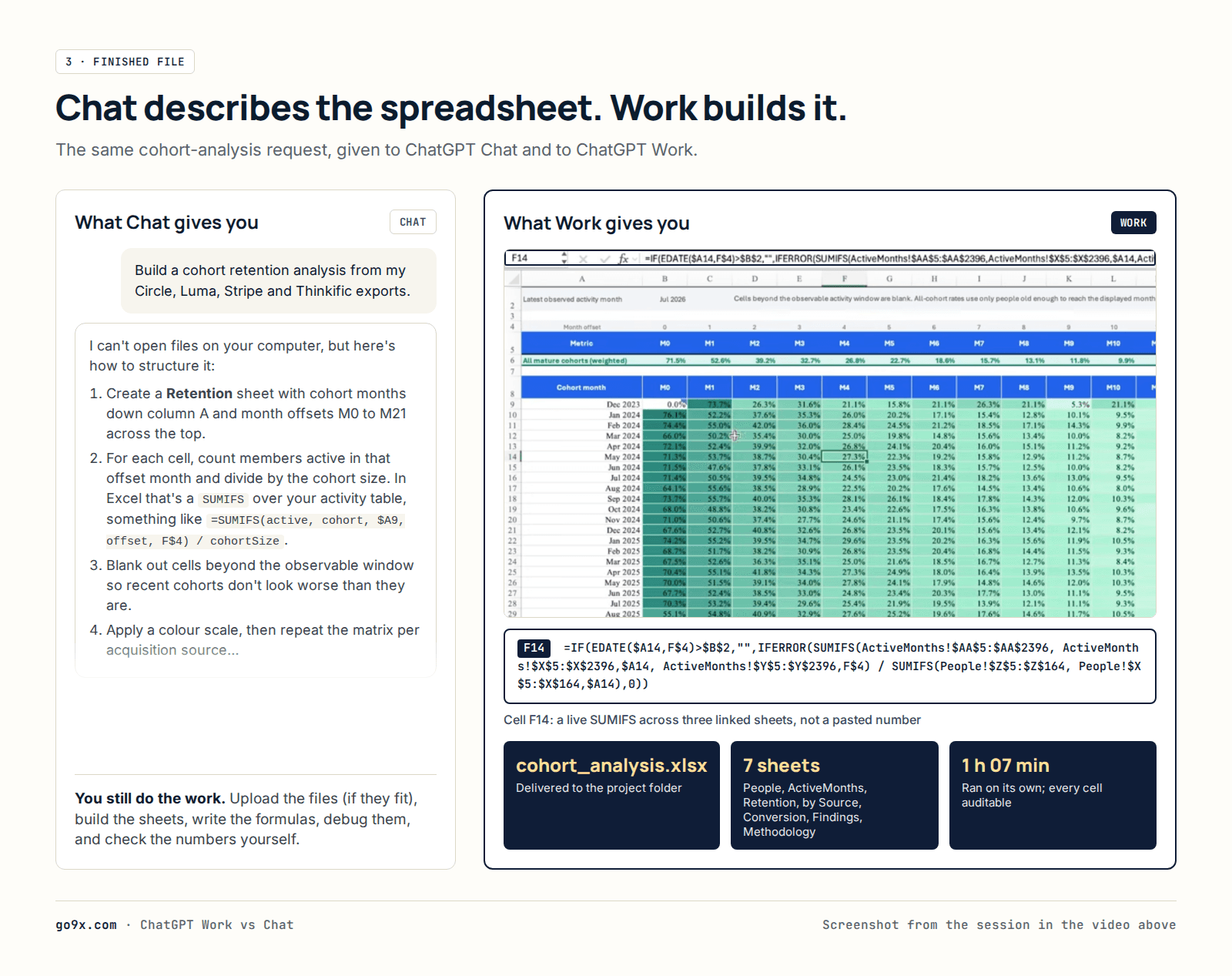
The cohort analysis is the clearest example I have. Five exports, one instruction that mattered, and one constraint: every number must be a formula, no hardcoded values, so the logic can be audited cell by cell. It ran for 1 hour, 7 minutes and 44 seconds.
What came back was a workbook with the raw data tabs, retention by cohort, the same split by acquisition channel, a findings tab with editable charts, and every figure traceable. Not a description of a cohort analysis. The cohort analysis.
Two habits follow from runs this long. Watch the plan when it appears, because stopping it at minute two is cheaper than discovering the wrong approach at minute fifty. And put the verification into the brief itself, the way that formulas-only rule did, so checking the output is possible rather than aspirational.
3. Produce the finished file, not a description of it
This is the difference Claude draws between Chat and Cowork too, and it is the one that changes your week.
Ask chat for a report and you get text you then have to assemble into a report. Ask Work and you get the .xlsx, the .docx, the deck, the folder of images, sitting where you told it to put them.
The receipts job is small but complete. I pointed a project at a folder of receipt images and asked it to extract the details, build an Excel register, then create a "processed receipts" subfolder and sort every image into month subfolders. Six minutes later: one row per expense, a confidence score against each, and a single receipt flagged for review because the printed VAT rate was too faint to read confidently.
It did not guess at the one it could not read. It flagged it. That behaviour is worth more than the six minutes.
4. Take actions inside your tools
Chat can tell you what to change. Work changes it.
The job that proves this is dull and enormous: adding a tracked call to action to more than 130 YouTube descriptions, each needing its own dynamic short link. The rules were conditional. If the description opened with a lead magnet, put the new line underneath. If it had no call to action at all, make it the first line. If it opened with a subscribe line, replace that entirely.
That is hours of clicking, which realistically means it never gets done. It also cannot be handled by a simple automation, because each description needs reading and judging before it can be edited.
Where a tool has no plugin at all, the route in is MCP, an open standard that both OpenAI and Anthropic support. Actions come through plugins, and the naming trips people up. A plugin is an installable package containing two different things: apps, which connect ChatGPT to a tool, much like Claude's connectors; and skills, which teach it a workflow. An app tells it where to work. A skill teaches it how. Before you trust one with write access, open it and read the actions list, because that is where the surprises are.
5. Drive a browser to reach tools with no API
Work has a browser built into the desktop app, and it can use it as a tool rather than showing it to you.
I asked it to visit our blog, download the first 20 feature images and build a CSV pairing each article title with its image. Rather than right-clicking twenty times, it wrote itself a piece of JavaScript and pulled the lot.
The real value is not blog images. It is every tool in your stack with no API, no connector and no export button, where a thing that can log in and click is the only route in. The browser settings even include a password manager, so a dedicated account can be stored for it to use.
One honest caveat: browser work is the least reliable capability here. It handled our own blog without complaint, and struggled badly trying to pull invoices from a logged-in Amazon account. Treat the browser as the last resort, after MCP and after a connector, not the first thing you reach for.
6. Split a job across sub-agents and run them in parallel
A chat is one thread doing one thing. Work can fan a job out.
On a lead-research run it spun up sub-agents by region: one for Berlin and Hamburg, another for Munich, Vienna and Zurich, another for the UK and Ireland, plus one checking results against our existing client list. They researched simultaneously and reported back to the main agent.
The output was 25 companies showing AI-training buying signals, in a little over 20 minutes. Every signal carries the source URL, so each claim can be checked in one click rather than trusted. One company had opened a principal AI transformation role that week, which is exactly the moment to make contact.
Sequentially that is most of an afternoon. In parallel it is a coffee.
7. Run on a schedule while you are not there
Chat runs when you type. Work can run because it is Tuesday.
Scheduled tasks turn a saved skill into something that happens without you: the receipts skill firing every morning, a competitor's release notes checked four times a day and written into a CSV, a weekly report assembled before you open the laptop.
There is a trap here that catches nearly everyone, and it has nothing to do with the tool. Anthropic makes the same point about unattended runs, recommending you start with low-risk tasks and review the output after each one. A scheduled task needs a way to know the work is already done. A job that checks a database each morning for items marked "ready" and acts on them will keep acting on the same items forever, unless something updates their status afterwards. Build the state change into the workflow, not into your memory.
The other constraint is physical. If the task touches local files, your computer has to be awake when the schedule fires. Cloud-only tasks do not care. And scheduled tasks are not on the free plan at all, so check before you design around one.
8. Be picked up from your phone mid-job
The Remote section in the ChatGPT mobile app lists the Work sessions you started at your desk.
I added an instruction to a running description-rewrite job from my phone and watched the laptop pick it up. Because the files live on that machine, it has to stay on, which is the same constraint as everything else in local mode.
This one sounds like a convenience and behaves like a change in habit. Once a job can run for an hour, the natural pattern is to start two or three, walk away, and steer them when they check in.
ChatGPT Work vs chat: where the line falls
This is also roughly where the value sits commercially. McKinsey's 2025 State of AI survey found the highest performers were nearly three times as likely to have redesigned a workflow rather than bolting AI onto the existing one, and the eight capabilities above are what a redesign is actually made of.
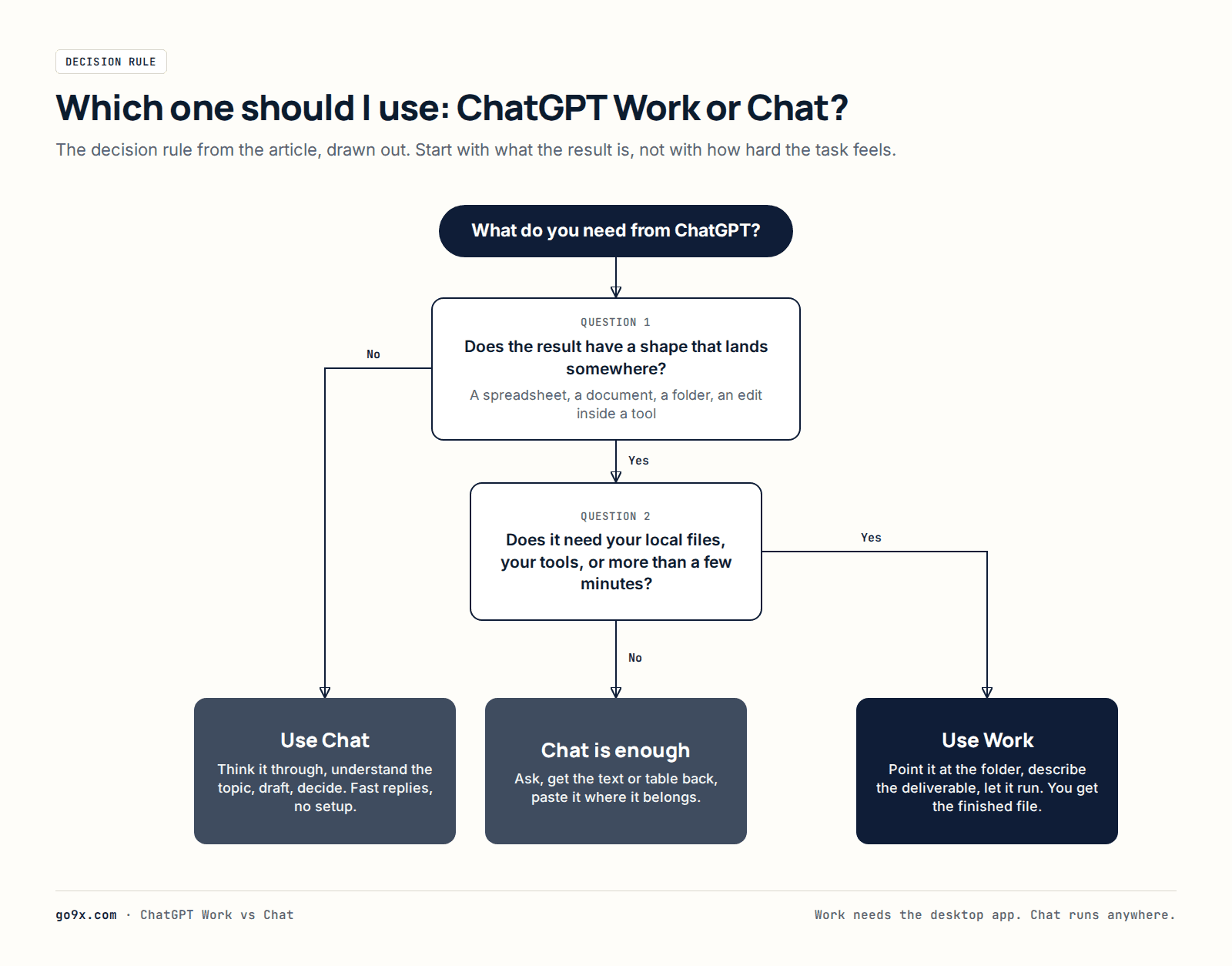
Chat is still the right tool most of the time. Thinking something through, drafting, a quick second opinion, understanding a concept: all faster in a chat window, and using an agent for them is just slower.
The test is whether you can describe the deliverable. If the answer is a thing, with a shape, that lands somewhere, it belongs in Work. If the answer is understanding, it belongs in Chat.
And of course: None of this removes the need to check. Longer runs mean bigger mistakes when they happen, and an agent that has been working for an hour sounds equally confident about work it got wrong. Build the check into the brief, the way that formulas-only rule did, and read the output properly before it goes anywhere.
Common questions
What is the difference between ChatGPT Work and chat? Chat answers questions. Work takes a whole task, uses your files and tools, and returns a finished deliverable. Same underlying models, different job.
Is ChatGPT Work worth it for non-technical roles? That is who it is aimed at. Codex is the version pointed at software. Work is pointed at knowledge work in finance, legal, HR, marketing, sales and operations.
Can ChatGPT Work edit files, or only read them? Both, inside the folders you connect to a project. It will not write outside them without you authorising it.
How long should a task take? Anything from a few minutes to over an hour, depending on the job. If a task is finishing in seconds, it was probably a chat question.
Do I need the desktop app? For anything involving your own files, yes. The web version cannot reach them.
So what's the difference between ChatGPT Work and ChatGPT's standard chat?
This question usually gets answered with vague words like "it's more powerful" or "it's agentic". That's not useful. What you really want to know is what ChatGPT Work can do that the chat can't do. And that's exactly what we're going to cover in this article—by way of eight things ChatGPT Work does that the chat window cannot do at all, whatever prompt you write.
Every one has its origins in work I've actually run, with the timings and failures attached. If you want to see them in action rather than just read about them, check out the video above.
1. Read the files already on your computer
Chat can accept an upload. Work can read your disk.
That sounds like a small difference until you hit the ceiling. I put five CSV exports from four systems, roughly 35MB and hundreds of thousands of rows, in front of both. The browser refuses the upload outright: too big, too many rows. The desktop app reads the same files straight off the disk, without uploading them anywhere.
The mechanism is a project. You create one, point it at source folders, and Work can read and write inside them. Claude reaches the same outcome through its own file creation environment, scoped to the folders you connect. A project can hold several folders but only one primary folder, which matters because that is where it looks for persistent instructions.
This is also the capability that decides local versus cloud mode. Anything touching your files has to run on your machine, which means the machine stays awake. Jobs that only use connected apps can run in the cloud on OpenAI's servers and keep going with the laptop shut.
2. Work for an hour on a single task
A chat answers in seconds because that is its job. An agent takes as long as the work takes.
The cohort analysis is the clearest example I have. Five exports, one instruction that mattered, and one constraint: every number must be a formula, no hardcoded values, so the logic can be audited cell by cell. It ran for 1 hour, 7 minutes and 44 seconds.
What came back was a workbook with the raw data tabs, retention by cohort, the same split by acquisition channel, a findings tab with editable charts, and every figure traceable. Not a description of a cohort analysis. The cohort analysis.
Two habits follow from runs this long. Watch the plan when it appears, because stopping it at minute two is cheaper than discovering the wrong approach at minute fifty. And put the verification into the brief itself, the way that formulas-only rule did, so checking the output is possible rather than aspirational.
3. Produce the finished file, not a description of it
This is the difference Claude draws between Chat and Cowork too, and it is the one that changes your week.
Ask chat for a report and you get text you then have to assemble into a report. Ask Work and you get the .xlsx, the .docx, the deck, the folder of images, sitting where you told it to put them.
The receipts job is small but complete. I pointed a project at a folder of receipt images and asked it to extract the details, build an Excel register, then create a "processed receipts" subfolder and sort every image into month subfolders. Six minutes later: one row per expense, a confidence score against each, and a single receipt flagged for review because the printed VAT rate was too faint to read confidently.
It did not guess at the one it could not read. It flagged it. That behaviour is worth more than the six minutes.
4. Take actions inside your tools
Chat can tell you what to change. Work changes it.
The job that proves this is dull and enormous: adding a tracked call to action to more than 130 YouTube descriptions, each needing its own dynamic short link. The rules were conditional. If the description opened with a lead magnet, put the new line underneath. If it had no call to action at all, make it the first line. If it opened with a subscribe line, replace that entirely.
That is hours of clicking, which realistically means it never gets done. It also cannot be handled by a simple automation, because each description needs reading and judging before it can be edited.
Where a tool has no plugin at all, the route in is MCP, an open standard that both OpenAI and Anthropic support. Actions come through plugins, and the naming trips people up. A plugin is an installable package containing two different things: apps, which connect ChatGPT to a tool, much like Claude's connectors; and skills, which teach it a workflow. An app tells it where to work. A skill teaches it how. Before you trust one with write access, open it and read the actions list, because that is where the surprises are.
5. Drive a browser to reach tools with no API
Work has a browser built into the desktop app, and it can use it as a tool rather than showing it to you.
I asked it to visit our blog, download the first 20 feature images and build a CSV pairing each article title with its image. Rather than right-clicking twenty times, it wrote itself a piece of JavaScript and pulled the lot.
The real value is not blog images. It is every tool in your stack with no API, no connector and no export button, where a thing that can log in and click is the only route in. The browser settings even include a password manager, so a dedicated account can be stored for it to use.
One honest caveat: browser work is the least reliable capability here. It handled our own blog without complaint, and struggled badly trying to pull invoices from a logged-in Amazon account. Treat the browser as the last resort, after MCP and after a connector, not the first thing you reach for.
6. Split a job across sub-agents and run them in parallel
A chat is one thread doing one thing. Work can fan a job out.
On a lead-research run it spun up sub-agents by region: one for Berlin and Hamburg, another for Munich, Vienna and Zurich, another for the UK and Ireland, plus one checking results against our existing client list. They researched simultaneously and reported back to the main agent.
The output was 25 companies showing AI-training buying signals, in a little over 20 minutes. Every signal carries the source URL, so each claim can be checked in one click rather than trusted. One company had opened a principal AI transformation role that week, which is exactly the moment to make contact.
Sequentially that is most of an afternoon. In parallel it is a coffee.
7. Run on a schedule while you are not there
Chat runs when you type. Work can run because it is Tuesday.
Scheduled tasks turn a saved skill into something that happens without you: the receipts skill firing every morning, a competitor's release notes checked four times a day and written into a CSV, a weekly report assembled before you open the laptop.
There is a trap here that catches nearly everyone, and it has nothing to do with the tool. Anthropic makes the same point about unattended runs, recommending you start with low-risk tasks and review the output after each one. A scheduled task needs a way to know the work is already done. A job that checks a database each morning for items marked "ready" and acts on them will keep acting on the same items forever, unless something updates their status afterwards. Build the state change into the workflow, not into your memory.
The other constraint is physical. If the task touches local files, your computer has to be awake when the schedule fires. Cloud-only tasks do not care. And scheduled tasks are not on the free plan at all, so check before you design around one.
8. Be picked up from your phone mid-job
The Remote section in the ChatGPT mobile app lists the Work sessions you started at your desk.
I added an instruction to a running description-rewrite job from my phone and watched the laptop pick it up. Because the files live on that machine, it has to stay on, which is the same constraint as everything else in local mode.
This one sounds like a convenience and behaves like a change in habit. Once a job can run for an hour, the natural pattern is to start two or three, walk away, and steer them when they check in.
ChatGPT Work vs chat: where the line falls
This is also roughly where the value sits commercially. McKinsey's 2025 State of AI survey found the highest performers were nearly three times as likely to have redesigned a workflow rather than bolting AI onto the existing one, and the eight capabilities above are what a redesign is actually made of.
Chat is still the right tool most of the time. Thinking something through, drafting, a quick second opinion, understanding a concept: all faster in a chat window, and using an agent for them is just slower.
The test is whether you can describe the deliverable. If the answer is a thing, with a shape, that lands somewhere, it belongs in Work. If the answer is understanding, it belongs in Chat.
And of course: None of this removes the need to check. Longer runs mean bigger mistakes when they happen, and an agent that has been working for an hour sounds equally confident about work it got wrong. Build the check into the brief, the way that formulas-only rule did, and read the output properly before it goes anywhere.
Common questions
What is the difference between ChatGPT Work and chat? Chat answers questions. Work takes a whole task, uses your files and tools, and returns a finished deliverable. Same underlying models, different job.
Is ChatGPT Work worth it for non-technical roles? That is who it is aimed at. Codex is the version pointed at software. Work is pointed at knowledge work in finance, legal, HR, marketing, sales and operations.
Can ChatGPT Work edit files, or only read them? Both, inside the folders you connect to a project. It will not write outside them without you authorising it.
How long should a task take? Anything from a few minutes to over an hour, depending on the job. If a task is finishing in seconds, it was probably a chat question.
Do I need the desktop app? For anything involving your own files, yes. The web version cannot reach them.
read next
Running AI Enablement Internally? Here are Three Things to Consider
AI enablement looks like a training project. It isn't. Skill levels, tools and functions all move at once. Here's what running it internally really takes.

What is Claude Slides, and How to Use Them (Guide for Beginners)
How to use Claude Slides to build an on-brand deck from a one-line brief, edit and export it, and where it beats PowerPoint and Google Slides, and where it doesn't.
read next
Running AI Enablement Internally? Here are Three Things to Consider
AI enablement looks like a training project. It isn't. Skill levels, tools and functions all move at once. Here's what running it internally really takes.
What is Claude Slides, and How to Use Them (Guide for Beginners)
How to use Claude Slides to build an on-brand deck from a one-line brief, edit and export it, and where it beats PowerPoint and Google Slides, and where it doesn't.