Wait a Minute… Why are We Doing This?

By
Alexandre Kantjas
・
・
2
Min
Read

Wait a Minute… Why are We Doing This?
By
Alexandre Kantjas
2
Min
Read
I recently commented a post from DHH on Elon Musk’s algorithm to ship anything. It is a more advanced and refined version of the simple idea I want to outline in this post.
Here’s the algorithm:
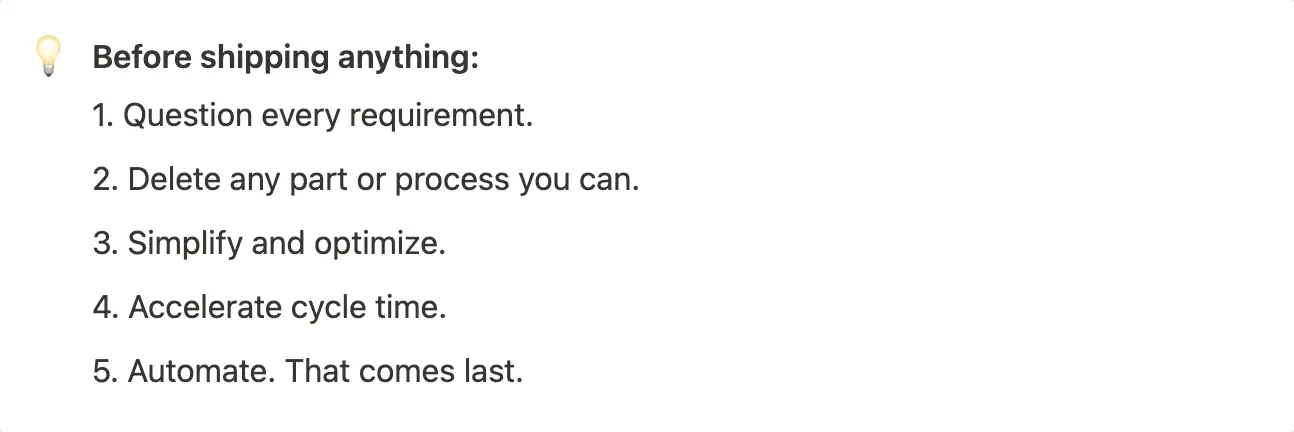
You’d be well advised to try to remember it or even implement a version of it in your team.
The takeaway is simple:
Shipping great things fast starts with a meticulous process of elimination.
The best founders and operators - the top 1% - are world-class at challenging assumptions and saying no to most suggestions that come to them.
Just because you can build it doesn’t mean you should
With no-code, anyone can potentially become a builder. There’s no problem with that - there are so many things to build.
But oftentimes, builders like to build beyond reason. Our brains are wired towards problem solving: faced with a new challenge, it takes a millisecond to instantly switch to problem solving, optimizing, rationalizing, automating.
Experienced no-code ops professionals and automation wizards are no exception. On the contrary: the more skilled you become, the more ways to solve the problem presented there are, the more you get pulled into problem solving mode … and end up solving a problem not worth solving after all.
Ask why every time and say no most times
Before shipping anything, ask the following question: why are we doing this?
Challenge that the problem that is presented to you deserves your attention, and time. There are no such things as quick automations. Even if you can build it in 15 minutes:
You’ll have to fix errors
You’ll have to maintain it in the future
You’ll need to document what it does
You’ll have to manage future dependencies
Etc.
Spend your first 15 minutes evaluating whether it’s worth solving for in the first place.
Once you’ve made that a habit, you can upgrade to Elon’s algorithm.
I recently commented a post from DHH on Elon Musk’s algorithm to ship anything. It is a more advanced and refined version of the simple idea I want to outline in this post.
Here’s the algorithm:
You’d be well advised to try to remember it or even implement a version of it in your team.
The takeaway is simple:
Shipping great things fast starts with a meticulous process of elimination.
The best founders and operators - the top 1% - are world-class at challenging assumptions and saying no to most suggestions that come to them.
Just because you can build it doesn’t mean you should
With no-code, anyone can potentially become a builder. There’s no problem with that - there are so many things to build.
But oftentimes, builders like to build beyond reason. Our brains are wired towards problem solving: faced with a new challenge, it takes a millisecond to instantly switch to problem solving, optimizing, rationalizing, automating.
Experienced no-code ops professionals and automation wizards are no exception. On the contrary: the more skilled you become, the more ways to solve the problem presented there are, the more you get pulled into problem solving mode … and end up solving a problem not worth solving after all.
Ask why every time and say no most times
Before shipping anything, ask the following question: why are we doing this?
Challenge that the problem that is presented to you deserves your attention, and time. There are no such things as quick automations. Even if you can build it in 15 minutes:
You’ll have to fix errors
You’ll have to maintain it in the future
You’ll need to document what it does
You’ll have to manage future dependencies
Etc.
Spend your first 15 minutes evaluating whether it’s worth solving for in the first place.
Once you’ve made that a habit, you can upgrade to Elon’s algorithm.
read next
Running AI Enablement Internally? Here are Three Things to Consider
AI enablement looks like a training project. It isn't. Skill levels, tools and functions all move at once. Here's what running it internally really takes.

What is Claude Slides, and How to Use Them (Guide for Beginners)
How to use Claude Slides to build an on-brand deck from a one-line brief, edit and export it, and where it beats PowerPoint and Google Slides, and where it doesn't.
read next
Running AI Enablement Internally? Here are Three Things to Consider
AI enablement looks like a training project. It isn't. Skill levels, tools and functions all move at once. Here's what running it internally really takes.
What is Claude Slides, and How to Use Them (Guide for Beginners)
How to use Claude Slides to build an on-brand deck from a one-line brief, edit and export it, and where it beats PowerPoint and Google Slides, and where it doesn't.