Start With the Goal: How to Drive ROI from AI Training

By
Alexandre Kantjas
・
・
5
Min
Read
Start With the Goal: How to Drive ROI from AI Training
By
Alexandre Kantjas
5
Min
Read
After an early phase of pilots, buying tools and encouraging experimentation, the conversation around AI has shifted to return on investment. Companies want to see results, not only demos. But showing what AI initiatives have actually delivered is often harder than getting people to adopt them.
And AI training is no exception. Teaching employees to work more productively is useful, but it isn't the end goal. That productivity needs to translate into something the business values: more revenue, lower costs, better customer retention, or faster delivery.
Give AI training a business target
The best way to get there is to direct training toward the work where AI has the strongest potential to improve business results. That means choosing the goal before choosing the use case.
Most training programs include use case selection. The challenge is choosing for business impact, not just individual convenience. If everyone chooses whatever saves them the most time, you may end up with useful individual improvements but little connection to the team's priorities. Instead, start with a shared business target and focus participants on problems that matter to the business.
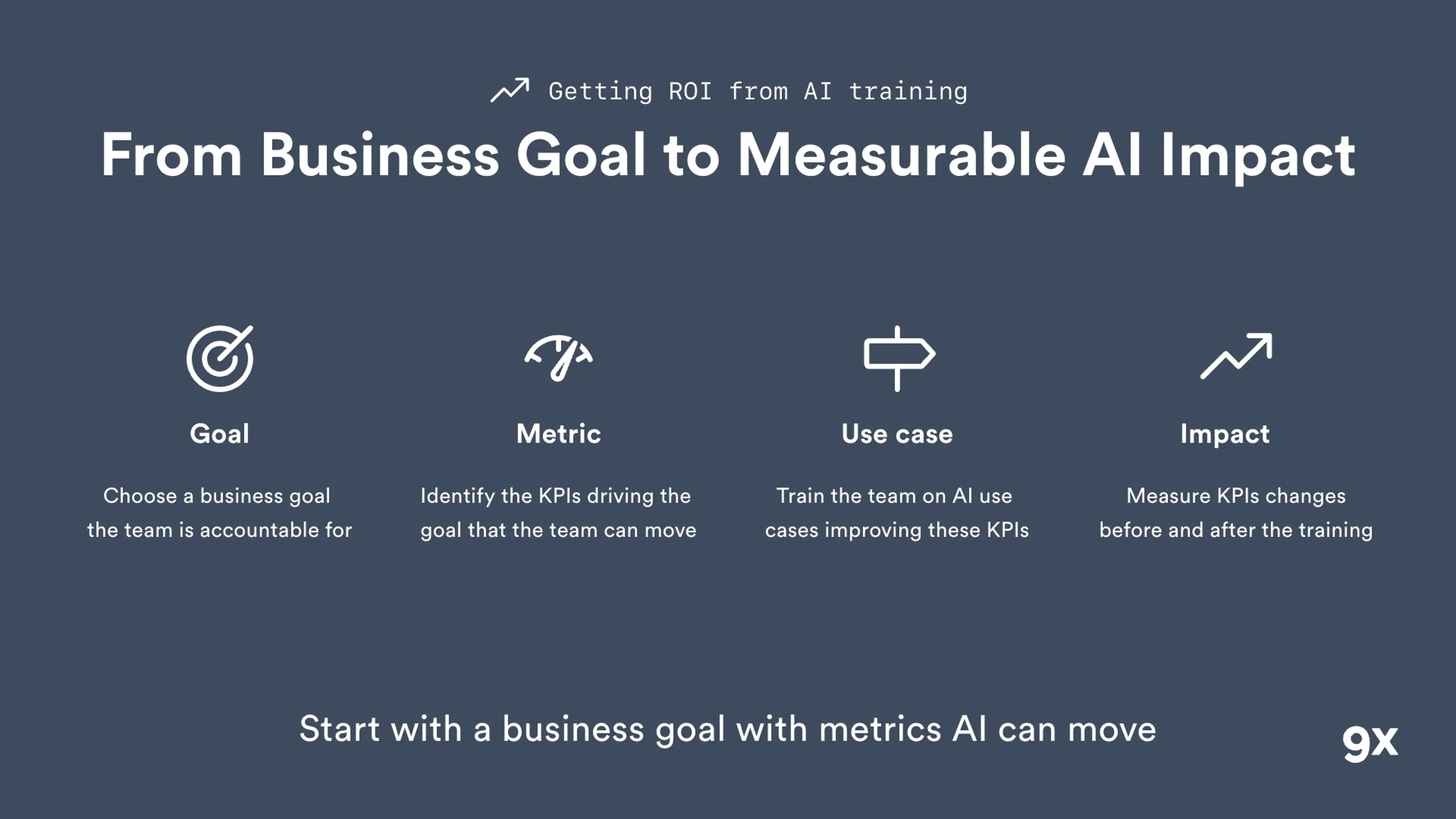
Here's how to do it in four steps.
Four steps to measurable AI training impact
Goal: Pick a business goal.
Metrics: Identify the KPIs driving the goal.
Use cases: Train on AI use cases that improve these KPIs
Impact: Measure impact on KPIs.
1. Pick a business goal
Start with a priority leadership has already agreed on:
Grow revenue
Improve profitability
Retain customers
Ask the program sponsor which goal this team is accountable for, what the target is, and when it needs to be reached. Use the existing business plan rather than creating separate AI goals. “Get everyone using AI” describes adoption, not what the business needs from it.
The Sales example: Set the goal
The Sales team needs to grow revenue without adding headcount. The Sales leader chooses to focus on converting more of the leads already coming in, rather than increasing activity volume.
That gives the training a clear starting point. Instead of commissioning a general workshop on AI for sales, the sponsor asks: where could AI help our existing reps turn more of their work into revenue? The next step is to identify which part of the sales process offers the best opportunity.
2. Identify the KPIs driving the goal
Break the goal into KPIs the team can influence.
Identify which offer the greatest opportunity to improve results, rather than choosing whatever is easiest to measure. Give each selected KPI a clear definition, an owner, and a reliable data source. These will guide both the use cases you teach and how you assess the program.
The Sales example: Find the constraint
The Sales leader reviews qualified meetings, conversion rates, deal size, and time to close. The team books enough meetings to support its revenue target, but too few discovery calls become qualified opportunities.
The team chooses discovery-to-opportunity conversion as its target KPI: the share of discovery calls that produce a qualified opportunity. The CRM provides the data, and the Sales leader owns the metric.
Before training starts, the team agrees on what counts as a qualified opportunity and keeps those criteria unchanged. Otherwise, reps could appear to improve conversion simply by advancing deals that aren't ready.
3. Train on AI use cases that improve these KPIs
Next, build your training initiative around work that could move your chosen KPIs.
Start with the tasks that contribute to those KPIs. A useful AI use case should help employees do that work:
Faster: reduce the time needed to complete a task.
Better: improve the quality of the result.
More reliably: reduce errors, omissions, or variation between employees.
At greater volume: handle more work without adding resources.
AI can also make room for valuable work that employees previously couldn't get to, such as researching every account before a call rather than only the largest ones. The test is the same: how would that change contribute to the chosen KPI?
Build the training around those use cases. Have participants practise with real tasks and data, check the outputs, and fit the workflow into their day. They should leave with a repeatable way to improve the work behind the metric, not just a better understanding of the tools.
The Sales example: Train on AI-assisted call preparation
Reviewing how reps prepare reveals a practical problem: they often arrive at discovery calls without enough account context. They spend part of the conversation establishing basic facts instead of exploring the customer's needs. The hypothesis is that better preparation will help them run more relevant calls and qualify more opportunities.
During training, reps build a pre-call brief using real accounts and approved data sources. They learn to use AI to pull together company context, identify possible needs, and suggest questions to investigate. The trainer helps them distinguish verified facts from assumptions, so a plausible AI-generated claim doesn't become an unsupported talking point.
Each rep checks and refines the brief, then uses it to prepare for an upcoming call. The team agrees on a shared format and adds the brief to its normal preparation routine. The output of training is a workflow they can repeat before every discovery call.
4. Measure impact on KPIs
Set a baseline for your chosen KPIs before training and agree on a review period long enough to observe results. After training, track whether participants use the new workflows and whether the KPIs improve. Compare against the baseline or a similar group that hasn't yet received training, accounting for other changes that could explain the difference. Usage and time saved help explain what happened; movement in the business KPIs shows whether the program is delivering value. Before claiming ROI, weigh the estimated financial benefit against training, tools, and review costs.
The Sales example: Test whether the briefs help
Before training, the Sales leader records discovery-to-opportunity conversion over a representative period, together with the number of calls behind it. After training, reps record which calls used the brief. The team reviews results once enough calls have progressed to assess conversion, rather than judging success from the first few meetings.
For a stronger comparison, train one group first and compare it with a similar group working during the same period. Randomize who goes first where practical, and check for differences in lead quality, pricing, or team composition. A before-and-after improvement alone doesn't prove AI caused it.
Read adoption and conversion together to decide what to do next:
Few reps use the brief: check whether it takes too long to prepare, contains unreliable information, or doesn't fit their routine. Fix the adoption problem before judging its business impact.
Reps use it, but conversion doesn't improve: revisit the hypothesis. Preparation may not be the main problem, or the brief may not provide the information reps need.
Reps use it and conversion improves: check for other explanations, then use the existing win rate and average deal value to estimate what the additional opportunities could be worth. Report this as potential revenue, not booked revenue, and compare it with training, tools, and ongoing review costs.
Turn the target into a training brief
By working from a business goal down to specific use cases, you give the program a clear purpose before it starts. Participants learn skills they can apply to the team's priorities, and leadership gets a way to assess the results beyond attendance, satisfaction, or self-reported time saved.
Capture those decisions in a short training brief. Before booking the first session, have the sponsor and trainer complete this sentence:
“We want to improve [business metric] by helping [team] use AI to [change a specific workflow]. We'll track [usage and results] and review progress after [an agreed period].”
That brief determines the exercises, the workflows participants build, and the support they need after training. It also gives you a basis for deciding what to do next: expand a workflow that shows promise, revise one that isn't helping, or investigate why people aren't using it.
The program's success is no longer just whether employees learned to use AI. It's whether they put those skills to work on a business priority, and what changed as a result.
Build AI training around your business priorities
Want to apply this approach with your team? We can help you identify relevant use cases and design hands-on AI training around the work that matters to your business.
Book a call with us to discuss your team's goals and what the right program could look like.
Credit where it’s due: this four-step framework adapts Michael Domanic's business-first approach to AI ROI. I love coming up with frameworks myself, but when someone else makes one that resonates this much, I don’t need to reinvent the wheel. Go check out his other articles too!
FREE LIVE SESSIONS
What’s the best way to learn AI?
With 9x Live! Join a free session and learn the skills that’ll get you ahead of the 99%.
What to do next
1
Start learning free
Take our AI starter course and apply the latest technologies to your first use case. Completely free. Get started today.
2
Learn it live
Join a free weekly 9x Live session, watch work get automated in real time, and get your questions answered by leading educators. Sign up for the next session.
3
Watch our videos on YouTube
With one of the fastest growing channels in the industry, hundreds of thousands of people watch our tutorials every week. Subscribe here so you never miss a video.

Training
After an early phase of pilots, buying tools and encouraging experimentation, the conversation around AI has shifted to return on investment. Companies want to see results, not only demos. But showing what AI initiatives have actually delivered is often harder than getting people to adopt them.
And AI training is no exception. Teaching employees to work more productively is useful, but it isn't the end goal. That productivity needs to translate into something the business values: more revenue, lower costs, better customer retention, or faster delivery.
Give AI training a business target
The best way to get there is to direct training toward the work where AI has the strongest potential to improve business results. That means choosing the goal before choosing the use case.
Most training programs include use case selection. The challenge is choosing for business impact, not just individual convenience. If everyone chooses whatever saves them the most time, you may end up with useful individual improvements but little connection to the team's priorities. Instead, start with a shared business target and focus participants on problems that matter to the business.
Here's how to do it in four steps.
Four steps to measurable AI training impact
Goal: Pick a business goal.
Metrics: Identify the KPIs driving the goal.
Use cases: Train on AI use cases that improve these KPIs
Impact: Measure impact on KPIs.
1. Pick a business goal
Start with a priority leadership has already agreed on:
Grow revenue
Improve profitability
Retain customers
Ask the program sponsor which goal this team is accountable for, what the target is, and when it needs to be reached. Use the existing business plan rather than creating separate AI goals. “Get everyone using AI” describes adoption, not what the business needs from it.
The Sales example: Set the goal
The Sales team needs to grow revenue without adding headcount. The Sales leader chooses to focus on converting more of the leads already coming in, rather than increasing activity volume.
That gives the training a clear starting point. Instead of commissioning a general workshop on AI for sales, the sponsor asks: where could AI help our existing reps turn more of their work into revenue? The next step is to identify which part of the sales process offers the best opportunity.
2. Identify the KPIs driving the goal
Break the goal into KPIs the team can influence.
Identify which offer the greatest opportunity to improve results, rather than choosing whatever is easiest to measure. Give each selected KPI a clear definition, an owner, and a reliable data source. These will guide both the use cases you teach and how you assess the program.
The Sales example: Find the constraint
The Sales leader reviews qualified meetings, conversion rates, deal size, and time to close. The team books enough meetings to support its revenue target, but too few discovery calls become qualified opportunities.
The team chooses discovery-to-opportunity conversion as its target KPI: the share of discovery calls that produce a qualified opportunity. The CRM provides the data, and the Sales leader owns the metric.
Before training starts, the team agrees on what counts as a qualified opportunity and keeps those criteria unchanged. Otherwise, reps could appear to improve conversion simply by advancing deals that aren't ready.
3. Train on AI use cases that improve these KPIs
Next, build your training initiative around work that could move your chosen KPIs.
Start with the tasks that contribute to those KPIs. A useful AI use case should help employees do that work:
Faster: reduce the time needed to complete a task.
Better: improve the quality of the result.
More reliably: reduce errors, omissions, or variation between employees.
At greater volume: handle more work without adding resources.
AI can also make room for valuable work that employees previously couldn't get to, such as researching every account before a call rather than only the largest ones. The test is the same: how would that change contribute to the chosen KPI?
Build the training around those use cases. Have participants practise with real tasks and data, check the outputs, and fit the workflow into their day. They should leave with a repeatable way to improve the work behind the metric, not just a better understanding of the tools.
The Sales example: Train on AI-assisted call preparation
Reviewing how reps prepare reveals a practical problem: they often arrive at discovery calls without enough account context. They spend part of the conversation establishing basic facts instead of exploring the customer's needs. The hypothesis is that better preparation will help them run more relevant calls and qualify more opportunities.
During training, reps build a pre-call brief using real accounts and approved data sources. They learn to use AI to pull together company context, identify possible needs, and suggest questions to investigate. The trainer helps them distinguish verified facts from assumptions, so a plausible AI-generated claim doesn't become an unsupported talking point.
Each rep checks and refines the brief, then uses it to prepare for an upcoming call. The team agrees on a shared format and adds the brief to its normal preparation routine. The output of training is a workflow they can repeat before every discovery call.
4. Measure impact on KPIs
Set a baseline for your chosen KPIs before training and agree on a review period long enough to observe results. After training, track whether participants use the new workflows and whether the KPIs improve. Compare against the baseline or a similar group that hasn't yet received training, accounting for other changes that could explain the difference. Usage and time saved help explain what happened; movement in the business KPIs shows whether the program is delivering value. Before claiming ROI, weigh the estimated financial benefit against training, tools, and review costs.
The Sales example: Test whether the briefs help
Before training, the Sales leader records discovery-to-opportunity conversion over a representative period, together with the number of calls behind it. After training, reps record which calls used the brief. The team reviews results once enough calls have progressed to assess conversion, rather than judging success from the first few meetings.
For a stronger comparison, train one group first and compare it with a similar group working during the same period. Randomize who goes first where practical, and check for differences in lead quality, pricing, or team composition. A before-and-after improvement alone doesn't prove AI caused it.
Read adoption and conversion together to decide what to do next:
Few reps use the brief: check whether it takes too long to prepare, contains unreliable information, or doesn't fit their routine. Fix the adoption problem before judging its business impact.
Reps use it, but conversion doesn't improve: revisit the hypothesis. Preparation may not be the main problem, or the brief may not provide the information reps need.
Reps use it and conversion improves: check for other explanations, then use the existing win rate and average deal value to estimate what the additional opportunities could be worth. Report this as potential revenue, not booked revenue, and compare it with training, tools, and ongoing review costs.
Turn the target into a training brief
By working from a business goal down to specific use cases, you give the program a clear purpose before it starts. Participants learn skills they can apply to the team's priorities, and leadership gets a way to assess the results beyond attendance, satisfaction, or self-reported time saved.
Capture those decisions in a short training brief. Before booking the first session, have the sponsor and trainer complete this sentence:
“We want to improve [business metric] by helping [team] use AI to [change a specific workflow]. We'll track [usage and results] and review progress after [an agreed period].”
That brief determines the exercises, the workflows participants build, and the support they need after training. It also gives you a basis for deciding what to do next: expand a workflow that shows promise, revise one that isn't helping, or investigate why people aren't using it.
The program's success is no longer just whether employees learned to use AI. It's whether they put those skills to work on a business priority, and what changed as a result.
Build AI training around your business priorities
Want to apply this approach with your team? We can help you identify relevant use cases and design hands-on AI training around the work that matters to your business.
Book a call with us to discuss your team's goals and what the right program could look like.
Credit where it’s due: this four-step framework adapts Michael Domanic's business-first approach to AI ROI. I love coming up with frameworks myself, but when someone else makes one that resonates this much, I don’t need to reinvent the wheel. Go check out his other articles too!
FREE LIVE SESSIONS
What’s the best way to learn AI?
With 9x Live! Join a free session and learn the skills that’ll get you ahead of the 99%.
What to do next
1
Start learning free
Take our AI starter course and apply the latest technologies to your first use case. Completely free. Get started today.
2
Learn it live
Join a free weekly 9x Live session, watch work get automated in real time, and get your questions answered by leading educators. Sign up for the next session.
3
Watch our videos on YouTube
With one of the fastest growing channels in the industry, hundreds of thousands of people watch our tutorials every week. Subscribe here so you never miss a video.
Training
read next
Running AI Enablement Internally? Here are Three Things to Consider
AI enablement looks like a training project. It isn't. Skill levels, tools and functions all move at once. Here's what running it internally really takes.

What is Claude Slides, and How to Use Them (Guide for Beginners)
How to use Claude Slides to build an on-brand deck from a one-line brief, edit and export it, and where it beats PowerPoint and Google Slides, and where it doesn't.
read next
Running AI Enablement Internally? Here are Three Things to Consider
AI enablement looks like a training project. It isn't. Skill levels, tools and functions all move at once. Here's what running it internally really takes.
What is Claude Slides, and How to Use Them (Guide for Beginners)
How to use Claude Slides to build an on-brand deck from a one-line brief, edit and export it, and where it beats PowerPoint and Google Slides, and where it doesn't.
Your new home for learning AI.
Weekly live workshops, on-demand courses, and plug-and-play downloadables. Get started for free today.
Your new home for learning AI.
Weekly live workshops, on-demand courses, and plug-and-play downloadables. Get started for free today.
Your new home for learning AI.
Weekly live workshops, on-demand courses, and plug-and-play downloadables. Get started for free today.